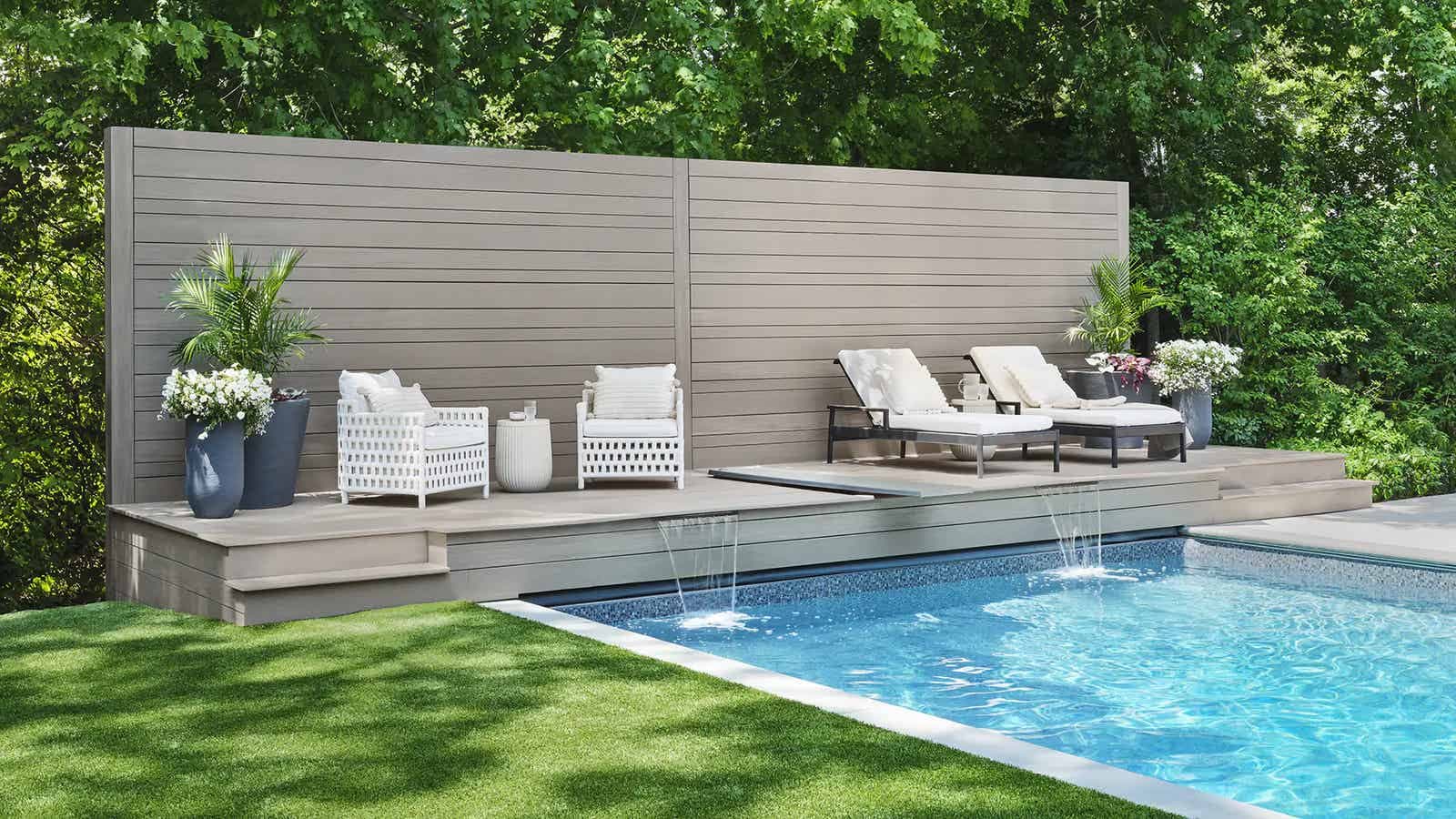
Why PVC Decking for Pool Terraces?
PVC (polyvinyl chloride) decking is engineered to be fully synthetic, meaning it contains no wood fibers. This composition is crucial for areas like pool surrounds, where boards are consistently exposed to water and splashes. The absence of wood fiber eliminates the potential for swelling, staining, or rot that can occur in wood or wood-composite materials when frequently wet. This makes PVC a suitable choice for 'wet-use' applications.
Another benefit of PVC decking is its resistance to salt spray, which is a consideration for coastal properties or saltwater pools. The material's non-porous nature also helps it shed grease and wine, simplifying cleanup with just soap and water. These characteristics contribute to a low-maintenance decking option that retains its appearance over time, even in challenging poolside conditions. Some PVC decking options also offer heat-mitigating color choices, which can be a comfort advantage for bare feet on sunny days.
Understanding PVC Decking Profiles and Appearance
PVC decking is available in various collections and profiles, often designed to mimic the aesthetic of natural wood. For example, lines like TimberTech Azek offer advanced capping and a range of colors and textures that replicate the look of deeper wood grains. These design options allow you to achieve a desired visual appeal without compromising on the material's performance in a wet environment.
When planning your pool terrace, consider how different board widths and finishes will integrate with your overall landscape design. While the material is synthetic, the visual diversity available means you can still create a sophisticated and inviting outdoor space. The consistency of PVC boards also allows for uniform spacing and a clean finish, which is important for both aesthetics and safety around a pool.
Planning for Edges and Fascia Around a Pool
The edges of your pool terrace are critical for both appearance and safety. PVC decking systems typically offer coordinating fascia boards and trim pieces that can be used to create a finished look around the perimeter of the deck and pool coping. These components ensure a cohesive aesthetic and help to conceal the substructure.
When designing the layout, pay attention to how the decking meets the pool coping. A slight slope away from the pool is often recommended to ensure proper drainage and prevent standing water on the deck surface. Discuss these details with your installer to ensure the correct profiles and installation techniques are used for a seamless and secure transition.
Installation Considerations for Poolside PVC Decking
PVC decking's lightweight nature can simplify handling and installation, potentially leading to faster project completion. This is particularly advantageous for larger pool terraces or projects with access constraints. While PVC is not structural, its lighter weight can be beneficial for the overall load on the deck frame.
Proper ventilation beneath the deck is important for any decking material, and PVC is no exception. Ensuring adequate airflow helps to manage moisture and maintain the integrity of the substructure. Always follow the manufacturer's specific installation guidelines for board spacing, fastening methods, and substructure requirements to ensure optimal performance and longevity, especially in high-moisture environments.
Maintenance and Longevity of PVC Pool Terraces
One of the primary advantages of PVC decking for a pool terrace is its low maintenance. Because it's 100% synthetic and waterproof to the core, it resists the common issues of swelling, staining, and rot that can plague other materials in wet conditions. Regular cleaning with soap and water is typically sufficient to maintain its appearance.
It is important to verify cleaning product compatibility with PVC decking to avoid damage to the surface. Avoid harsh abrasives or solvents unless specifically approved by the manufacturer. Adhering to manufacturer guidelines for cleaning and care will help preserve the deck's aesthetic and structural integrity over its lifespan.
Worked Example: Planning a Rectangular Pool Terrace
Let's consider a hypothetical rectangular pool terrace measuring 20 feet by 15 feet. We'll assume a standard PVC decking board width of 5.5 inches and a length of 16 feet.
First, calculate the total area: 20 ft * 15 ft = 300 square feet. Next, determine the number of boards needed. For the 20-foot dimension, if boards run parallel to the 15-foot side, you would need approximately (15 ft * 12 in/ft) / 5.5 in/board = 32.7 boards. Since you can't buy partial boards, you'd need 33 boards. For the 20-foot length, you'd use 16-foot boards, with a 4-foot offcut from each. If the offcuts are not usable elsewhere, this would be a significant waste. A more efficient plan might involve running boards parallel to the 20-foot side, reducing cuts.
If boards run parallel to the 20-foot side, you would need (20 ft * 12 in/ft) / 5.5 in/board = 43.6 boards. So, 44 boards. These boards would be 15 feet long, requiring a 16-foot board to be cut by 1 foot. This results in 44 boards of 16 feet in length purchased. This example highlights the importance of detailed layout planning to minimize waste and ensure efficient material use. Always factor in a waste percentage, typically 5-10%, for cuts and potential errors.
Before you order
- Confirm PVC decking is 100% synthetic with no wood fibers for optimal wet-use performance.
- Verify heat-mitigating color options if the deck will be in direct sun.
- Plan for coordinating fascia and trim pieces for a finished edge around the pool.
- Consider the weight of PVC decking for easier handling and installation.
- Ensure the installation plan includes proper ventilation beneath the deck.
- Review manufacturer's specific cleaning instructions and compatible products.
- Calculate material needs carefully, considering board lengths and potential waste from cuts.
Confirm installation details, approved uses and warranty terms in the current instructions for the exact product and profile. Your installer should verify the substrate, structure and applicable project requirements.
This is a planning guide for projects in San Diego, CA. Ask our team to confirm availability, delivery to your ZIP code and which branch can support your order.
Questions to help you decide
Is PVC decking slippery when wet?
However, any wet surface can present a slip hazard. It is always recommended to exercise caution on a wet deck surface.
Can PVC decking be installed directly on concrete around a pool?
PVC decking typically requires a substructure (joists) for proper support, drainage, and ventilation, even over a concrete slab. Direct installation on concrete is generally not recommended as it can trap moisture and prevent adequate airflow, potentially leading to issues with the decking or the underlying concrete. Always consult the manufacturer's installation guidelines for specific substructure requirements.
How does PVC decking handle chlorine and saltwater?
PVC decking is designed to be highly resistant to moisture, including chlorinated water and saltwater. Its synthetic composition prevents the material from swelling, staining, or degrading due to chemical exposure from pool water or salt spray. This makes it a suitable choice for both freshwater and saltwater pool environments.
Ready to Plan Your PVC Pool Terrace?
Request a material quote with your project dimensions, desired PVC decking profile, and ZIP code to confirm current availability and service options for your project.
Request a material quote →