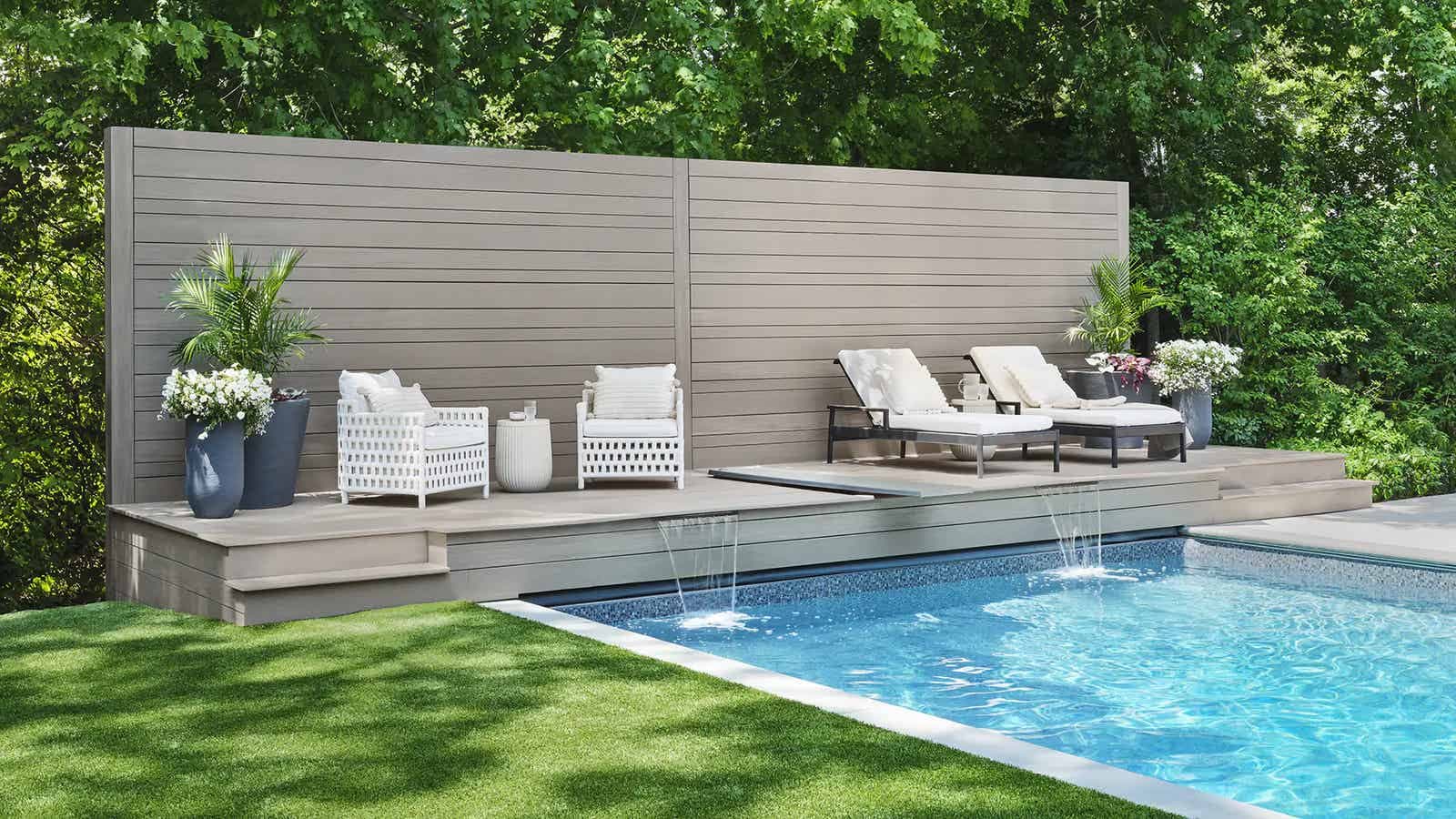
Why PVC Decking for Pool Terraces?
PVC decking is a strong candidate for pool terraces due to its inherent material properties. Being 100% synthetic and free of wood fiber, it does not absorb moisture in the same way traditional wood or wood-composite products might. This makes it particularly resistant to the effects of standing water, splash zones, and even salt spray if your pool uses a saltwater system.
The complete absence of wood fiber means there is nothing in the board structure to swell, stain, or rot when exposed to consistent moisture. This can contribute to a longer lifespan and potentially lower maintenance requirements compared to materials that are susceptible to moisture-related degradation. For areas directly adjacent to a pool, where boards are frequently wet, this characteristic is especially beneficial.
Beyond its water resistance, PVC decking is also noted for its lighter weight compared to hardwood and even some composite options. This can simplify handling during installation and may be a factor for projects involving elevated decks or rooftop installations, though such applications require specific structural engineering reviews.
Considering Surface Appearance and Feel
Modern PVC decking lines offer a range of aesthetic options, including collections with deep wood-look textures and a variety of colors. The advanced capping on many PVC boards is designed to shed common spills like grease and wine, allowing for simpler cleanup with soap and water. When selecting a color, it's worth noting that some PVC decking options include 'heat-mitigating' colors, which are designed to absorb less heat from direct sunlight. This can be a practical consideration for a pool terrace where bare feet will frequently be on the surface, especially in areas like Salem, OR, that experience warm summer days.
The overall finished appearance of a PVC deck can mimic traditional wood, offering aesthetic versatility to match various architectural styles. It's important to view physical samples to accurately assess the texture and color in different lighting conditions and how it complements your existing outdoor design.
Cleaning and Maintenance for Poolside Environments
One of the key advantages of PVC decking for a pool terrace is its relatively low maintenance profile. The capped polymer surface is designed for easy cleaning. Spills from poolside activities, such as drinks or food, can typically be wiped clean with a solution of soap and water. This ease of cleaning is a practical benefit for high-use areas like pool decks, where spills are common.
Regular cleaning helps maintain the appearance of the deck and prevents the buildup of dirt or debris that can become embedded in the surface over time. While PVC decking resists mold and mildew better than wood, occasional cleaning is still recommended to remove any surface growth that might occur due in a consistently damp environment. Always refer to the manufacturer's specific cleaning guidelines for your chosen product to ensure compatibility with cleaning agents and methods.
Planning Your Layout and Quantities: A Hypothetical Example
Let's consider a hypothetical pool terrace project in Salem, OR, where the homeowner wants to deck an area measuring 20 feet by 15 feet around an existing pool.
First, calculate the total area: 20 ft * 15 ft = 300 square feet. To determine the number of boards needed, we'll consider the layout. For a 20-foot width, if boards run parallel to the 15-foot dimension, you'd need approximately (20 ft / 0.458 ft per board) = 43.6 boards. Since you can't buy fractional boards, you'd need 44 boards. Each board is 12 feet long. So, for the 15-foot length, you'd need to cut boards. Two 12-foot boards can be used end-to-end with a seam, or you could use a combination of 12-foot and 8-foot boards if available. Assuming you primarily use 12-foot boards, you would need enough to cover the 15-foot run. If you lay boards parallel to the 20-foot length, you would need (15 ft / 0.458 ft per board) = 32.7 boards, rounded up to 33 boards. Each board is 20 feet long, which means you would need a custom order or to seam two 12-foot boards and one 8-foot board (or similar cuts) to achieve the 20-foot length. This means each 12-foot board needs to be joined with an 8-foot section (or two 10-foot sections from 20-foot boards). If 20-foot boards are available, you'd need 33 boards of 20 feet each. If only 12-foot boards are available, you'd need 33 runs, each requiring cuts and seams to achieve 20 feet. For simplicity, let's assume 20-foot boards are available.
Total boards needed: 33 boards * 20 feet/board = 660 linear feet. If boards are sold in 20-foot lengths, you'd purchase 33 boards. If boards are sold in 12-foot lengths, you'd need 33 runs * (20 feet/run / 12 feet/board) = 55 boards. This example illustrates that precise measurements and a clear layout plan are essential for accurate material estimates, especially when considering board lengths and potential waste from cuts.
This calculation does not account for waste due to miscuts, future repairs, or specific design elements like picture-frame borders, which would require additional material. Always add 10-15% for waste and future needs.
Installation Considerations and Support Structure
While PVC decking boards themselves are waterproof, the underlying deck structure must also be designed to manage moisture effectively. Proper ventilation beneath the deck is crucial to prevent moisture accumulation, which can affect the joists and beams, regardless of the decking material. In Salem, OR's climate, which can see significant rainfall, ensuring adequate drainage and airflow is particularly important.
The specific fastening methods for PVC decking, whether hidden fasteners or face-fastening, should adhere strictly to the manufacturer's instructions. These instructions will also specify the appropriate joist spacing and support requirements. Never assume that PVC decking can span greater distances than recommended; this can lead to deflection and compromise the deck's integrity. For any structural elements, consult with a qualified builder or engineer.
For pool terrace applications, ensuring a level and stable sub-structure is paramount for the long-term performance and safety of the deck. Any movement or settling of the support system can negatively impact the decking material.
Before you order
- Verify local building codes and permits for pool deck construction.
- Confirm the specific PVC decking product's suitability for continuous wet exposure and chemical resistance (e.g., chlorine).
- Review available color options, especially heat-mitigating colors, for comfort in direct sun.
- Obtain physical samples to evaluate texture and color in your specific lighting conditions.
- Calculate precise material quantities, including waste factor, based on your exact layout and board lengths.
- Plan for adequate ventilation and drainage beneath the deck structure.
- Familiarize yourself with manufacturer-specific installation guidelines for fastening and joist spacing.
- Consider edge finishing options and ensure they are compatible with your chosen PVC decking.
- Research manufacturer's cleaning and maintenance recommendations for poolside environments.
Confirm installation details, approved uses and warranty terms in the current instructions for the exact product and profile. Your installer should verify the substrate, structure and applicable project requirements.
This is a planning guide for projects in Salem, OR. Ask our team to confirm availability, delivery to your ZIP code and which branch can support your order.
Questions to help you decide
Is PVC decking slippery when wet?
The degree of slip resistance can vary by product line and finish. It is always recommended to exercise caution on any wet surface, especially around a pool. You can review specific product specifications or samples to assess the texture.
Can PVC decking be installed directly on concrete around a pool?
Installing decking directly on concrete typically requires a specific substructure system, such as sleepers or pedestals, to allow for drainage and ventilation. PVC decking, like most decking materials, needs proper support and airflow underneath. Direct contact with a flat concrete slab without adequate drainage can lead to moisture issues and may not be recommended by manufacturers. Always consult the installation guide for your chosen PVC decking product.
How does PVC decking withstand UV exposure in a sunny climate?
PVC decking products are engineered with UV inhibitors to resist fading and degradation from sun exposure. Many manufacturers offer specific warranties against fade and stain. However, all materials exposed to the elements will experience some degree of change over time. Choosing lighter or heat-mitigating colors can also help manage surface temperature in direct sunlight.
Request a Quote for Your PVC Decking Pool Terrace
Ready to plan your pool terrace with PVC decking? Provide your project dimensions, desired profile, and ZIP code to request a material quote. We can help confirm current availability and service options for your location.
Request a material quote →