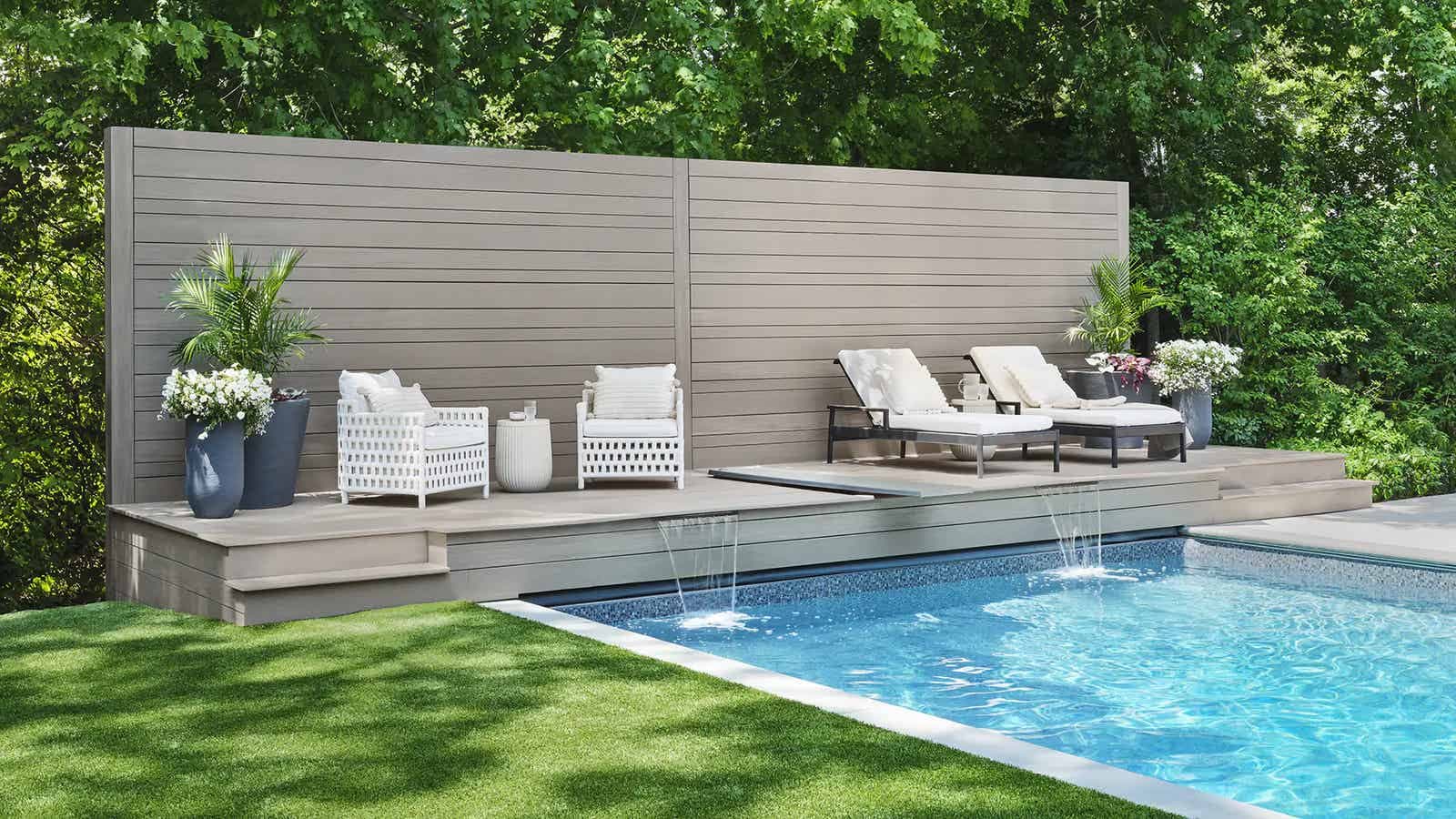
Why PVC Decking for Pool Terraces?
PVC (polyvinyl chloride) decking is a 100% synthetic material, meaning it contains no wood fibers. This composition is key to its performance in environments with consistent moisture, such as a pool terrace.
Unlike wood or wood-composite materials, PVC boards are designed to be waterproof to the core. They do not absorb water, which helps prevent swelling, staining, or rot, even with prolonged exposure to standing water, splash zones, or salt spray. This makes PVC decking a default consideration where boards are frequently wet, including pool surrounds and docks.
Additionally, many PVC decking products feature advanced capping layers that contribute to their resistance against stains from common poolside spills like grease or wine. These surfaces are generally easy to clean with soap and water.
Key Characteristics for Poolside Suitability
The fully synthetic nature of PVC decking provides several advantages for pool terraces. Its core waterproof property means that the boards themselves are not susceptible to moisture absorption that can lead to deterioration in wood-based products.
The capped polymer surface of PVC decking is designed to shed liquids and resist common stains. This is particularly useful around a pool where sunscreen, drinks, and other substances may be spilled. Manufacturers often offer heat-mitigating color options within their PVC lines, which can be a consideration for areas exposed to direct sunlight.
PVC decking is also a lighter material compared to many hardwood or composite options. This can simplify handling and installation, especially in projects with complex access or on elevated structures.
Planning Your Pool Terrace Layout
When designing a PVC deck around a pool, consider both functionality and aesthetics. Think about the flow of traffic, areas for seating, and zones for sunbathing. The consistent dimensions and profiles of PVC boards allow for clean lines and various layout patterns, from straight lay to diagonal designs.
Edge finishes are important for safety and appearance around a pool. PVC decking systems typically offer matching fascia boards or trim pieces to create a finished look on the exposed edges of the deck. Ensure these are integrated into your design plan to conceal the substructure and provide a smooth transition.
Proper substructure and ventilation are still critical, even with waterproof PVC boards. While the boards themselves resist water, the area beneath the deck needs to be designed to allow for drainage and air circulation to prevent moisture buildup and protect the supporting structure.
Cleaning and Maintenance for Pool Terraces
Maintaining PVC decking around a pool generally involves routine cleaning to remove dirt, debris, and any poolside spills. For general cleaning, a broom or leaf blower can remove loose material, followed by a wash with soap and water.
For more stubborn stains, consult the manufacturer's specific cleaning guidelines for your chosen PVC decking product. These instructions will detail compatible cleaning solutions and methods to ensure the surface is not damaged. Avoiding abrasive cleaners or power washers at high pressure is often recommended.
Regular cleaning helps preserve the appearance of your deck and prevents the buildup of substances that could lead to staining over time. The capped polymer surface is designed to be low-maintenance, reducing the need for sealing, staining, or sanding.
Worked Example: A Rectangular Pool Terrace
Consider a homeowner planning a new rectangular PVC deck terrace for a pool that measures 15 feet by 30 feet, with the deck extending 8 feet out from one long side and 5 feet out from one short side. The total deck area would be (15 ft + 5 ft) by (30 ft + 8 ft), resulting in a 20 ft by 38 ft deck, or 760 square feet.
Let's assume the chosen PVC decking boards are 12 feet long and 5.5 inches wide (nominal 6-inch width). To cover a 20-foot width using 5.5-inch boards, you would need approximately 44 boards (20 feet * 12 inches/foot / 5.5 inches/board = 43.6 boards, so round up to 44).
For the 38-foot length, if boards are laid parallel to the 38-foot dimension, you would need 38 feet / 12 feet per board = 3.17 boards per run. This implies that some boards will need to be cut, and some runs will require two boards with a seam. A more efficient approach for an area this size might involve staggering seams and utilizing longer board lengths if available to minimize waste. However, for this example, we'll assume a simple calculation for total board length.
Total linear feet of decking needed would be 44 boards * 38 feet (length of the deck) = 1672 linear feet. If boards are sold in 12-foot lengths, this would be 1672 / 12 = approximately 140 boards. This calculation does not account for specific cut plans, waste factor, or picture-framing details, which would add to the total. It serves as a rough estimate for initial material planning.
Fascia boards would be needed for the exposed perimeter. For a 20-foot by 38-foot deck, the perimeter is 2*(20+38) = 116 linear feet. If fascia boards are also 12 feet long, approximately 10 fascia boards (116/12 = 9.67) would be needed, plus extra for cuts and waste. This example is illustrative; always conduct a detailed material takeoff with your specific product dimensions and layout plan.
Before you order
- Is PVC decking's waterproof nature essential for my pool terrace's exposure to splash and standing water?
- Do I prefer the low-maintenance characteristics of PVC, such as easy cleaning and no need for sealing?
- Have I considered the available color options, including heat-mitigating choices, for my sunny poolside area?
- Is the substructure adequately designed for drainage and ventilation beneath the PVC deck?
- Have I planned for appropriate edge finishes and fascia boards to complete the look around the pool?
- Am I prepared to follow manufacturer-specific cleaning guidelines to maintain the deck's appearance?
- Have I obtained a detailed material takeoff for my specific project dimensions, accounting for cuts and waste?
Confirm installation details, approved uses and warranty terms in the current instructions for the exact product and profile. Your installer should verify the substrate, structure and applicable project requirements.
This is a planning guide for projects in Sacramento, CA. Ask our team to confirm availability, delivery to your ZIP code and which branch can support your order.
Questions to help you decide
Is PVC decking slippery when wet?
The slip resistance of any decking material can vary based on surface texture, specific product line, and the presence of contaminants like algae or pool chemicals. Always exercise caution on any wet surface.
Can PVC decking get hot in the sun?
Like many outdoor materials, PVC decking can absorb heat from direct sunlight. However, many PVC decking manufacturers offer specific color options, often lighter shades, that are formulated with heat-mitigating properties to reduce surface temperature compared to darker colors. It's advisable to consider these options, especially for pool areas with extensive sun exposure.
How do I clean pool chemicals or sunscreen off PVC decking?
For most spills, a simple cleaning with soap and water is effective. For specific substances like pool chemicals, sunscreen, or food spills, refer to the manufacturer's cleaning and care guide for your particular PVC decking product. These guides provide detailed instructions on compatible cleaning agents and methods to ensure the integrity and appearance of the decking are maintained.
Ready to Plan Your PVC Decking Pool Terrace?
Request a material quote for your project. Provide your project dimensions, desired PVC decking profile, and ZIP code to confirm current availability and service options.
Request a material quote →