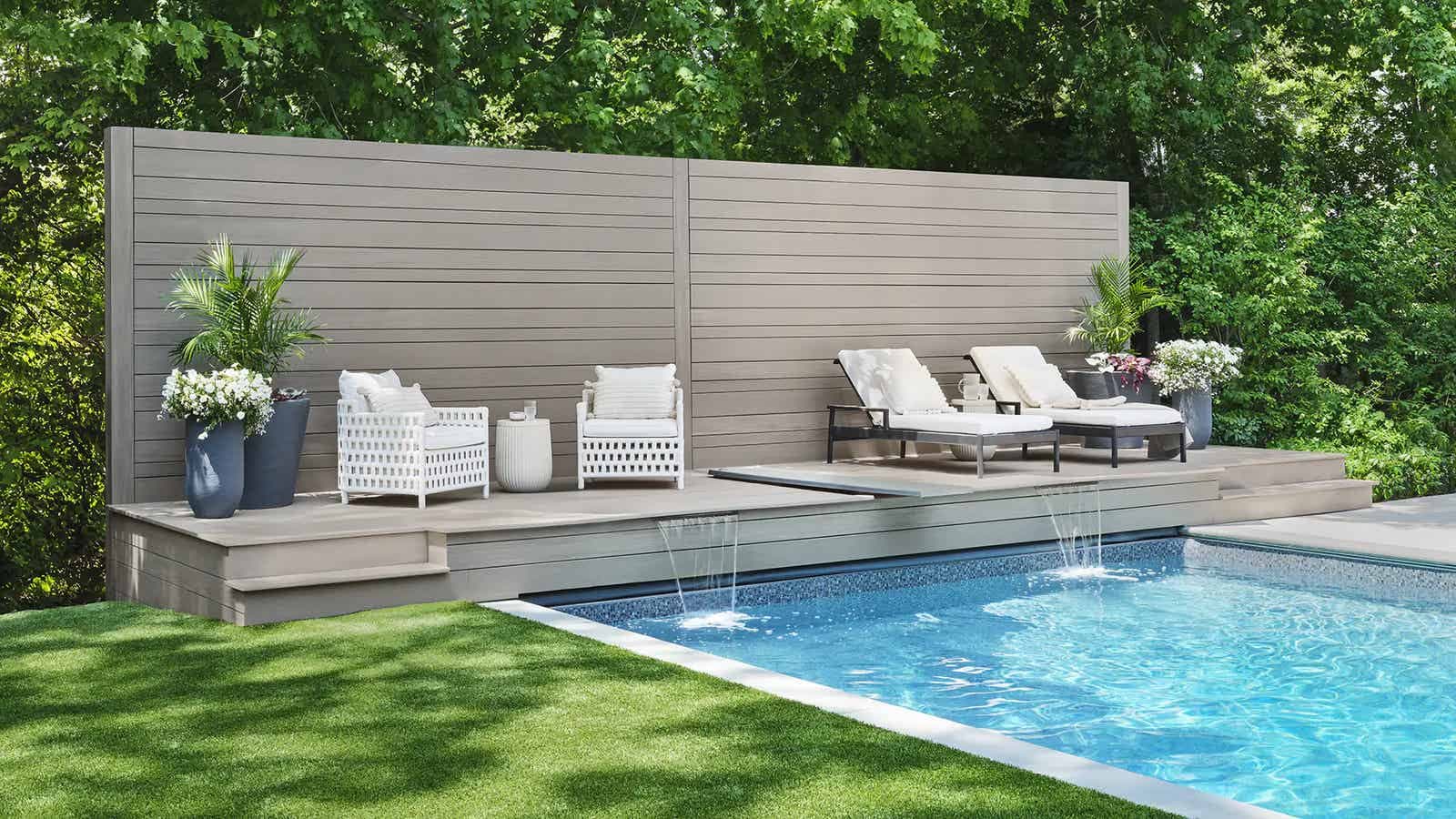
Why PVC Decking for Pool Terraces?
PVC decking, a 100% synthetic material, stands out for pool terraces due to its inherent resistance to water. Unlike wood-fiber composites or natural wood, PVC boards do not contain organic material that can swell, stain, or rot when exposed to standing water, splash zones, or even salt spray if applicable. This makes it a robust option for areas constantly exposed to moisture around a pool.
The advanced capping on many PVC decking lines further enhances their performance, providing a surface that sheds grease and wine, and can be cleaned with soap and water. This ease of cleaning is a significant benefit around pools where spills and dirt are common. Additionally, some PVC decking options offer heat-mitigating color choices, which can be an important factor for bare feet on sunny Pierre, SD days.
PVC decking is often considered the default specification for applications where boards are consistently wet, such as pool surrounds and docks, precisely because of its waterproof core and synthetic composition. This material is designed for longevity in challenging, high-moisture environments.
Moisture Resistance and Durability
The core advantage of PVC decking for a pool terrace is its complete impermeability to water. This means that splashing from the pool, rainwater, or even prolonged dampness from wet towels will not compromise the material's integrity over time. This characteristic prevents common issues like rot, warping, or insect damage often associated with wood products in similar environments.
This waterproof quality extends to its resistance against staining. Pool chemicals, sunscreen, and other common poolside substances are less likely to penetrate and stain PVC surfaces compared to more porous materials. This contributes to a long-lasting, attractive appearance with minimal effort.
The durability of PVC decking in wet conditions translates into a lower maintenance burden. While all outdoor materials benefit from regular cleaning, PVC decking requires less intensive care to maintain its appearance and structural stability around a pool compared to materials that are susceptible to moisture absorption.
Design and Aesthetic Considerations
PVC decking is available in a range of collections, such as the Vintage, Landmark, and Harvest lines, offering various wood-look aesthetics with deep textures. This allows for design flexibility, enabling homeowners to achieve the desired visual style for their pool terrace, from traditional to contemporary.
When planning, consider the board widths and lengths available to optimize the layout and minimize waste. Picture-frame borders can define the pool area and provide a clean finish. Coordinating fascia and edge finishes ensure a cohesive look around the entire pool surround.
Color selection is also crucial. Lighter colors may reflect more sunlight, potentially making the surface cooler underfoot, which is a practical consideration for a pool terrace in sunny conditions. Reviewing available color options and their heat-mitigating properties is advisable for comfort.
Installation and Ventilation
While PVC decking is lightweight, facilitating easier handling and installation, proper installation practices are essential for a successful pool terrace. This includes ensuring adequate ventilation beneath the deck surface. Even though PVC itself is waterproof, good airflow helps prevent moisture buildup in the substructure and keeps the deck surface cooler.
Manufacturers typically provide specific guidelines for board spacing to allow for thermal expansion and contraction. Adhering to these instructions is critical for the long-term performance and appearance of the deck. Hidden fastening systems are often used with PVC decking to create a smooth, fastener-free surface, which can be desirable around a pool for aesthetics and comfort.
Worked Example: Planning a 24-by-12-foot Pool Terrace in Pierre, SD
Let's consider a hypothetical rectangular pool terrace project in Pierre, SD, measuring 24 feet by 12 feet, requiring PVC decking. We'll assume the use of 12-foot long PVC decking boards, which are a common length.
To cover the 24-foot length, you would need two 12-foot boards laid end-to-end for each row. For the 12-foot width, if using standard 5.5-inch wide boards, you would need approximately 26 boards across (12 feet * 12 inches/foot / 5.5 inches/board = 26.18 boards, rounded up).
Therefore, for a 24-foot length, you would need 26 rows, each consisting of two 12-foot boards. This means a total of 52 individual 12-foot boards (26 rows * 2 boards/row). This calculation assumes no diagonal cuts and minimal waste, but it's always prudent to add 5-10% for cuts, waste, and future repairs. For this project, ordering 55-57 boards would provide a sensible buffer.
Remember to also account for any perimeter boards (fascia) if a finished edge is desired, as these are typically ordered separately and often in wider profiles or different lengths. For example, a 24x12 terrace would need approximately (24+24+12+12) = 72 linear feet of fascia, adjusted for corner cuts and overlaps.
Before you order
- Confirm PVC decking's suitability for continuous wet exposure around your pool.
- Evaluate available PVC decking collections for desired aesthetic (e.g., wood-look, color, texture).
- Consider heat-mitigating color options for comfort underfoot in direct sun.
- Plan board layout to optimize lengths and minimize seams; account for waste factor (5-10%).
- Select compatible hidden fasteners or face fasteners according to manufacturer guidelines.
- Verify requirements for under-deck ventilation to ensure proper airflow.
- Choose coordinating fascia and trim boards for a finished edge.
- Review cleaning and maintenance instructions specific to the chosen PVC decking product.
Confirm installation details, approved uses and warranty terms in the current instructions for the exact product and profile. Your installer should verify the substrate, structure and applicable project requirements.
This is a planning guide for projects in Pierre, SD. Ask our team to confirm availability, delivery to your ZIP code and which branch can support your order.
Questions to help you decide
Is PVC decking slippery when wet?
It is important to review the specific product's surface texture and finish. Regular cleaning helps maintain surface traction by removing algae or dirt buildup.
How do I clean PVC decking around a pool?
Most PVC decking can be cleaned with mild soap and water using a soft brush or pressure washer on a low setting. Always refer to the manufacturer's specific cleaning instructions for your chosen product to ensure compatibility and avoid damage. Promptly cleaning spills, especially pool chemicals, is recommended.
Can PVC decking be installed directly over a concrete pool deck?
Installing PVC decking over an existing concrete pool deck typically requires a substructure to provide ventilation and drainage, as well as a secure fastening point for the deck boards. Direct installation without a proper substructure is generally not recommended as it can trap moisture and prevent proper airflow. Consult installation guides for specific requirements.
Ready to Plan Your PVC Decking Pool Terrace?
Request a material quote with your project dimensions, exact profile preferences, and ZIP code. We can help you confirm current availability and service options for your Pierre, SD project.
Request a material quote →