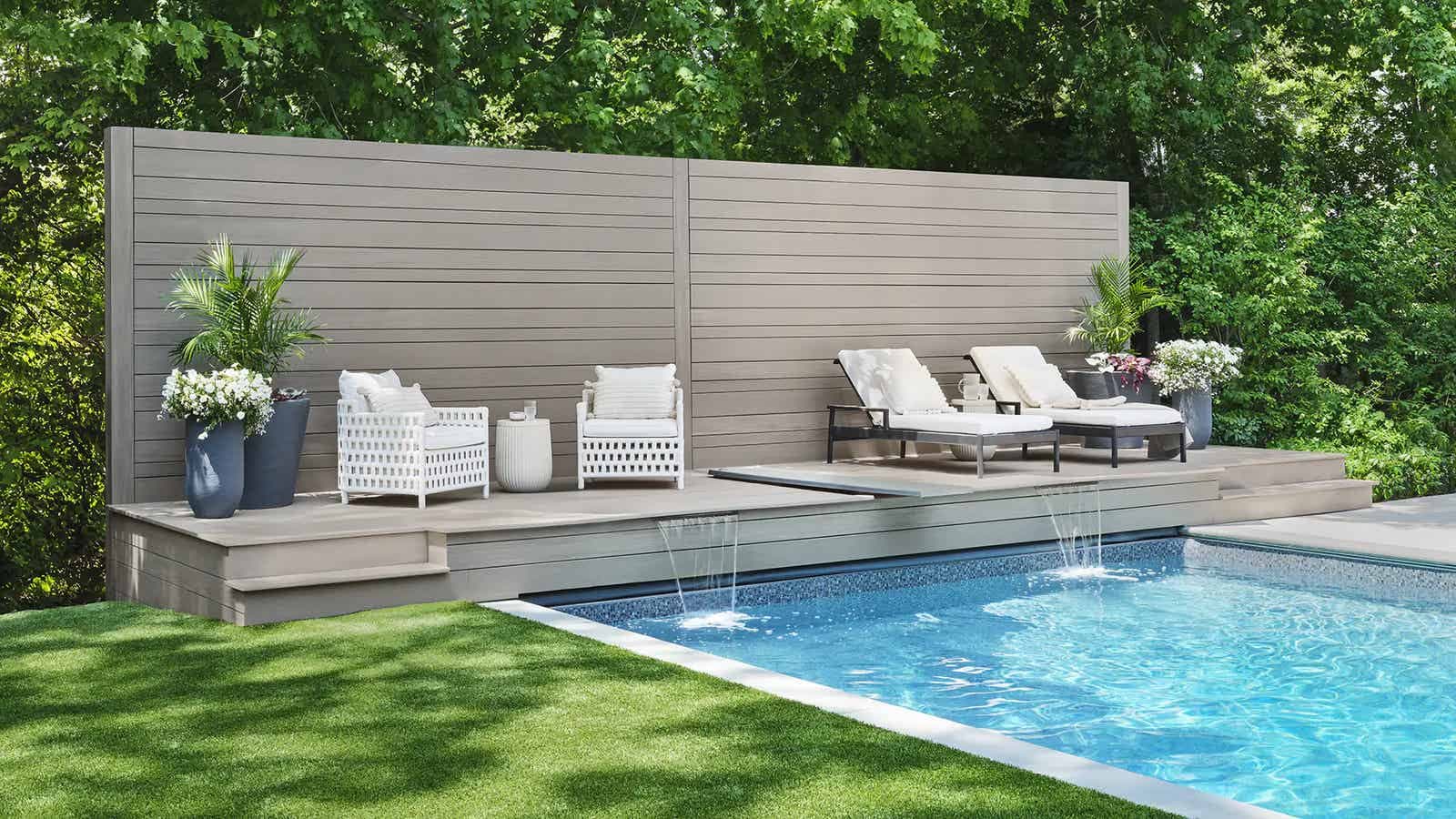
Why PVC Decking for a Newport Pool Terrace?
In Newport's coastal climate, materials for outdoor surfaces must contend with humidity, salt air, and direct sun. PVC decking is a 100% synthetic material, meaning it contains no wood fiber. This composition is crucial for pool terraces where water exposure is constant. Unlike wood or even some composite materials, PVC is waterproof to its core, which helps prevent issues like swelling, staining from water, or rot.
The advanced capping on PVC boards provides a protective layer that resists stains from common poolside spills like grease and wine, which can be cleaned with soap and water. This low-maintenance aspect is a significant benefit for homeowners looking to minimize upkeep on their outdoor living spaces.
Additionally, PVC decking often weighs less than traditional hardwood or composite options, which can simplify handling and installation, particularly for larger or more complex terrace designs.
Understanding PVC Decking Profiles and Appearance
PVC decking is available in various collections, offering different aesthetic profiles. For example, lines like TimberTech Azek's Vintage, Landmark, and Harvest collections are known for their deep wood-look textures and diverse color palettes. These options allow for customization to match your home's architectural style or create a specific ambiance around your pool.
When selecting a profile, consider the desired finish and how it will interact with sunlight and water. Some PVC decking options are designed with heat-mitigating color choices, which can be a practical consideration for poolside surfaces that receive direct sun exposure throughout the day. While no material remains cool under intense sun, these options aim to reduce surface heat compared to darker, non-mitigating colors.
Planning for Water Management and Drainage
Even with waterproof PVC decking, proper water management beneath the deck surface is essential for a long-lasting and functional pool terrace. Ensure that the sub-structure allows for adequate drainage away from your home's foundation and prevents standing water beneath the deck. While PVC boards themselves are waterproof, prolonged moisture can still affect the underlying framing or create an environment for mildew growth in shaded areas.
Consulting with a professional about the specific requirements for your Newport property, considering local rainfall patterns and site grading, is recommended. This helps ensure that the entire deck system, from the surface to the substructure, is designed to handle the inevitable water exposure of a pool area.
Edge Details and Fascia for a Finished Look
The edges of your pool terrace play a significant role in both aesthetics and safety. PVC decking offers complementary fascia and trim boards that can be used to create a clean, finished edge around the perimeter of the deck and any steps. These components are designed to match the decking boards in color and texture, providing a cohesive appearance.
Consider how the decking will meet other surfaces, such as coping stones around the pool or adjacent landscaping. Planning these transitions carefully ensures a seamless and visually appealing integration of your pool terrace with the surrounding outdoor space. Specific product lines may offer different edging solutions, so review the available options for your chosen decking.
Hypothetical Project: Newport Poolside Lounge Area
Imagine a new poolside lounge area in Newport, RI, measuring 15 feet by 20 feet. This area will be constructed using PVC decking boards, specifically a 12-foot length and a 16-foot length for minimal waste and seams. We'll assume a standard board width of 5.5 inches (0.458 feet) for this example.
To cover a 15-foot by 20-foot area (300 square feet), we first determine the number of boards needed. If boards are laid parallel to the 20-foot dimension, each board will be 20 feet long. The 15-foot width divided by the 5.5-inch (0.458-foot) board width means approximately 32.75 boards are needed across the width (15 ft / 0.458 ft/board). Since boards must be purchased in full units, we round up to 33 boards.
For a 20-foot run, using 16-foot boards would require cuts and seams. A more efficient approach for a 20-foot length would be to use a combination of 12-foot and 8-foot boards, or to specify 20-foot custom lengths if available and cost-effective. If using standard 12-foot and 16-foot lengths, one might consider a layout where boards run parallel to the 15-foot dimension, requiring fewer cuts. In this case, each board would be 15 feet long. For a 20-foot width, 20 ft / 0.458 ft/board = 43.66 boards, rounded up to 44 boards. If using 16-foot boards, 44 boards would be purchased, and each would be cut to 15 feet, resulting in a 1-foot offcut per board. This illustrates the importance of a detailed cut plan to minimize waste.
For this example, let's assume we can source 20-foot boards or plan a layout with minimal seams. To cover 15 feet, we need 33 boards. If each board is 20 feet long, then 33 boards x 20 feet/board = 660 linear feet of decking. This is a simplified calculation and does not account for waste from cuts, specific fastening systems, or fascia boards. Always create a detailed material list and cut plan based on your exact product and project dimensions.
Maintenance and Care for PVC Pool Decking
One of the primary advantages of PVC decking for a pool terrace is its relatively low maintenance. The synthetic nature of the material means it does not require sanding, staining, or sealing. Routine cleaning typically involves soap and water to remove dirt, pool chemicals, and other residues. For tougher stains, consult the manufacturer's specific cleaning recommendations, as not all cleaning products are compatible with all PVC decking.
Regularly clearing debris from the deck surface and between boards can help prevent water from pooling and keep the surface looking its best. While PVC is waterproof, ensuring good airflow and drainage can help prevent the buildup of mold or mildew, especially in shaded areas or during periods of high humidity common in coastal regions.
Before you order
- Confirm local building codes and permits for deck construction in Newport, RI.
- Evaluate site-specific conditions: sun exposure, prevailing winds, and proximity to salt spray.
- Select a PVC decking collection that offers the desired aesthetic and performance characteristics.
- Plan for proper drainage and ventilation underneath the deck structure.
- Choose complementary fascia and trim boards for a finished appearance.
- Consider heat-mitigating color options for areas with intense direct sun.
- Develop a detailed material list and cut plan to minimize waste.
- Review manufacturer's installation guidelines for board spacing and fastening.
- Understand the recommended cleaning and maintenance procedures for your chosen PVC decking.
Confirm installation details, approved uses and warranty terms in the current instructions for the exact product and profile. Your installer should verify the substrate, structure and applicable project requirements.
This is a planning guide for projects in Newport, RI. Ask our team to confirm availability, delivery to your ZIP code and which branch can support your order.
Questions to help you decide
Is PVC decking slippery when wet, especially around a pool?
The degree of slip resistance can vary between different product lines and finishes. It's always advisable to consider the specific product's surface texture and walkability, particularly in high-traffic wet areas like pool surrounds. Some manufacturers may offer enhanced traction options.
How does PVC decking withstand chlorine and saltwater from a pool?
PVC decking is well-suited for environments exposed to chlorine and saltwater because it is 100% synthetic and contains no wood fibers. However, it is still recommended to rinse off excessive chemical or salt residue periodically to maintain the deck's appearance.
Can PVC decking be installed directly on concrete around a pool?
Installing PVC decking typically requires a substructure (joists and beams) to provide proper support, ventilation, and drainage. While it's possible to build a substructure over an existing concrete slab, the PVC decking boards themselves are not usually designed for direct application to a flat concrete surface. Always follow the manufacturer's specific installation instructions regarding substructure requirements and clearance.
Request a Quote for Your Newport Pool Terrace Project
Ready to plan your PVC decking pool terrace? Provide your project dimensions, desired PVC decking profile, and ZIP code to request a material quote. We can help confirm current availability and service options for your Newport, RI, project.
Request a material quote →