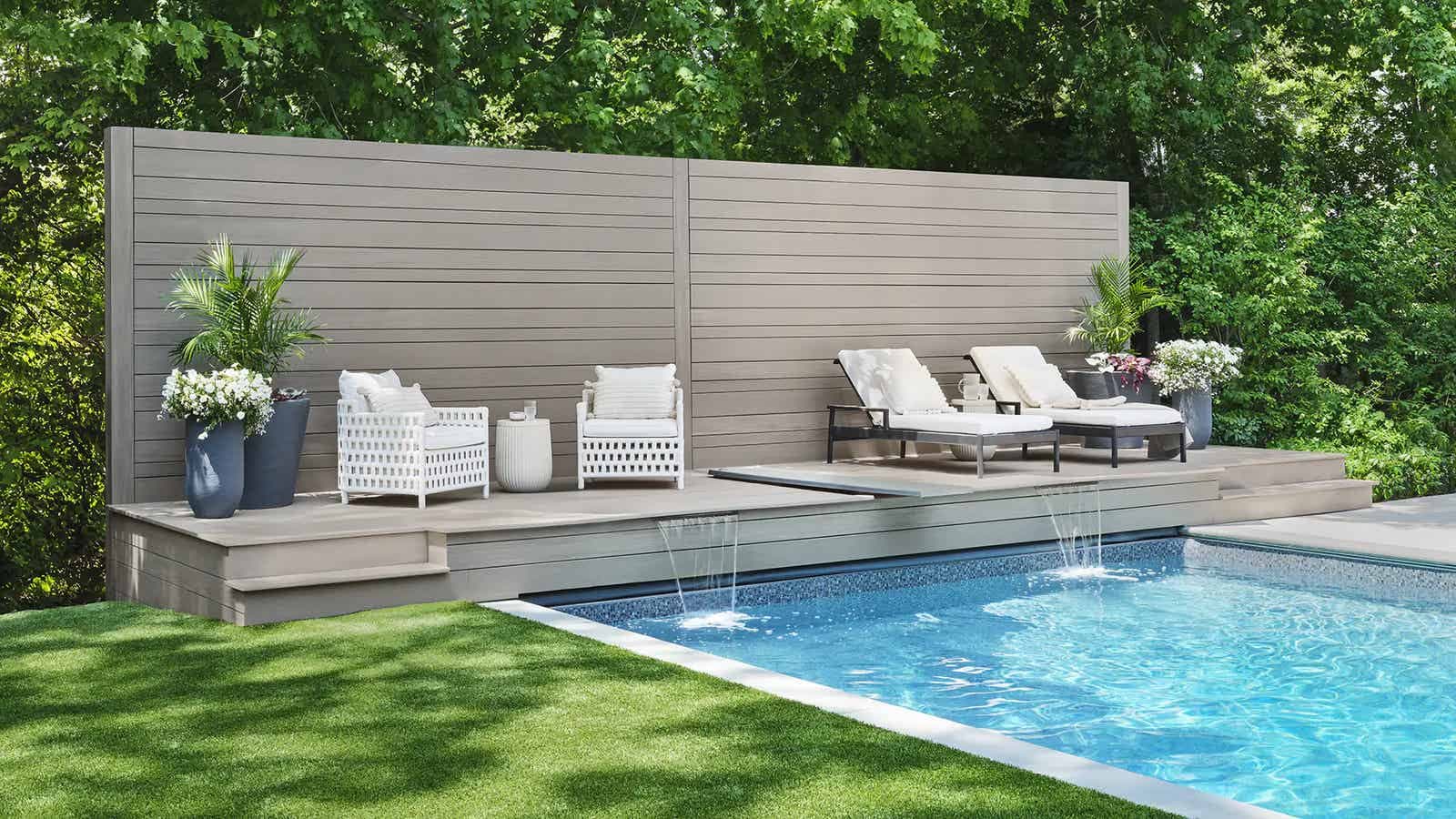
Why PVC Decking Excels in Poolside Environments
PVC decking is engineered to perform in wet conditions, making it a suitable choice for areas prone to splash zones and standing water, such as a pool terrace. Unlike wood fiber-based materials, PVC is 100% synthetic, meaning it contains no wood content that can swell, stain, or rot when exposed to moisture.
This inherent water resistance is a primary reason why PVC decking is often specified for pool surrounds and similar applications where boards are frequently wet. Its composition helps ensure the material maintains its structural integrity and appearance over time, even with regular water exposure from pool activities.
Additionally, many PVC decking options feature advanced capping, which contributes to their resistance against stains from common poolside spills like grease or wine. This surface can typically be cleaned with soap and water, simplifying maintenance for homeowners.
Understanding Material Composition and Durability
PVC decking is a full polymer board, crafted entirely from polyvinyl chloride. This complete absence of wood fiber distinguishes it from composite decking, which typically combines wood fibers with plastic. The 100% synthetic nature of PVC is key to its performance in high-moisture settings.
This material composition means PVC boards are waterproof to the core, offering protection against the effects of prolonged wetness. For a Milwaukee pool terrace, where boards may experience significant moisture and even standing water after heavy rain or enthusiastic swimming, this waterproof characteristic is a notable advantage.
Beyond water resistance, PVC decking is generally lighter than hardwood and some composite options, which can facilitate easier handling during installation. This can be a practical consideration for projects with specific logistical requirements.
Design Considerations for a Milwaukee Pool Terrace
When designing your pool terrace in Milwaukee, consider how PVC decking can integrate with your overall aesthetic. PVC decking is available in various collections, some offering deep wood-look textures and a range of color options. These choices allow for customization to complement your home's exterior and landscaping.
Heat mitigation is another important factor for poolside surfaces. Some PVC decking lines offer color options designed to reflect more sunlight, potentially resulting in a cooler surface temperature compared to darker colors. While no decking material eliminates heat absorption entirely, selecting lighter shades can be a practical consideration for a pool area that receives direct sun exposure.
Additionally, planning for proper drainage around the pool terrace is crucial, regardless of the decking material. Ensure the sub-structure and surrounding landscaping are designed to direct water away from the deck boards and foundation, further enhancing the longevity of your installation.
Maintenance and Care for PVC Pool Decking
One of the appeals of PVC decking for a pool terrace is its low-maintenance profile. The capped polymer surface is designed to shed common spills and can typically be cleaned with mild soap and water. This ease of cleaning is particularly beneficial for a pool area where splashes, sunscreen, and foot traffic are common.
Regular cleaning helps maintain the appearance of the deck and prevents the buildup of dirt or debris. It is important to follow the specific cleaning guidelines provided by the manufacturer for your chosen PVC decking product to ensure compatibility with cleaning agents and to preserve the surface finish.
While PVC decking is resistant to rot and insect damage, periodic inspection of the deck surface and substructure is still recommended to identify and address any potential issues promptly, helping to ensure the long-term enjoyment of your pool terrace.
Worked Example: Designing a 10x15 Foot Pool Terrace in Milwaukee
Consider a hypothetical Milwaukee home planning a 10-foot by 15-foot rectangular pool terrace adjacent to an existing inground pool. The homeowner desires a low-maintenance surface that can withstand frequent water exposure.
Using a standard PVC decking board that is 12 feet long and 5.5 inches wide, we can estimate material needs. For the 15-foot length, each board would require a 3-foot cut. For the 10-foot width, approximately 22 boards (10 feet / 5.5 inches = 120 inches / 5.5 inches ≈ 21.8) would be needed per 15-foot run. Since each 12-foot board yields one 10-foot section and one reusable 2-foot offcut (for smaller cuts elsewhere or waste), and we need 15 feet of length, we'd need to consider the most efficient layout.
A more practical approach for a 10x15 foot area using 12-foot boards: For the 15-foot dimension, two 12-foot boards can be cut to create one 15-foot run with a seam, or 15-foot boards could be sourced if available. If using 12-foot boards and running them parallel to the 15-foot dimension, each 12-foot board would cover 12 feet of the 15-foot length, requiring a 3-foot section from another board to complete the run. This leads to more cuts and potential waste. If running the boards parallel to the 10-foot dimension, each 12-foot board can be cut into one 10-foot section, with a 2-foot offcut. For the 15-foot width, you would need 15 feet / 5.5 inches (0.458 feet) = approximately 32.7 boards. Rounding up to 33 boards, each 12 feet long, would cover the area with minimal waste for the 10-foot length. This layout would result in 33 boards, each cut to 10 feet in length, with 33 two-foot offcuts.
Total area is 150 square feet. If boards are 5.5 inches (0.458 ft) by 12 feet, each board is 5.5 square feet. 150 sq ft / 5.5 sq ft/board = approximately 27.27 boards. Due to cuts and waste, purchasing 30-33 boards would be a more realistic estimate. Always consult with a professional and create a detailed cut plan to optimize material use.
The homeowner would also need to consider fasteners (hidden or face-fastened), fascia boards for the deck edges, and appropriate substructure materials that are compatible with the local climate and intended use, such as pressure-treated lumber for joists and beams. Ensuring proper ventilation underneath the deck is also important, particularly in a climate like Milwaukee's where temperature and humidity can fluctuate.
Before you order
- Is the decking material 100% synthetic with no wood fiber for maximum water resistance?
- Does the product line offer colors that align with your aesthetic and potential heat mitigation needs?
- Have you reviewed the manufacturer's specific installation guidelines for poolside applications, including board spacing and fastening?
- Are you clear on the recommended cleaning and maintenance procedures for the chosen PVC decking?
- Have you planned for adequate ventilation under the deck to prevent moisture buildup?
- Is your substructure material compatible with PVC decking and suitable for the Milwaukee climate and wet conditions?
- Have you accounted for fascia boards and other trim pieces for a finished edge around the pool terrace?
Confirm installation details, approved uses and warranty terms in the current instructions for the exact product and profile. Your installer should verify the substrate, structure and applicable project requirements.
This is a planning guide for projects in Milwaukee, WI. Ask our team to confirm availability, delivery to your ZIP code and which branch can support your order.
Questions to help you decide
Is PVC decking slippery when wet around a pool?
However, any wet surface can be slippery. It is always advisable to exercise caution around wet pool areas. Many manufacturers design their PVC boards with specific surface finishes to enhance traction.
How does PVC decking withstand Milwaukee's winters?
PVC decking is engineered to be durable in various climates, including those with cold winters and freeze-thaw cycles like Milwaukee. Its 100% synthetic composition means it does not absorb water like wood, which helps prevent issues like cracking or warping due to freezing and thawing. Proper installation, including adequate ventilation and drainage, further supports its performance in winter conditions.
Can PVC decking be installed directly on concrete around a pool?
While PVC decking boards themselves are not structural, they can be installed over a concrete slab. However, this typically requires a sleeper system or a sub-frame to allow for proper drainage and ventilation beneath the deck boards. Directly adhering PVC boards to concrete without an air gap or drainage path is generally not recommended as it can trap moisture and prevent proper expansion/contraction. Always refer to the manufacturer's specific installation instructions for concrete applications.
Request a Quote for Your PVC Decking Project
Ready to plan your Milwaukee pool terrace with PVC decking? Request a material quote by providing your project dimensions, desired profile, and ZIP code. We can also confirm current availability and service options for your area.
Request a material quote →