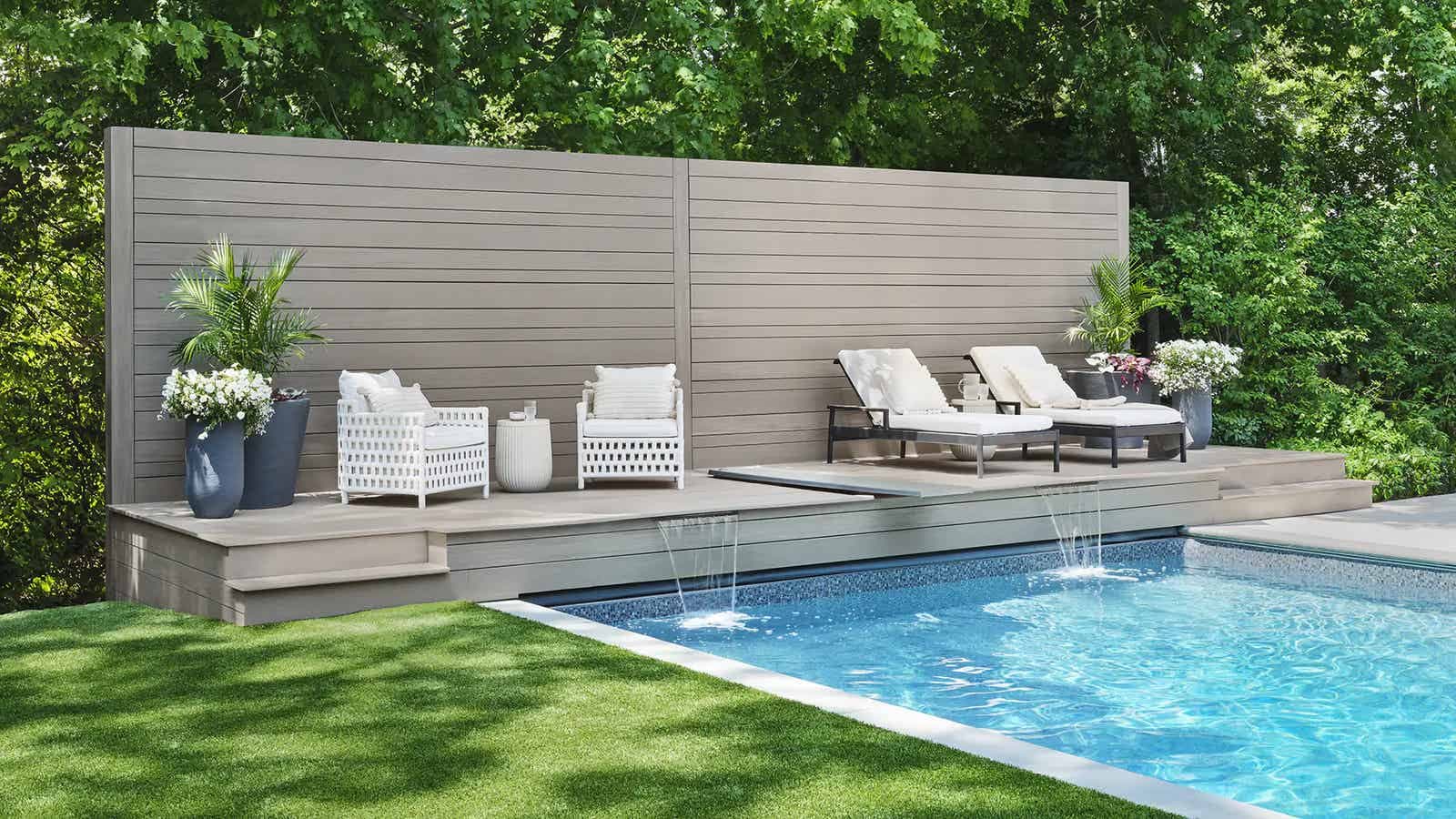
Why PVC Decking for Pool Terraces?
PVC decking stands out for pool terraces due to its entirely synthetic composition. This means it contains no wood fibers, a key factor in its performance in wet environments. Materials like Azek PVC decking are designed to be waterproof to the core, preventing swelling, staining, or rot that can occur with wood-based products when exposed to standing water, splash zones, or salt spray.
The inherent waterproof nature of PVC makes it a practical choice for areas constantly subjected to pool water, rain, and cleaning. It resists moisture absorption, which helps maintain its structural integrity and appearance over time. This characteristic is particularly beneficial for pool surrounds where boards frequently get wet and dry.
Beyond its water resistance, PVC decking is generally lighter than hardwood and some composite options, which can streamline handling and installation. This can be an advantage for projects requiring quicker installation or where material weight is a concern.
Understanding PVC Decking Properties
PVC decking, such as the TimberTech Azek line, is manufactured with advanced capping that provides a durable surface. This capping is engineered to shed common spills like grease and wine, allowing them to be wiped clean with soap and water. This ease of cleaning is a significant benefit for a pool terrace, where spills and dirt are common.
Some PVC decking options also offer heat-mitigating color choices. While no decking material remains completely cool in direct sun, these options are designed to reduce surface heat absorption, potentially making the deck more comfortable for bare feet around a pool.
The material is also 100% recyclable, contributing to sustainability efforts by allowing boards to be reprocessed at the end of their life cycle rather than ending up in a landfill.
Design and Aesthetics for Your Pool Terrace
PVC decking is available in various collections, such as Vintage, Landmark, and Harvest, offering a range of aesthetics from deep wood looks to more contemporary finishes. These options allow you to choose a style that complements your home's architecture and landscaping.
When planning your pool terrace, consider the overall visual impact. Lighter colors can create a more expansive feel and may contribute to a cooler surface temperature. Darker colors can offer a rich, sophisticated look but may absorb more heat. Coordinate your decking choice with other elements like coping, landscaping, and outdoor furniture.
Consider board widths and lengths to minimize seams and create a cohesive look. A well-planned layout can enhance the visual flow from your home to the pool area, creating a unified outdoor living space.
Installation Considerations for Poolside Environments
Proper installation is crucial for any decking project, especially around a pool. Ensure the deck frame is structurally sound and designed to support the decking material and anticipated loads, including furniture and foot traffic. Adequate ventilation beneath the deck is important to prevent moisture buildup, even with waterproof materials.
Follow manufacturer guidelines precisely for board spacing and fastening. While PVC decking is dimensionally stable, proper spacing accounts for minor thermal expansion and contraction and allows for drainage. Hidden fastening systems are often preferred for PVC decking as they create a clean, fastener-free surface that is comfortable underfoot, an important consideration for a pool terrace.
Edge finishing is also vital. Use compatible fascia and trim boards to create a finished look around the perimeter of your pool terrace and any deck stairs. These elements protect the substructure and complete the aesthetic.
Worked Example: PVC Decking for a Rectangular Pool Terrace
Let's consider a hypothetical rectangular pool terrace measuring 20 feet by 12 feet. You've chosen PVC decking boards that are 16 feet long and 5.5 inches wide, with a nominal coverage width of 5.5 inches per board (0.458 feet).
First, calculate the total area: 20 feet * 12 feet = 240 square feet.
Next, determine how many boards are needed to cover the 12-foot width. If laid parallel to the 20-foot length, you would need 12 feet / 0.458 feet per board = approximately 26.2 boards. Since you can't buy partial boards, round up to 27 boards.
Each board is 16 feet long. Since your deck length is 20 feet, each 16-foot board will cover part of the length, requiring cuts and seams if a continuous run is desired. A more efficient approach for a 20-foot length might involve using two 10-foot sections per run, or combining a 16-foot board with a 4-foot piece. For simplicity in this example, assuming a layout where boards run the 20-foot length with seams, or using longer special-order boards if available, we need 27 boards. If using 16-foot boards on a 20-foot run, you would need 27 boards x (20/16) = 33.75, so 34 boards, with significant waste from the 16-foot boards. A better plan would be to use 20-foot long boards if available to minimize seams and waste.
If 20-foot boards are available, you would need 27 boards, each 20 feet long. Total lineal feet: 27 boards * 20 feet/board = 540 lineal feet.
This would require 20 feet / 16 feet = 1.25 boards per run, so 2 boards per run for a 20-foot length. For the 12-foot width, 12 feet / 0.458 feet per board = 27 boards. So, 27 boards * 2 (for the 20-foot length) = 54 boards. This assumes each 16-foot board yields a 10-foot section and a 6-foot offcut, meaning you'd need to strategically use the offcuts. For a realistic purchase, you'd likely need to buy enough 16-foot boards to cover the entire area, accounting for cuts and potential waste. For 240 sq ft, and if a 16-foot board is 16 * 0.458 = 7.328 sq ft, you'd need 240 / 7.328 = 32.75 boards. Round up to 33 boards. This example highlights the importance of precise layout planning to optimize material use.
This calculation is an estimate. Always add a percentage (e.g., 5-10%) for cuts, waste, and future repairs. Consult with your installer and supplier for exact quantities based on your specific layout and available board lengths. For this example, if we assume 20-foot boards are used and 5% waste, 27 boards * 1.05 = 28.35, so 29 boards would be a more prudent purchase.
Before you order
- Confirm local building codes and permits required for deck construction around a pool.
- Assess the existing substructure for suitability with PVC decking, or plan for a new frame.
- Choose a PVC decking color and finish that complements your home and pool area.
- Determine board width and length preferences for your desired aesthetic and to minimize seams.
- Plan for adequate ventilation under the deck to prevent moisture buildup.
- Select compatible fasteners (hidden or face-fastened) according to manufacturer recommendations.
- Account for fascia, trim, and stair components in your material list.
- Consider the need for heat-mitigating colors if the deck will be in direct sun.
- Review manufacturer-specific cleaning and maintenance guidelines for chosen PVC decking.
Confirm installation details, approved uses and warranty terms in the current instructions for the exact product and profile. Your installer should verify the substrate, structure and applicable project requirements.
This is a planning guide for projects in Madison, WI. Ask our team to confirm availability, delivery to your ZIP code and which branch can support your order.
Questions to help you decide
Is PVC decking slippery when wet?
However, any wet surface can be slippery. Exercise caution around pool areas, and consider integrating non-slip mats or textures in high-traffic zones if desired. Always refer to specific product specifications for any slip resistance ratings.
How do I clean PVC decking around a pool?
PVC decking is generally easy to clean. For routine maintenance, a broom or leaf blower can remove loose debris. For more thorough cleaning, use a mild soap and water solution with a soft-bristle brush. Always rinse thoroughly with water. Avoid abrasive cleaners, high-pressure washers, or solvents unless specifically approved by the decking manufacturer, as these can damage the surface. Promptly clean up spills from pool chemicals, suntan lotions, or food to prevent potential staining.
Can PVC decking be installed directly on concrete around a pool?
Installing PVC decking directly on concrete typically requires a sleeper system or a subframe to allow for drainage and ventilation. This prevents moisture from being trapped between the decking and the concrete, which can lead to issues even with waterproof materials. Always follow the manufacturer's specific installation instructions for ground-level or concrete-adjacent applications to ensure proper performance and warranty validity. Pedestal systems are also an option for creating a ventilated, level surface over concrete.
Ready to Plan Your PVC Pool Terrace?
Request a material quote with your project dimensions, desired PVC decking profile, and ZIP code. We can help you confirm current availability and service options for your project.
Request a material quote →