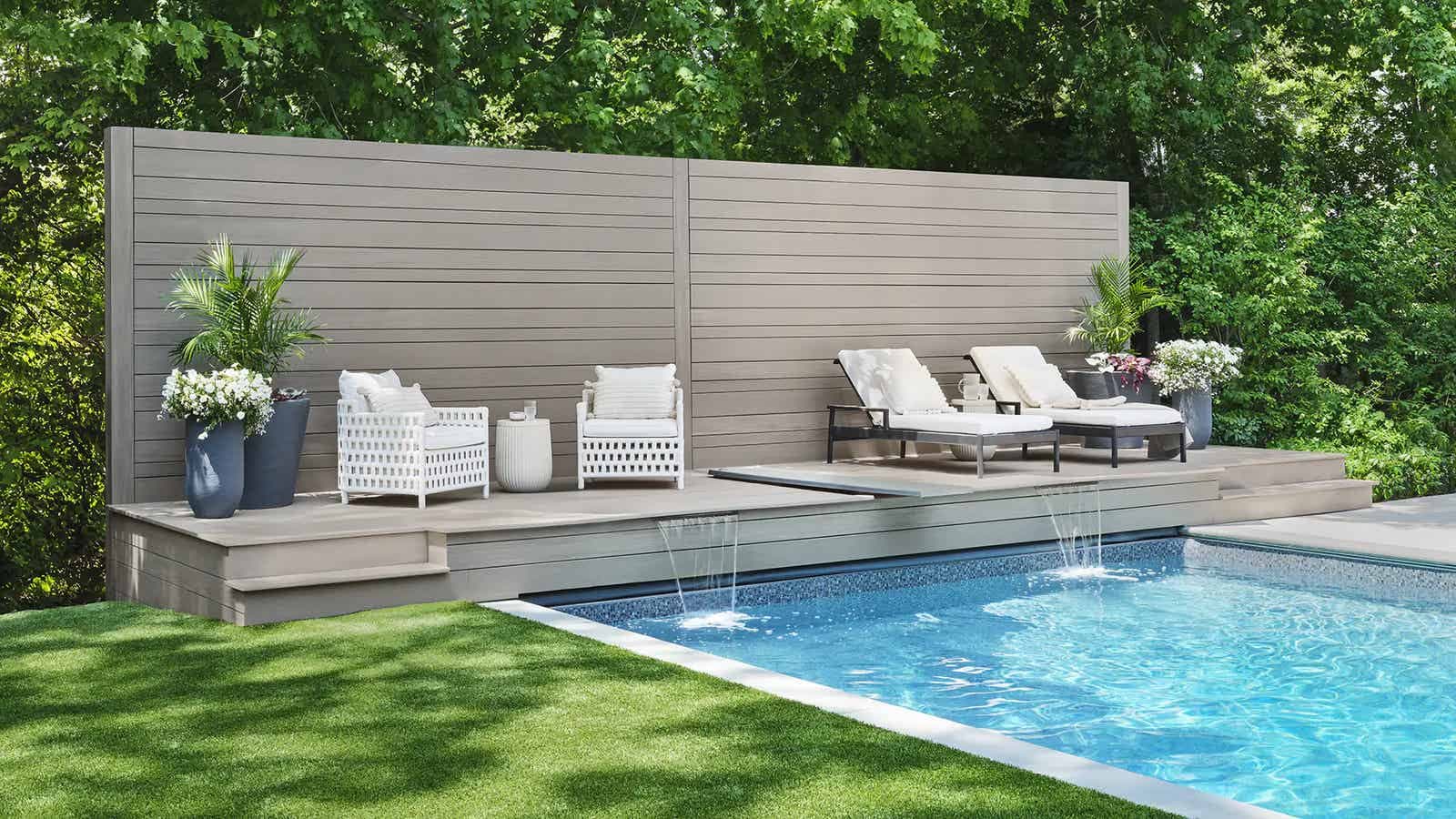
Why PVC Decking for a Pool Terrace?
The primary advantage of PVC decking for a pool terrace, especially in a location like Hilton Head Island, is its inherent resistance to moisture. Made entirely of synthetic polymers, PVC boards do not contain wood fibers, which eliminates the potential for swelling, staining, or rot that can affect other decking materials when exposed to constant water.
This makes PVC decking a practical choice for splash zones, areas around pools, and even docks where boards are frequently wet. Its waterproof core ensures stability and durability in conditions where other materials might deteriorate over time. The material's lighter weight compared to hardwood can also simplify handling and installation.
Additionally, PVC decking is designed to shed common spills like grease and wine, making cleanup straightforward with just soap and water. Many options also feature advanced capping and heat-mitigating color choices, which can be beneficial in sunny climates.
For those considering the environmental impact, PVC decking is often recyclable, contributing to a circular material stream rather than ending up in a landfill when a deck is eventually replaced.
Understanding PVC Decking Profiles and Appearance
PVC decking is available in various collections that mimic the look of natural wood, offering deep wood grain textures and a range of color options. For instance, lines like TimberTech Azek's Vintage, Landmark, and Harvest collections are known for their aesthetic appeal and advanced capping.
When selecting for a pool terrace, consider how the board profile and color will integrate with your existing landscaping and home architecture. Lighter colors may reflect more sunlight, potentially contributing to a cooler surface underfoot, a consideration for bare feet around a pool in the Hilton Head Island sun. Always consult product specifications for exact color and texture details.
Installation Considerations for Poolside PVC Decking
While PVC decking is designed for wet environments, proper installation is crucial for its performance and longevity. Ensure that the substructure is adequately prepared and provides proper drainage. Even though the boards are waterproof, water should not be allowed to pool underneath or around the decking, as this can still impact the substructure or surrounding areas.
Follow the manufacturer's specific guidelines for board spacing, fastening methods (hidden fasteners are often preferred for a clean look), and ventilation. Adequate ventilation beneath the deck helps prevent moisture buildup and ensures air circulation, which is important in humid climates. For coastal areas, fasteners and any supporting hardware should be corrosion-resistant.
Given the proximity to water, ensure all components of your decking system, including fasteners and substructure materials, are suitable for exposure to moisture and potentially chlorinated or salt water.
Maintenance and Cleaning for a Pool Terrace
One of the key benefits of PVC decking is its low maintenance. Regular cleaning typically involves sweeping away debris and washing with soap and water. For spills or more stubborn marks common around a pool, such as sunscreen or food, prompt cleaning is recommended.
Always refer to the manufacturer's specific cleaning instructions and recommended products. Avoid harsh chemicals, abrasive cleaners, or pressure washers that can damage the surface of the decking. While PVC is stain-resistant, proactive cleaning helps maintain its appearance over time. In a coastal environment, periodic rinsing to remove salt residue may also be beneficial.
Hypothetical Project Example: A 12' x 20' Pool Terrace
Consider a hypothetical pool terrace project in Hilton Head Island, measuring 12 feet by 20 feet. The client desires a light-colored PVC deck with a wood-grain texture, using boards that are 5.5 inches wide and 16 feet long.
First, calculate the total area: 12 ft x 20 ft = 240 square feet. Next, determine the number of boards needed. If boards are laid parallel to the 20-foot dimension, each 16-foot board covers a width of 5.5 inches (0.458 feet).
The number of boards required for the 12-foot width would be 12 feet / 0.458 feet/board = approximately 26.2 boards. Since boards are typically sold in full lengths, you would need 27 boards of 16 feet each. This gives a total board length of 27 boards * 16 feet/board = 432 linear feet.
For a deck of this size, it's prudent to add 5-10% for cuts, waste, and potential future repairs. For this example, adding 10% would mean purchasing approximately 432 * 1.10 = 475.2 linear feet of decking. Rounded up, this would mean purchasing 30 boards (30 boards * 16 feet/board = 480 linear feet).
This calculation is for the main deck surface only. Additional materials like fascia boards for edges, hidden fasteners, and substructure materials (joists, beams, concrete footings) would need separate calculations based on the specific design and local building codes. Always confirm precise dimensions and waste factors with your installer and product supplier.
Before you order
- Confirm local building codes and permits required for poolside decking in Hilton Head Island, SC.
- Verify substructure requirements for PVC decking, especially for wet environments.
- Choose a PVC decking product specifically rated for ground contact or wet applications if applicable.
- Select a board color and finish that complements your home and landscape, considering heat absorption.
- Plan for proper drainage around and under the deck to prevent standing water.
- Identify compatible fasteners and edge finishing options (fascia, trim) for a complete look.
- Review manufacturer-specific installation guidelines for board spacing and ventilation.
- Determine the total square footage and calculate linear footage of decking boards required, adding for waste.
- Consider the need for any specialized cleaning products or tools for ongoing maintenance.
- Account for delivery logistics and on-site storage requirements for the decking materials.
Confirm installation details, approved uses and warranty terms in the current instructions for the exact product and profile. Your installer should verify the substrate, structure and applicable project requirements.
This is a planning guide for projects in Hilton Head Island, SC. Ask our team to confirm availability, delivery to your ZIP code and which branch can support your order.
Questions to help you decide
Is PVC decking slippery when wet, especially around a pool?
Many manufacturers incorporate surface textures designed to enhance grip. It's always advisable to check specific product specifications and consider samples in wet conditions. Maintaining a clean surface free of algae or debris will also help prevent slipperiness.
Does PVC decking get hot in the sun?
Like many outdoor materials, PVC decking can absorb heat from the sun. However, many PVC decking lines offer 'heat-mitigating' color options, which are designed to stay cooler than darker alternatives. Lighter colors generally reflect more sunlight and can be a more comfortable choice for bare feet around a pool terrace in sunny climates like Hilton Head Island. Always test samples in direct sunlight if surface temperature is a primary concern.
Can I install PVC decking directly on the ground or over an existing concrete slab?
PVC decking generally requires a proper substructure for ventilation and drainage, similar to other decking materials. It is not typically designed for direct ground contact without a supporting frame. While it can be installed over an existing concrete slab, this usually still requires a treated wood or aluminum joist system to create airspace and ensure proper water runoff. Always refer to the manufacturer's specific installation instructions for approved substructure types and methods.
Plan Your Hilton Head Island Pool Terrace Deck
Ready to explore PVC decking for your pool terrace project? Request a material quote today. Provide your project dimensions, desired PVC decking profile, and ZIP code to confirm current availability and service options for Hilton Head Island, SC.
Request a material quote →