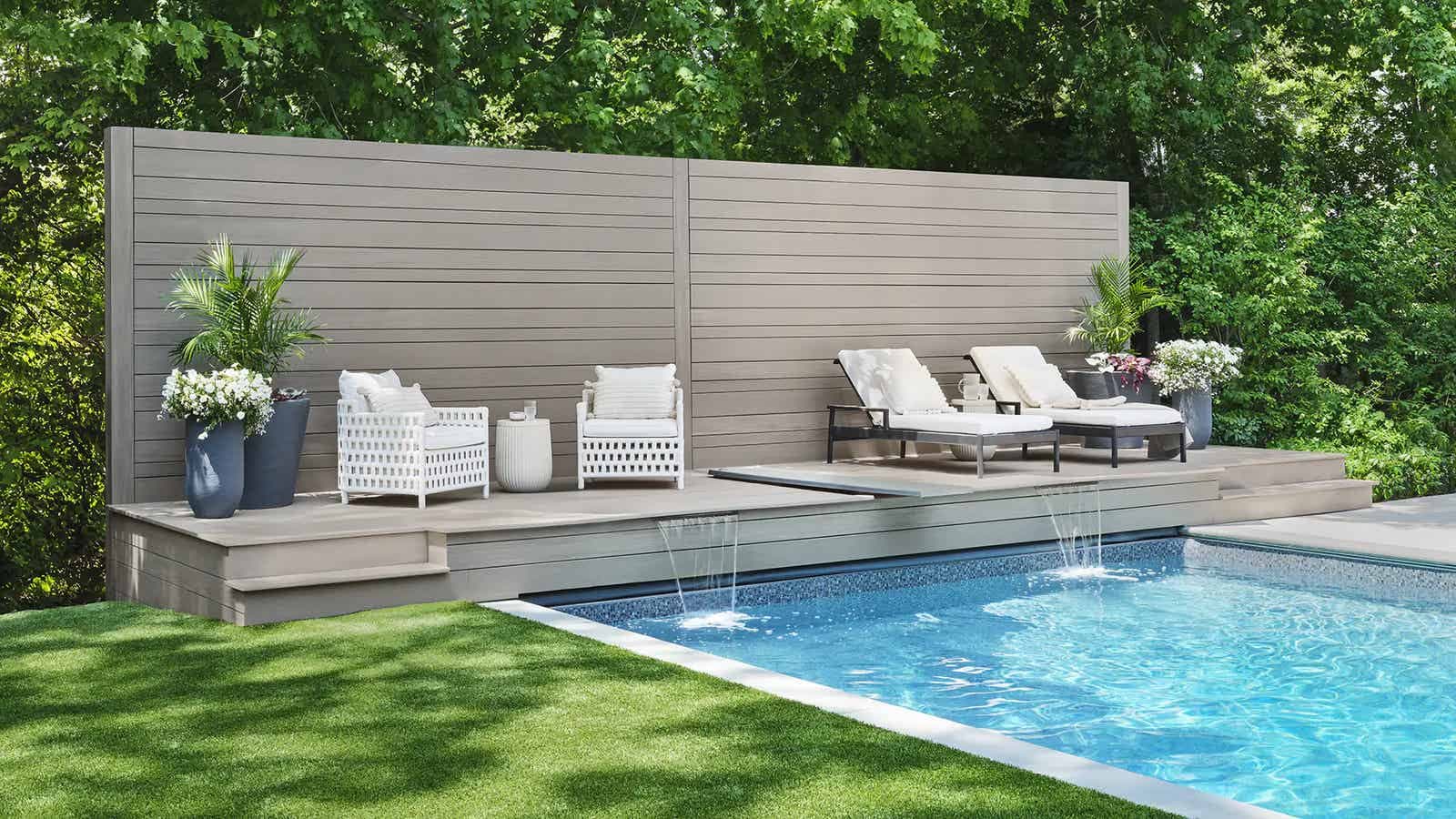
Why PVC Decking for Pool Areas?
PVC decking is a 100% synthetic material, meaning it contains no wood fiber. This composition is particularly relevant for pool surrounds where boards are frequently exposed to standing water, splash zones, and potentially chlorinated or salt-treated water. Unlike wood-based materials, PVC does not swell, stain, or rot when wet, which is a key advantage in these applications.
The waterproof core of PVC decking makes it a choice for areas that consistently get wet. This characteristic helps maintain the structural integrity and appearance of the deck over time, even with regular pool use. Its low moisture absorption also contributes to ease of cleaning and resistance to common poolside issues.
Additionally, PVC decking can be lighter than some hardwood or composite options, which may facilitate handling and installation, especially in more complex project scenarios.
Understanding PVC Decking Profiles and Appearance
PVC decking is available in various collections that offer different aesthetics, often mimicking the look of natural wood with varied grain patterns and color tones. For a pool terrace, selecting a profile that complements your home's exterior and landscaping is important.
Many PVC decking lines feature advanced capping, which contributes to their resistance to stains and fading. While all decking materials absorb some heat from the sun, some PVC options offer heat-mitigating color choices, which can be a consideration for bare feet around a pool. It is advisable to review specific product information for details on color retention and heat absorption characteristics.
Designing Your Hartford Pool Terrace with PVC
When planning a pool terrace in Hartford, consider how the decking will integrate with the pool coping, landscaping, and any other hardscaping. Proper drainage away from the pool and deck is crucial to prevent water accumulation.
Think about the layout of your deck boards. Options include linear installations, diagonal patterns, or picture-frame borders. Each choice can influence the visual flow and complexity of the installation. Ensure that any fasteners used are compatible with PVC decking and appropriate for wet conditions.
For areas around the pool that transition to other surfaces, such as paved patios or grass, plan for smooth and safe transitions. This includes considering the height of the decking relative to other surfaces and the use of appropriate edge finishes and fascia boards to create a complete look.
Maintenance for a PVC Pool Terrace
One of the benefits of PVC decking for a pool terrace is its relatively low maintenance. The capped polymer surface is designed to shed common spills like grease and wine, which can be wiped clean with soap and water. Regular cleaning helps to remove dirt, pollen, and other debris that can accumulate.
While PVC decking is resistant to moisture, it is still important to follow manufacturer-specific cleaning guidelines. Avoid harsh chemicals or abrasive cleaners that could potentially damage the surface. For areas around a pool, consider periodic rinsing to remove chlorinated or salt water residues.
Unlike wood, PVC decking does not require sanding, staining, or sealing. This reduces the ongoing maintenance tasks, allowing more time to enjoy your pool area.
Hypothetical Project Example: A 200 sq ft Pool Terrace
Consider a hypothetical pool terrace project in Hartford, CT, measuring 20 feet by 10 feet, totaling 200 square feet. This area is intended for a PVC deck around an in-ground pool, with a linear board layout.
If using PVC deck boards that are 12 feet long and 5.5 inches wide, each board covers approximately 5.5 square feet (12 feet * 5.5 inches / 12 inches/foot). To cover the 200 square feet, an area-equivalent calculation would suggest 200 / 5.5 = 36.36 boards. However, due to cuts and potential waste, especially for a 20-foot length, a more accurate estimate is needed.
For a 20-foot length, one 12-foot board and one 8-foot board (cut from another 12-foot board) would be needed per run. If the boards are oriented along the 20-foot dimension, you would need 20 feet / (5.5 inches / 12 inches/foot) = approximately 43.6 runs. Since each run requires two board segments, you would need 44 full boards of 12 feet to account for cuts and waste, assuming the 8-foot offcuts are reusable elsewhere on the project. Always confirm dimensions and consult with a professional for precise material takeoffs.
This example assumes a simple rectangular layout. More complex designs, such as those with curves around a pool or diagonal patterns, will require more detailed planning and may result in higher material waste.
Before you order
- Confirm the exact dimensions of your pool terrace area, including any curves or irregular shapes.
- Research PVC decking collections for desired aesthetics (color, grain pattern) and heat-mitigating properties.
- Verify manufacturer recommendations for poolside installation, including spacing, fasteners, and substructure.
- Plan for proper drainage around the pool and deck to prevent water accumulation.
- Consider edge finishes and fascia boards for a polished look and safe transitions.
- Review cleaning and maintenance instructions for chosen PVC decking, especially concerning pool chemicals.
- Obtain a material quote based on your project dimensions, exact profile, and ZIP code.
Confirm installation details, approved uses and warranty terms in the current instructions for the exact product and profile. Your installer should verify the substrate, structure and applicable project requirements.
This is a planning guide for projects in Hartford, CT. Ask our team to confirm availability, delivery to your ZIP code and which branch can support your order.
Questions to help you decide
Is PVC decking slippery when wet?
It is important to exercise caution on any wet surface, especially around a pool. Always refer to specific product information for details on slip resistance.
Can PVC decking be installed directly over concrete?
PVC decking typically requires a substructure for proper support and ventilation, even over a concrete slab. Direct installation without a substructure is generally not recommended as it can trap moisture and prevent adequate airflow. Always follow the manufacturer's installation guidelines for the specific product.
How does PVC decking handle sun exposure in Hartford's climate?
PVC decking is engineered for UV resistance to minimize fading. Many lines incorporate advanced capping and color technology to help maintain their appearance over time. While all materials will experience some degree of natural weathering, PVC is designed to perform well in various climates, including areas with strong summer sun. Some colors may feel hotter underfoot than others; consider lighter shades or those specifically marketed as heat-mitigating for pool areas.
Ready to Plan Your PVC Pool Terrace?
Request a material quote for your project. Provide your project dimensions, desired PVC decking profile, and ZIP code to confirm current availability and service options for your Hartford, CT location.
Request a material quote →