Assess Your Existing Deck Frame and Substructure
Before selecting any decking material, a thorough inspection of your existing deck's frame and substructure is crucial. This involves checking for signs of rot, insect damage, or structural weakness in joists, beams, and support posts. Even if your current decking boards are worn, the underlying structure might still be sound. However, hardwood decking, particularly dense species like Ipe and Cumaru, is heavier than many common decking materials or older softwoods. Your existing frame must be robust enough to support this increased weight.
Consider consulting a local structural engineer or experienced contractor in Hartford, CT to evaluate the load-bearing capacity and overall condition of your frame. They can confirm if the existing joist spacing and dimensions are adequate for the chosen hardwood species and its installation requirements. This step helps ensure safety and the longevity of your renovated deck, preventing potential issues down the line.
Measuring Your Renovation Area Accurately
Accurate measurements are fundamental to any renovation project. Begin by clearing the existing deck surface to expose the full dimensions. Measure the length and width of your deck in multiple places to account for any slight irregularities. Note down all dimensions, including any cut-outs for posts, railings, or other features. For complex shapes, a detailed sketch with measurements is invaluable.
When calculating material quantities for hardwood decking, remember that boards are typically sold in specific lengths. While a total square footage gives an estimate, you'll need to plan for board layout, cuts, and potential waste. For instance, if your deck is 10 feet wide and you are using 12-foot boards, you'll have 2 feet of offcut per board in that dimension. Consider if these offcuts can be utilized for shorter sections or if they will be waste. Always add a percentage for cuts and potential errors, typically 5-10%, depending on the complexity of your layout.
Comparing Hardwood Decking Options: Ipe vs. Cumaru
Lumber Plus offers a selection of Brazilian hardwood decking species, each with distinct characteristics suitable for renovation projects. Two popular choices for their durability and appearance are Ipe and Cumaru.
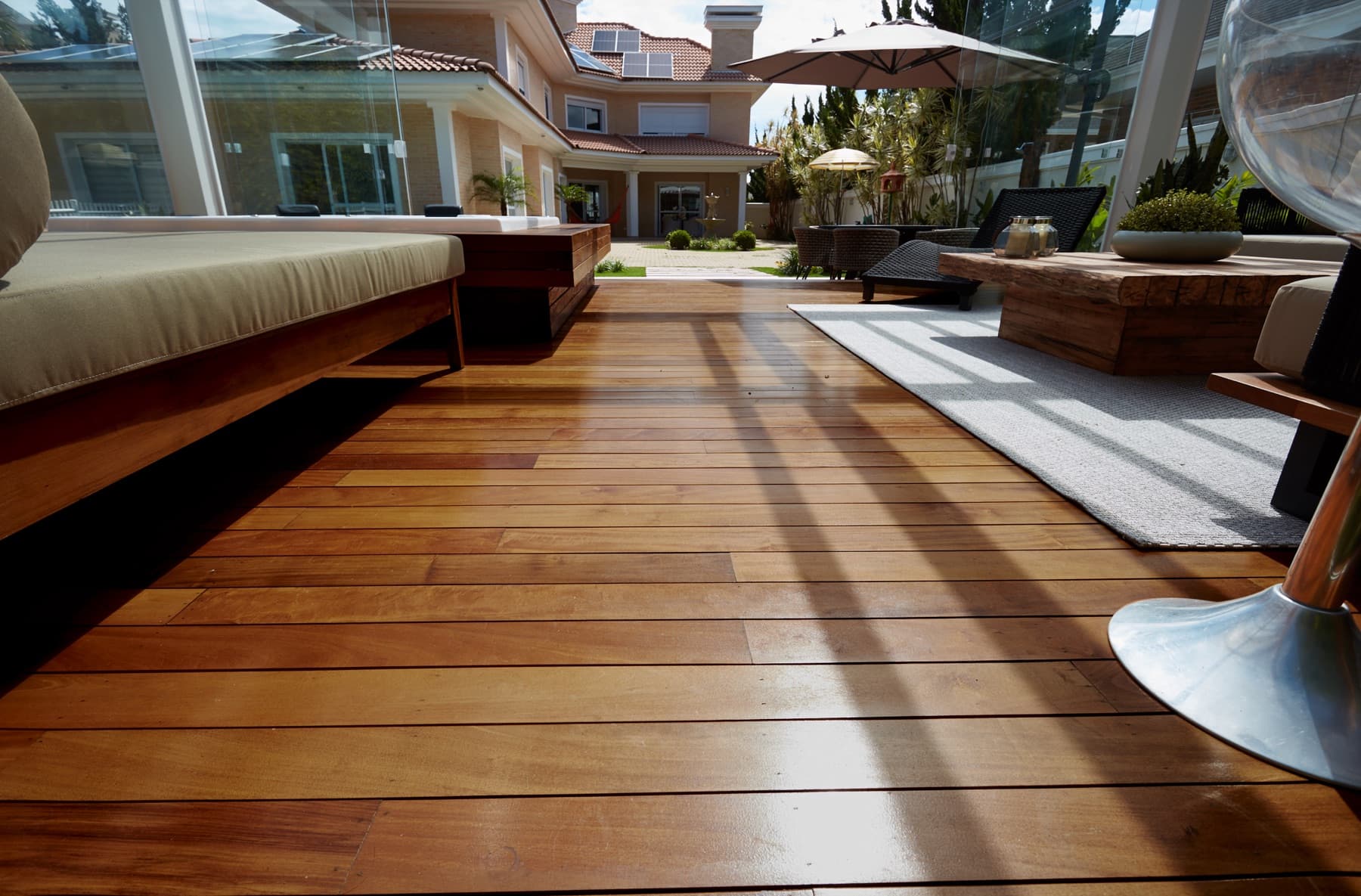
Ipe, also known as Brazilian walnut, is a benchmark hardwood. Its color ranges from reddish-brown to olive-brown and it is naturally resistant to rot, insects, and mold. Ipe is also noted for its minimal movement post-installation and resistance to weather changes. With proper care, Ipe decking can last for decades. It is a premium choice for projects requiring superior longevity and performance.
Cumaru is another very durable tropical hardwood, often considered a close alternative to Ipe. Cumaru is resistant to termites and weather changes, making it a dependable choice for demanding builds. It offers stiffness, strength, and extreme hardness. Cumaru shares many of Ipe's advantages, including natural resistance to insects, rot, and fungi, and can be a strong contender for those seeking high performance with a slightly different budget tier. When worked, Cumaru can give off a scent of cinnamon and vanilla.
Both Ipe and Cumaru can be left untreated to weather to a silvery-gray patina or can be regularly oiled to maintain their original rich color.
Find more details on Ipe here: [Ipe Hardwood Decking](/decking/hardwood/ipe)
Explore general hardwood decking options: [Hardwood Decking](/decking/hardwood)
Worked Example: Calculating Hardwood Decking for a Renovation
Let's consider a hypothetical deck renovation project in Hartford, CT. You have an existing deck that measures 12 feet by 18 feet. You plan to use Ipe decking boards, available in 5.5-inch width (nominal 1x6) and various lengths, including 12-foot and 16-foot options. You decide on a straight lay pattern.
First, calculate the total square footage: 12 ft x 18 ft = 216 sq ft.
Next, determine the number of boards needed. Since the deck is 12 feet wide, using 12-foot long boards for the length of the deck will result in minimal waste for that dimension. The width of each board is 5.5 inches (0.458 feet).
Number of boards needed across the 18-foot length: 18 feet / 0.458 feet/board = approximately 39.3 boards. You will need to round up to 40 boards to cover the width.
If you choose 12-foot long boards to run the length of the deck (12 feet), you would need 40 boards of 12 feet each. Total linear footage: 40 boards * 12 feet/board = 480 linear feet.
Alternatively, if you were to use 16-foot boards and cut them to fit the 12-foot deck, you'd have 4 feet of offcut per board. While some offcuts might be usable for other sections, for a simple rectangular deck, this might lead to more waste. For this example, using 12-foot boards directly aligns better with the deck's dimension.
Always add a waste factor. For a simple rectangular deck, a 5-7% waste factor is usually sufficient. 480 linear feet * 1.07 (7% waste) = 513.6 linear feet. Round up to the nearest full board length available. If boards are sold in 12-foot increments, you would likely order 43 boards (516 linear feet).
This example assumes a simple layout. More complex designs, diagonal patterns, or picture-frame borders will require more detailed planning and potentially a higher waste factor.
Long-Term Considerations for Hardwood Decking in Hartford, CT
Hartford, CT experiences a range of seasonal weather, from humid summers to cold, snowy winters. Hardwood decking species like Ipe and Cumaru are well-suited to these conditions due to their natural density and resistance to moisture and temperature fluctuations.
Maintenance is straightforward: a yearly wash to remove dirt and debris is generally sufficient. If you prefer to maintain the original rich color, an annual application of a UV-blocking sealer is recommended. Without it, the wood will naturally weather to a silvery-gray patina, which does not impact its structural integrity. This low-maintenance aspect contributes to the long-term value of hardwood decking.
Consider also the ventilation beneath your deck. Proper airflow helps prevent moisture buildup, which is important for the longevity of both the decking and the substructure. Ensure that landscaping or other elements do not obstruct ventilation around and under the deck.
Before you order
- Inspect existing deck frame for rot, insect damage, and structural integrity.
- Consult a structural professional if unsure about frame capacity for heavier hardwoods.
- Measure deck dimensions accurately, accounting for irregular shapes and features.
- Sketch your deck layout and plan board placement to minimize waste.
- Choose a hardwood species (e.g., Ipe or Cumaru) based on durability, appearance, and budget.
- Account for a waste factor (5-10%) when calculating material quantities.
- Plan for annual cleaning and consider UV-blocking sealer for color retention.
- Ensure adequate ventilation beneath the deck to prevent moisture issues.
Confirm installation details, approved uses and warranty terms in the current instructions for the exact product and profile. Your installer should verify the substrate, structure and applicable project requirements.
This is a planning guide for projects in Hartford, CT. Ask our team to confirm availability, delivery to your ZIP code and which branch can support your order.
Questions to help you decide
How do I know if my existing deck frame can support hardwood decking?
Hardwood decking, especially dense species like Ipe and Cumaru, is heavier than many other decking materials. It is crucial to have your existing deck frame and substructure inspected by a qualified contractor or structural engineer. They can assess the condition of joists, beams, and posts, and confirm if the current construction and joist spacing are adequate to safely support the increased load.
Will hardwood decking withstand Hartford's winter weather?
Yes, species such as Ipe and Cumaru are highly resistant to extreme weather conditions, including the cold and snow experienced in Hartford, CT. Their natural density and oils help protect them from cracking, warping, and moisture absorption, making them a durable choice for year-round outdoor exposure. Regular cleaning and optional sealing can further enhance their performance.
What is the primary maintenance required for hardwood decking?
Hardwood decking is considered low maintenance. The primary task is an annual cleaning with soap and water to remove dirt, pollen, and debris. If you wish to preserve the original rich color of the wood, an annual application of a UV-blocking sealer or oil is recommended. If left untreated, the wood will naturally weather to a silvery-gray patina, which is a common and desirable aesthetic for many, and does not affect the wood's structural integrity.
Request a Hardwood Decking Quote for Your Hartford Renovation
Ready to transform your deck in Hartford, CT? Provide your project dimensions, desired hardwood profile (e.g., Ipe, Cumaru), and your ZIP code. Our team can help confirm current availability, service options, and provide a material quote tailored to your renovation needs.
Request a material quote →