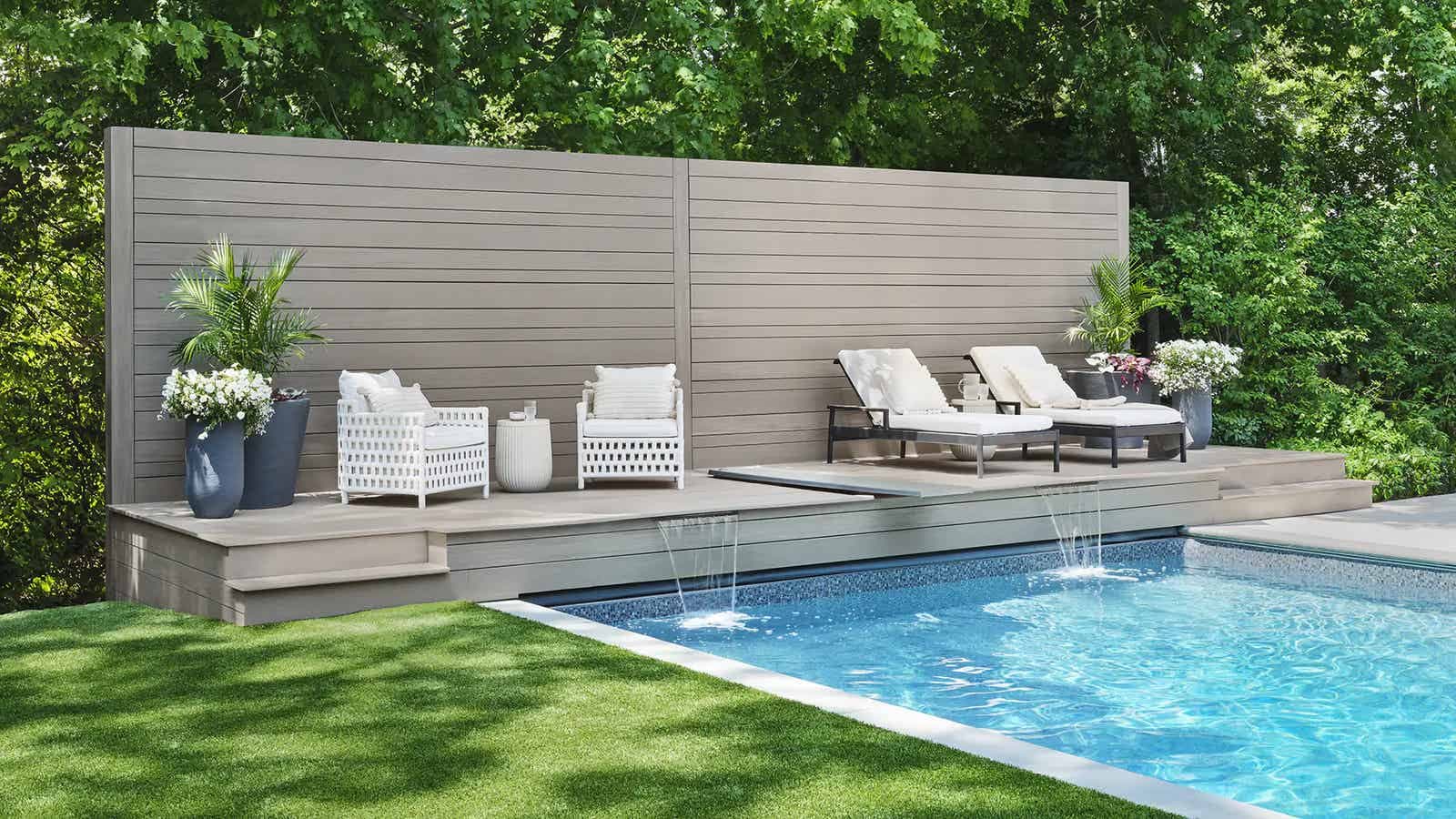
Why Choose PVC Decking for Pool Terraces?
PVC decking is engineered for environments where boards are frequently wet. Its core benefit for a pool terrace is its 100% synthetic composition, meaning it contains zero wood fiber. This characteristic is crucial for areas exposed to standing water, splash zones, and even salt spray if applicable, as it eliminates the potential for the material to swell, stain, or rot due to moisture absorption.
The advanced capping on many PVC boards provides additional protection against stains from common poolside spills like grease and wine. These surfaces are designed to be wiped clean with soap and water, simplifying maintenance. Furthermore, some PVC decking options offer heat-mitigating color choices, which can be a consideration for bare feet on sunny Des Moines days.
Beyond its moisture resistance, PVC decking is often lighter than hardwood and some composite options, which can facilitate easier handling during installation. This can be particularly beneficial for projects with access constraints or complex layouts around a pool.
Understanding PVC Decking Profiles and Appearance
PVC decking is available in various collections, such as the Vintage, Landmark, and Harvest lines, which offer a range of aesthetic choices. These collections often feature deep wood-look textures and diverse color palettes, allowing for design flexibility to complement your home's exterior and landscaping. The appearance can range from subtle, natural tones to richer, more pronounced wood grain patterns.
When selecting PVC decking for a pool terrace, consider how the chosen profile and color will integrate with the existing design elements of your outdoor space. Lighter colors can help reflect sunlight and potentially reduce surface temperature, which can be a comfort factor for pool users. Ensure that any selected finish provides a consistent look, especially if you are combining different board lengths or widths.
Planning for Moisture Management and Drainage
Even though PVC decking is waterproof to the core, proper planning for moisture management and drainage is still important for the overall health of your deck structure and to prevent water pooling on the surface. Ensure that the sub-structure allows for adequate airflow and drainage beneath the deck boards. This helps prevent standing water from accumulating on joists or other structural components.
Consider the slope of the underlying terrain and the deck frame to direct water away from the pool area and your home's foundation. Follow manufacturer guidelines for board spacing to allow for proper drainage between boards.
Installation Considerations for a Pool Terrace
The installation of PVC decking around a pool requires attention to detail. Ensure that the deck frame is built to local code requirements and provides stable support for the decking material. When installing, it is critical to follow the manufacturer's specific instructions for fasteners, spacing, and any required ventilation.
For a pool terrace, consider using hidden fasteners to create a clean, seamless appearance, which can also be more comfortable for bare feet. Edge finishes and fascia boards should also be carefully selected to provide a finished look around the perimeter of the pool and deck. These components should be made from a compatible material, ideally PVC, to maintain the same level of moisture resistance.
Hypothetical Project Example: Des Moines Pool Terrace
Let’s consider a hypothetical pool terrace project in Des Moines. Imagine a rectangular pool measuring 15 feet by 30 feet, with a desired PVC deck surround extending 6 feet out from all sides of the pool. This creates an outer deck perimeter of 27 feet by 42 feet. The total area of the deck would be (27 ft * 42 ft) - (15 ft * 30 ft) = 1134 sq ft - 450 sq ft = 684 square feet.
If using standard PVC decking boards that are approximately 5.5 inches wide (0.458 feet) and available in 16-foot lengths, we can estimate material needs. For a linear run of 42 feet, you would need 3 boards end-to-end (16+16+10 feet or similar cuts). To cover the width of 6 feet, you would need approximately 6 ft / 0.458 ft/board = 13.1 boards. Rounding up, we’d plan for 14 boards for each 6-foot section. The total linear footage for the entire perimeter would be significant, requiring careful layout planning to minimize waste and manage seams.
For the 684 square feet of decking, if each 16-foot board covers 16 ft * 0.458 ft = 7.328 square feet, you would need approximately 684 sq ft / 7.328 sq ft/board = 93.3 boards. Rounding up, a preliminary estimate would be 94 full 16-foot boards. This calculation is a basic area-equivalent and does not account for specific cut plans, waste, or border details. Always consult with a professional and create a detailed cut list for precise ordering.
Before you order
- Verify local building codes for pool deck construction and materials.
- Assess the existing sub-structure for compatibility and required repairs/upgrades.
- Choose a PVC decking color and finish that complements your home and landscape.
- Confirm the availability of matching fascia and trim pieces.
- Plan for adequate drainage and ventilation beneath the deck surface.
- Consider heat-mitigating color options if the deck will be in direct sun exposure.
- Review manufacturer guidelines for installation, spacing, and fastening methods.
- Factor in potential waste for cuts and a buffer for material ordering (typically 10-15% extra).
- Identify preferred cleaning and maintenance routines for your chosen PVC product.
Confirm installation details, approved uses and warranty terms in the current instructions for the exact product and profile. Your installer should verify the substrate, structure and applicable project requirements.
This is a planning guide for projects in Des Moines, IA. Ask our team to confirm availability, delivery to your ZIP code and which branch can support your order.
Questions to help you decide
Is PVC decking slippery when wet?
While PVC decking is designed for wet environments, any surface can become slippery when wet, especially with pool chemicals or organic debris. It is important to keep the deck clean and consider the texture of the specific PVC board profile you choose. Regular cleaning with soap and water can help maintain traction.
How do I clean PVC decking around a pool?
PVC decking is generally low-maintenance. For most poolside spills and general cleaning, a mixture of mild soap and water with a soft brush or cloth is often sufficient. Always refer to the specific manufacturer's cleaning guidelines for your chosen product to ensure compatibility with cleaning agents and to avoid voiding any warranties. Avoid harsh chemicals or abrasive cleaners.
Can PVC decking be used with a hot tub?
PVC decking is suitable for areas around hot tubs due to its resistance to moisture and many common chemicals. However, ensure that the deck structure is adequately reinforced to support the significant weight of a filled hot tub and its occupants. Proper ventilation and drainage remain important considerations in these areas as well.
Ready to Plan Your Des Moines Pool Terrace with PVC Decking?
Request a material quote with your project dimensions, exact profile, and ZIP code. We can confirm current availability and service options for your project.
Request a material quote →