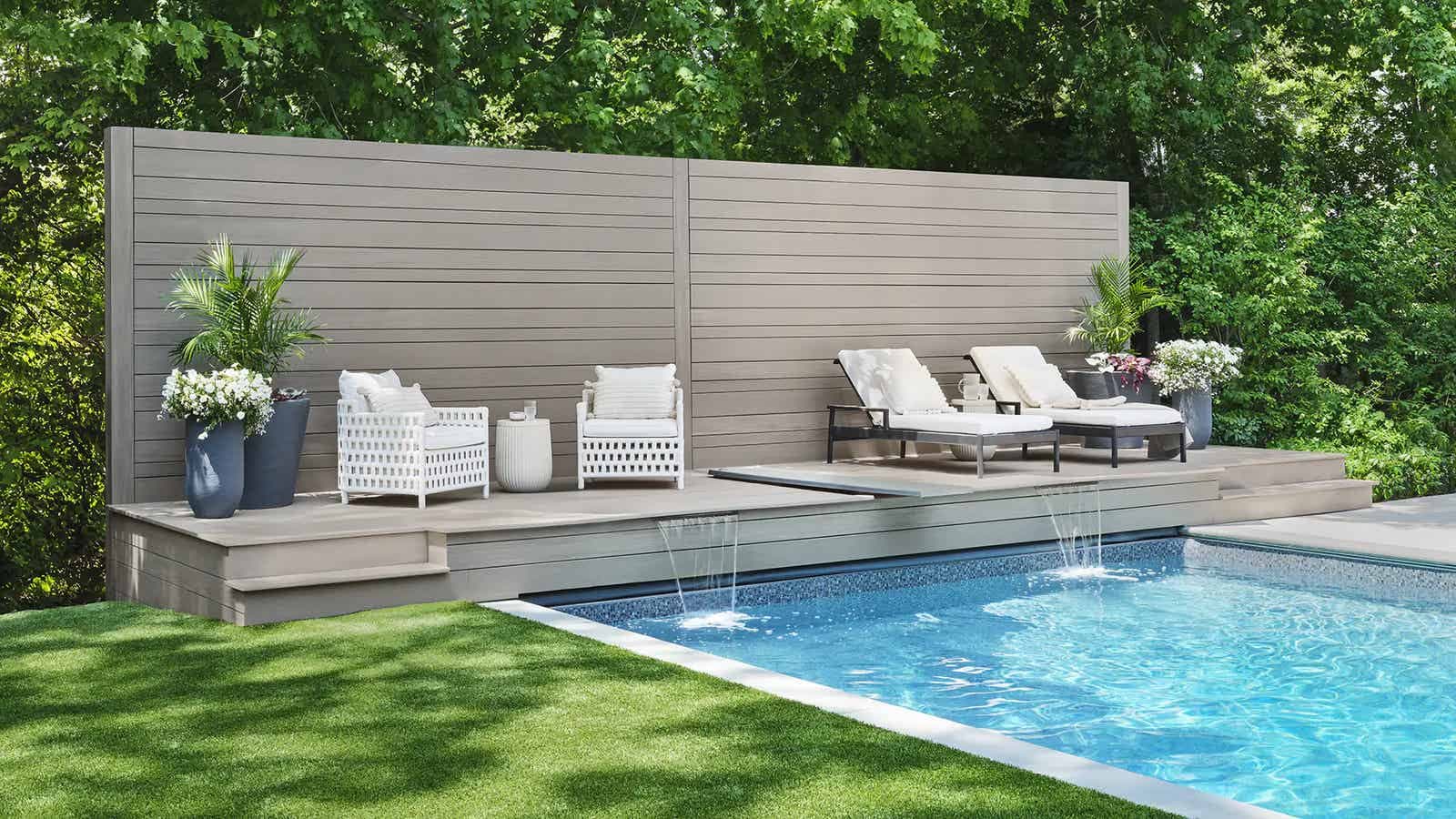
Why PVC Decking Excels in Poolside Environments
The primary reason PVC decking is a strong contender for pool terraces is its 100% synthetic, waterproof core. Unlike wood-composite alternatives that contain wood fibers, PVC contains no organic material that can swell, rot, or degrade when consistently exposed to water, chlorine, or salt spray. This makes it particularly suitable for areas where standing water and splash zones are common.
This inherent water resistance means PVC boards are less prone to issues like mold and mildew that can affect other decking materials in damp conditions. Furthermore, the advanced capping on many PVC boards is designed to shed grease and wine, allowing for easy cleaning with just soap and water. This is a practical benefit for a pool area where spills from drinks and sunscreens are frequent.
Understanding PVC Decking Profiles and Appearance
PVC decking is available in various collections, offering a range of aesthetic choices to complement your home and pool design. Collections like Vintage, Landmark, and Harvest often feature deep, multi-tonal wood-grain patterns that mimic the look of natural timber without the associated maintenance. These options allow for a sophisticated appearance that integrates well with diverse architectural styles.
Beyond visual appeal, the profiles of PVC boards are engineered for performance. They are typically lighter than hardwood or composite boards, which can simplify handling and installation, particularly for larger projects or those with access challenges. While specific heat-mitigating color options are available, it's always advisable to consider lighter colors for surfaces exposed to direct sunlight to minimize heat absorption, especially in warm climates.
Planning for Water Management and Drainage
Even with waterproof decking, proper water management beneath the deck is crucial. Ensure your pool terrace design includes adequate slope and drainage to prevent water from pooling under the deck structure. While PVC boards themselves are impervious to water, the substructure (joists, beams) may still be susceptible to moisture if not properly protected and ventilated. Consult with your installer to ensure the substructure materials and design are appropriate for a wet environment.
Consider the spacing between boards. While PVC boards are dimensionally stable, following the manufacturer's specific recommendations for board spacing is essential to allow for proper drainage and airflow, which contributes to the longevity of the entire deck system.
Installation Considerations for Pool Terraces
Installing PVC decking around a pool requires careful attention to detail. Ensure that all cuts are clean and that fasteners (whether hidden or face-fastened) are installed according to manufacturer guidelines to maintain the integrity of the surface. For areas immediately adjacent to the pool, consider how the decking transitions to the pool coping or other hardscaping elements.
The light weight of PVC can be an advantage during installation, but it also means that the substructure must be level and sound. Any imperfections in the frame will be reflected in the finished deck surface. For a professional finish, pay close attention to edge details, using matching fascia or trim boards to conceal the ends of the decking and create a cohesive look around the pool perimeter.
Maintenance and Longevity of PVC Pool Decks
One of the key benefits of PVC decking for a pool terrace is its low maintenance requirement. Unlike wood, it does not require sanding, staining, or sealing. Regular cleaning with soap and water is typically sufficient to remove dirt, pool chemicals, and other residues. Always refer to the specific manufacturer's cleaning instructions to ensure compatibility with your chosen product.
While PVC is highly durable, it's still important to address spills promptly and avoid harsh abrasive cleaners that could dull the surface finish. By following recommended cleaning practices, your PVC pool terrace can maintain its appearance and structural integrity for an extended period.
Hypothetical Project Example: A 15x20 Foot Pool Terrace
Consider a hypothetical pool terrace project measuring 15 feet by 20 feet. This area totals 300 square feet. If you select a PVC decking board with dimensions of 1 inch thick, 5.5 inches wide, and 16 feet long, let's calculate the material needed.
Each 16-foot board covers approximately (5.5 inches / 12 inches/foot) * 16 feet = 7.33 square feet. To cover 300 square feet, you would need roughly 300 / 7.33 = 40.9 boards. Always round up to the nearest whole board, so you would purchase 41 boards. However, this is a simplified area calculation. For accurate planning, consider the layout, potential waste from cuts, and any pattern requirements like picture framing. For a 15-foot width, a 16-foot board allows for minimal waste if laid parallel to the 15-foot dimension. If laid parallel to the 20-foot dimension, each board would need to be cut, resulting in a 4-foot offcut that might be reusable depending on the layout. Always add an additional 5-10% for cuts and waste.
Remember to also account for joist tape, fasteners (hidden clips or screws), and any fascia or trim boards for the edges. For a 15x20 foot area, the perimeter for fascia would be (15+20)*2 = 70 linear feet, which would require approximately five 16-foot fascia boards, assuming standard dimensions.
Before you order
- Confirm local building codes and permits for pool decking.
- Assess direct sun exposure and consider heat-mitigating color options.
- Verify manufacturer's specific installation guidelines for poolside applications.
- Plan for adequate substructure ventilation and drainage under the deck.
- Select compatible fasteners and trim/fascia boards.
- Review cleaning and maintenance instructions for your chosen PVC product.
- Consider the transition details between decking and pool coping.
- Obtain samples to evaluate color and texture in your specific environment.
Confirm installation details, approved uses and warranty terms in the current instructions for the exact product and profile. Your installer should verify the substrate, structure and applicable project requirements.
This is a planning guide for projects in Columbia, SC. Ask our team to confirm availability, delivery to your ZIP code and which branch can support your order.
Questions to help you decide
Is PVC decking slippery when wet?
The textured finishes of many PVC boards are designed to provide some traction. However, it's always important to exercise caution around wet surfaces, especially near a pool.
Can PVC decking be installed directly over an existing concrete slab around a pool?
Installing PVC decking over a concrete slab is possible, but it requires a properly designed substructure to ensure adequate ventilation and drainage. You cannot typically lay PVC boards directly on concrete. A sleeper system or a raised pedestal system is usually necessary to create an air gap and allow water to escape, preventing moisture buildup and potential damage to the substructure.
How does PVC decking compare to composite decking for a pool area?
The main distinction for a pool area is that PVC decking is 100% synthetic, containing no wood fibers. Composite decking, while durable, typically includes wood fibers that can absorb some moisture, making PVC a preferred choice where boards are consistently wet, such as around a pool, due to its complete resistance to water absorption, rot, and mold.
Ready to Plan Your PVC Pool Terrace?
Request a material quote with your project dimensions, desired profile, and ZIP code. We can help confirm current availability and service options for your project.
Request a material quote →