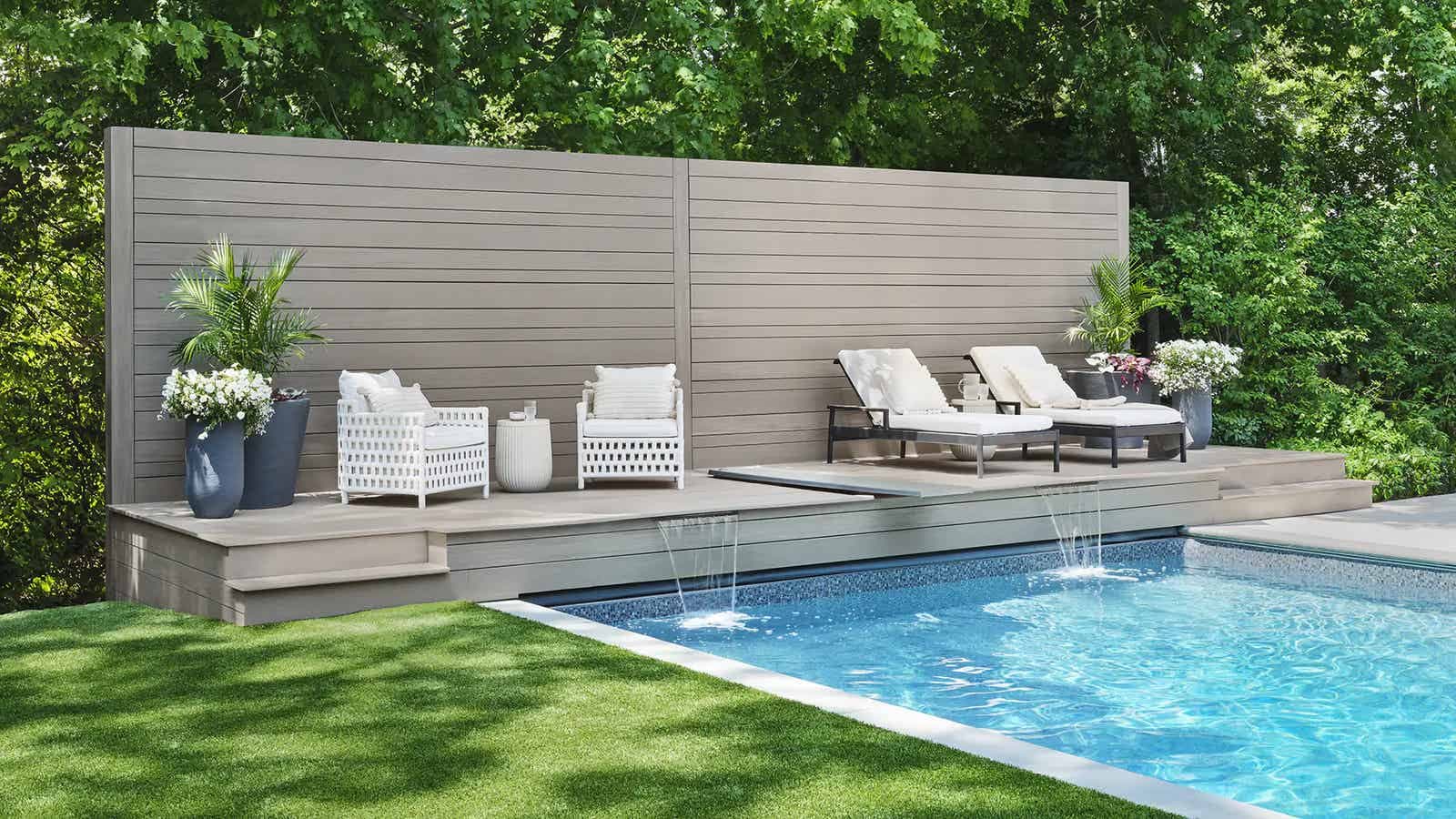
Why PVC Decking for Pool Terraces?
PVC decking is designed to perform in environments where moisture is a constant factor. Its 100% synthetic composition means it is waterproof to the core, distinguishing it from traditional wood or wood-composite options. This makes it a strong candidate for pool surrounds, docks, and other applications where boards are frequently wet.
The absence of wood fiber eliminates concerns about swelling, staining, or rot that can affect other materials when exposed to water, salt spray, or chlorine. This inherent resistance contributes to the material's long-term performance and appearance around a pool, offering a low-maintenance surface that sheds water and cleans easily with soap and water.
Additionally, PVC decking can be significantly lighter than hardwood or composite options, which can simplify handling during installation and be advantageous for certain structural considerations.
Considering Poolside Exposure in Atlantic City
The coastal environment of Atlantic City, NJ, presents specific conditions for outdoor materials. High humidity, salt air, and strong sun exposure are common, adding to the demands placed on a pool terrace. PVC decking's resistance to moisture and salt spray aligns well with these regional factors.
While PVC is durable, prolonged exposure to intense sun can still influence surface temperature. Some PVC decking lines offer heat-mitigating color options, which can be a consideration for comfort underfoot, especially in direct sunlight during peak summer months. It is advisable to review specific product documentation for details on heat performance and color retention.
Material Selection: Collections and Appearance
PVC decking is available in various collections, offering different aesthetic profiles. For example, lines like TimberTech Azek's Vintage, Landmark, and Harvest collections provide a range of wood-look finishes with advanced capping. These options allow homeowners to achieve a desired aesthetic, from deep, rich wood tones to lighter, more contemporary shades, without the maintenance demands of natural wood.
When selecting, consider how the decking's color and texture will complement your home's exterior and the surrounding landscape. The appearance of the boards, including their grain patterns and color variations, can significantly impact the overall feel of your pool area.
Planning for Drainage and Edges
Proper drainage is essential for any pool terrace to prevent water from pooling and to manage runoff effectively. While PVC decking is waterproof, ensuring water can drain away from the deck surface and foundation is crucial for the longevity of the entire structure. This involves careful planning of the sub-structure's slope and any surrounding landscaping.
For the edges of your pool terrace, consider coordinating fascia and trim boards to create a finished look. These elements not only enhance the aesthetic but also protect the deck's perimeter. Ensure that any chosen edge profiles are compatible with your selected PVC decking boards and meet any specific requirements for poolside applications.
Hypothetical Project Example: Atlantic City Pool Terrace
Consider a hypothetical pool terrace project for a home in Atlantic City, NJ. The homeowner wants to replace an existing concrete slab around an 18-foot by 36-foot rectangular in-ground pool with a new PVC deck. The desired deck area will extend 6 feet out from all sides of the pool.
First, calculate the total area: The pool dimensions are 18' x 36'. Adding 6' to each side means the new deck perimeter will be (18+6+6) = 30' wide and (36+6+6) = 48' long. The total footprint of the deck is 30' x 48' = 1440 square feet. The pool opening itself is 18' x 36' = 648 square feet. Therefore, the actual decking surface area required is 1440 - 648 = 792 square feet.
If using standard PVC decking boards that are nominally 5.5 inches wide and available in 12, 16, and 20-foot lengths, a material takeoff would involve determining the most efficient lengths to minimize waste, considering the layout and any picture-framing or border details. For instance, if running boards parallel to the long side of the pool (48 feet), 16-foot and 20-foot boards would be cut to fit, requiring careful calculation of cuts and potential offcut reuse. For a 48-foot run, three 16-foot boards end-to-end would cover 48 feet. For a 6-foot wide section, approximately 13 boards (72 inches / 5.5 inches per board) would be needed per 6-foot strip. This calculation would be repeated for each section of the perimeter, accounting for cuts around the pool edge and any desired design elements. Always factor in extra material for cuts and waste, typically 5-10%.
Before you order
- Confirm the exact dimensions of your pool and the desired deck perimeter.
- Evaluate available PVC decking collections for color, finish, and heat-mitigating properties.
- Plan for proper drainage away from the deck and pool foundation.
- Select compatible fascia and trim boards for a cohesive edge finish.
- Consider the structural requirements for the deck's substructure, especially if replacing a different material.
- Review manufacturer installation guidelines for recommended gapping and fastening methods.
- Account for any specific maintenance requirements for your chosen PVC decking product.
Confirm installation details, approved uses and warranty terms in the current instructions for the exact product and profile. Your installer should verify the substrate, structure and applicable project requirements.
This is a planning guide for projects in Atlantic City, NJ. Ask our team to confirm availability, delivery to your ZIP code and which branch can support your order.
Questions to help you decide
Is PVC decking slippery when wet around a pool?
However, any surface can become slippery when wet, especially with pool chemicals or organic debris. Regular cleaning and good drainage can help maintain traction. Always exercise caution on wet surfaces.
How do I clean PVC decking around a pool?
PVC decking is typically easy to clean. For general maintenance, a broom or leaf blower can remove loose debris. For spills or more stubborn dirt, soap and water are often sufficient. It is important to refer to the specific manufacturer's cleaning guidelines for your chosen product, as some cleaning agents may not be compatible. Avoid abrasive cleaners or pressure washers set to high pressure, as these can damage the surface.
Can PVC decking be installed directly over an existing concrete slab?
Installing PVC decking directly over an existing concrete slab typically requires a properly constructed substructure (joists) to allow for drainage and ventilation beneath the deck boards. This prevents moisture buildup and ensures the deck remains stable and properly supported. Direct installation without a substructure is generally not recommended and can void warranties. Always consult manufacturer guidelines and local building codes for proper installation methods over existing surfaces.
Ready to Plan Your Atlantic City Pool Terrace?
Request a material quote for PVC decking. Provide your project dimensions, desired profile, and ZIP code to confirm current availability and service options for your Atlantic City, NJ project.
Request a material quote →