Understanding Why Wood Moves
Wood is a hygroscopic material, meaning it absorbs and releases moisture from its surrounding environment. As humidity increases, wood absorbs moisture and swells; as humidity decreases, it releases moisture and shrinks. This process is continuous and affects all solid wood, including live edge slabs.
The direction of movement is not uniform. Wood moves significantly more across its grain (tangentially and radially) than along its grain (longitudinally). For a typical live edge tabletop, this means the slab will primarily expand and contract in its width, with minimal change in length. Understanding this differential movement is fundamental to designing a table that can withstand environmental changes.
Impact of Wood Movement on Table Design
When a live edge slab is rigidly attached to a table base or frame without accounting for movement, the internal stresses can become immense. If the slab tries to shrink but is held fast, it can crack. If it tries to expand but is constrained, it can buckle or warp, or even cause the fasteners to fail or pull out.
The most common issues arise when a wide slab is attached to a static base. A 30-inch wide slab of a common hardwood, for example, might change its width by up to 1/8 to 1/4 inch or more across seasonal humidity cycles. This seemingly small amount can exert thousands of pounds of force if restricted, leading to structural damage in the table or the slab itself.
Essential Fastening Methods for Tabletops
The primary goal of fastening a live edge slab to its base is to secure it firmly while allowing for cross-grain movement. Several methods achieve this, each with its own advantages:
Z-Clips (Tabletop Fasteners): These metal clips are routed into a groove on the underside of the tabletop and screwed into the apron or base. They allow the slab to expand and contract freely while keeping it securely attached. Z-clips are a popular choice for their simplicity and effectiveness.
Figure-Eight Fasteners: Similar to Z-clips, these small metal plates are routed into the underside of the slab and screwed into the base. Their unique shape allows for rotational movement, accommodating expansion and contraction.
Slotted Screw Holes: For more direct attachment, elongated or slotted holes can be drilled in the table base or apron where screws will pass through to secure the slab. The screws are then tightened just enough to hold the slab, allowing it to slide within the slots as it moves. This method is common for attaching wide tops to cross-members.
Wooden Buttons (Tabletop Buttons): These are small blocks of wood, often with an elongated slot, that are screwed to the underside of the slab and fit into corresponding dadoes or grooves in the apron. They offer a traditional, elegant solution that allows for movement.
Batten Systems: For very wide or particularly unstable slabs, a batten system can be employed. Battens are cross-members (often metal or sturdy wood) attached to the underside of the slab, often in routed grooves, using fasteners that allow for movement. The battens themselves help keep the slab flat while still allowing for width changes.
Choosing the Right Joinery for Legs and Bases
While fastening the top is crucial, the joinery used for the table legs and base also plays a role in overall stability. Mortise and tenon joints, dowel joints, or robust bolted connections are generally preferred over simple butt joints and screws, especially for heavy live edge slabs. These stronger joints distribute stress more effectively and are less likely to loosen over time due to any subtle movements or forces from the top.
Consider the overall design and weight of the slab. A very heavy, thick slab may benefit from a more substantial base and joinery to ensure long-term stability. The species of wood also influences its density and potential for movement; a dense hardwood like Cumaru or Ipe might exert more force than a lighter wood like Cedar if movement is restricted.
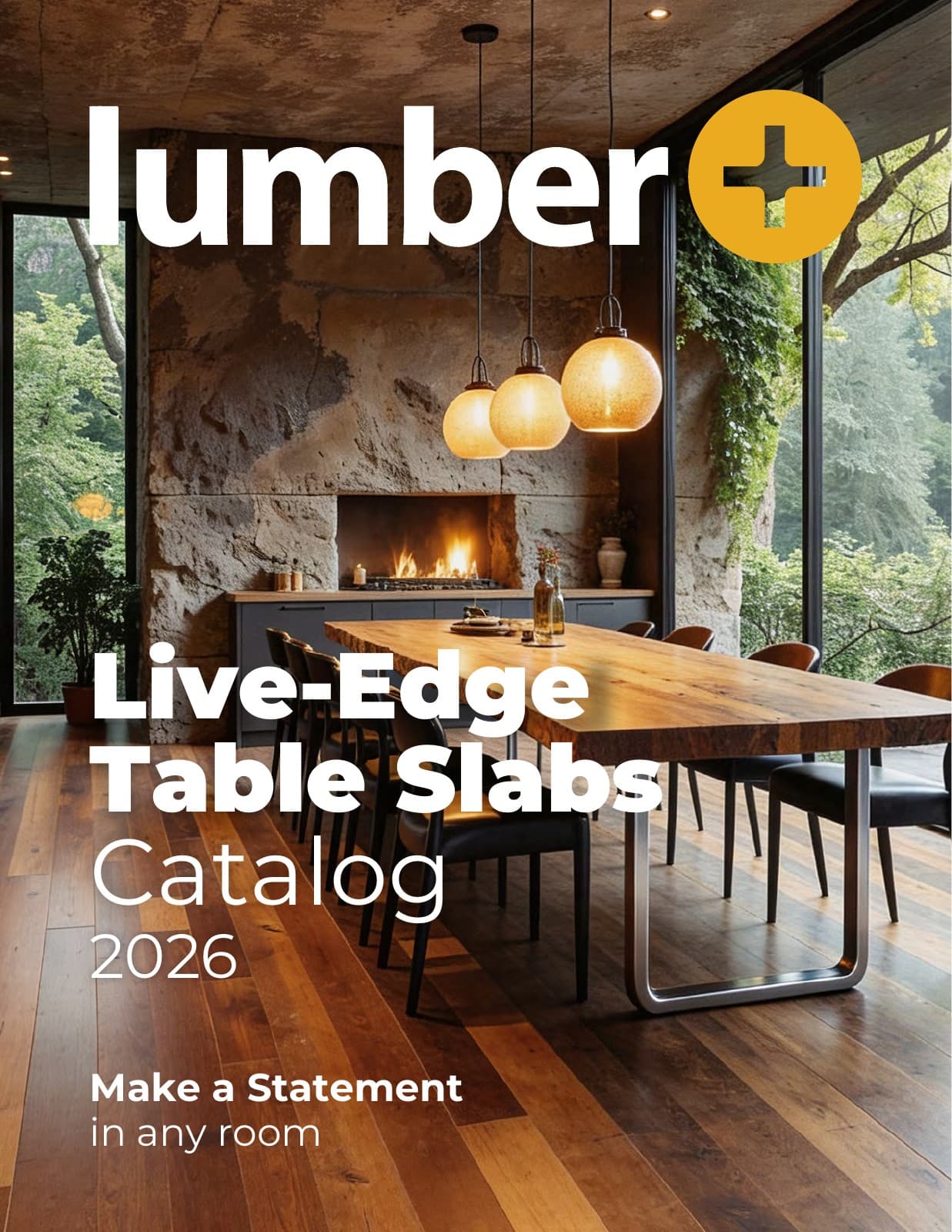
For species information and typical dimensions, refer to the Lumber Plus live-edge slab catalog. (<a href="/downloads/lumber-plus-2026-live-edge-slab-catalog.pdf">2026 Live-Edge Slab Catalog</a>)
A Hypothetical Example: Dining Table Design
Let's consider a dining table with a live edge slab measuring 96 inches long by 40 inches wide, and 2 inches thick. The base will consist of two trestle-style legs connected by a stretcher. We need to attach this slab securely while allowing for movement.
The primary movement will be across the 40-inch width. Assuming a potential expansion/contraction of 1/8 inch to 1/4 inch across this width over a year, our fastening system must accommodate this. We could use Z-clips along the inside edges of the trestle top rails. For a 96-inch long slab, we might space Z-clips every 12-16 inches along both long sides of the trestle top rails, using approximately 12-16 clips in total. The clips would be inserted into a routed slot on the underside of the slab, allowing the slab to slide horizontally while remaining firmly attached vertically. This distributes the holding force and permits the necessary movement.
Alternatively, if the trestle top rails are wide enough, slotted screw holes could be used. Drilled perpendicular to the grain of the slab, these slots would allow wood screws to hold the slab down while permitting it to slide along the length of the slot. This requires precise alignment and careful tightening to avoid over-constraining the slab.
Before you order
- Identify the primary direction of wood movement for your slab (typically across the width).
- Choose a fastening method that allows for cross-grain movement (e.g., Z-clips, figure-eight fasteners, slotted holes, wooden buttons).
- Ensure the chosen fasteners are appropriate for the slab's weight and thickness.
- Plan the spacing and number of fasteners to distribute holding power evenly.
- Select robust joinery for the table base (e.g., mortise and tenon, dowel joints, bolted connections).
- Consider the environmental conditions where the table will be placed (humidity levels).
- Account for the specific species of wood and its known movement characteristics (consult the Lumber Plus catalog for details).
- Allow for minor gaps between the tabletop and any fixed elements of the base if direct contact is unavoidable, to provide room for expansion.
Confirm installation details, approved uses and warranty terms in the current instructions for the exact product and profile. Your installer should verify the substrate, structure and applicable project requirements.
Questions to help you decide
Does wood movement ever stop?
No, wood movement is a continuous process as long as the wood is exposed to changes in humidity. While kiln-drying reduces the initial moisture content and stabilizes the wood, it does not eliminate its hygroscopic nature. A finished table will still experience seasonal expansion and contraction, though the finish can slow down the rate of moisture exchange.
Can I prevent wood movement with a sealant or finish?
Sealants and finishes can slow down the rate at which wood absorbs and releases moisture, making the movement less dramatic and more gradual. However, no finish completely stops wood movement. It's crucial to finish all surfaces of the slab (top, bottom, and edges) evenly to help minimize differential movement and potential warping. An uneven finish can lead to one side absorbing or releasing moisture faster than the other, causing stress.
What if my live edge slab has existing cracks?
Existing cracks, especially those that run with the grain, can be managed. If they are stable and not progressing, they can be filled with epoxy or left as part of the natural character. However, if a crack is deep and appears to be expanding, it indicates significant stress or ongoing movement. In such cases, discuss the slab's stability with your woodworker or supplier. Proper fastening to allow for overall slab movement is still essential, as restricting the movement of the wider slab can exacerbate stress on existing cracks.
Plan Your Live Edge Project
Request a material quote for your live edge slab project. Provide your desired dimensions, preferred profile (e.g., single slab, bookmatched), and your ZIP code to confirm current availability and service options. Our team can help you select the right slab for your design.
Request a material quote →