Why Moisture Content Matters for Live Edge Slabs
Wood is a hygroscopic material, meaning it naturally absorbs and releases moisture from its surrounding environment. When a tree is felled, it contains a high percentage of water. This water must be carefully removed through a drying process, typically air-drying followed by kiln-drying, to stabilize the wood for interior use.
If a live edge slab is installed in an environment with a significantly different humidity level than its moisture content, it will attempt to reach equilibrium with its new surroundings. This process of gaining or losing moisture causes the wood to expand or contract, leading to movement. For a finished piece of furniture, this movement can manifest as checks, cracks, cupping, or warping, compromising both its appearance and structural integrity.
Understanding and verifying the moisture content helps predict how a slab will behave in your home or office, ensuring a more stable and durable final product.
Target Moisture Content for Indoor Applications
For most indoor furniture and countertop applications in a typical climate-controlled home or office, the ideal moisture content for a live edge slab generally falls within a specific range. This range is designed to be in equilibrium with the average indoor relative humidity.
In many US regions, interior relative humidity fluctuates, but a common average for conditioned spaces is around 30% to 50%. Slabs intended for these applications should ideally be kiln-dried to this range to minimize post-installation movement.
For outdoor applications or unconditioned spaces, a higher moisture content might be acceptable, often aligning with local ambient conditions. However, live edge slabs are frequently chosen for interior focal pieces, making the 6-8% range a crucial target for stability.
Reading Moisture Content Data and What to Ask
When evaluating a live edge slab, always request its measured moisture content. Reputable suppliers should be able to provide this information, often taken at the time of sale or recent inventory check. Here’s what to ask and consider:
2. **When was the MC last measured?** Recent measurements are more reliable. If a slab has been stored for an extended period, especially in an uncontrolled environment, its MC might have changed.
3. **What drying method was used?** Kiln-drying is generally preferred for interior-grade live edge slabs as it provides more uniform and stable moisture removal compared to air-drying alone.
4. **What are the expected environmental conditions for the finished piece?** Be prepared to describe the typical temperature and humidity of the room where the slab will be installed. This helps confirm if the slab's MC is appropriate.
5. **Are there any specific recommendations for acclimation?** Even with proper MC, allowing the slab to acclimate in its final environment for a period (e.g., 1-2 weeks) before fabrication can further reduce stress and movement.
A Hypothetical Scenario: The Dining Table Project
Consider a project to create a dining table from a live edge slab for a home in a climate-controlled environment. The desired finished dimensions for the tabletop are approximately 96 inches long by 42 inches wide.
You browse the available inventory and find a beautiful Black Walnut slab, 100 inches long, with a variable width of 40-44 inches, and 2.5 inches thick. Before committing, you ask about its moisture content. The supplier provides a recent reading of 7.2% MC, stating it was kiln-dried and has been stored indoors in their climate-controlled warehouse.
This 7.2% MC falls squarely within the recommended 6-8% range for indoor furniture. Given the slab's species (Black Walnut is generally stable), thickness, and measured MC, it is a strong candidate for your dining table. You would still plan to acclimate it in your home for a week or two before beginning the finishing process. This due diligence regarding moisture content helps ensure the slab will remain stable and beautiful as a dining table for years to come.
Beyond Moisture: Complementary Considerations
While moisture content is paramount, it's part of a larger picture when selecting a live edge slab. Always review current photos, checks, voids, and other natural characteristics of the specific slab you are considering.
Confirm the species and its expected color or grain behavior, as this can influence the aesthetic of your finished piece. Understanding the minimum and maximum width of the slab is also crucial, as live edge dimensions can be irregular.
For your project planning, consider related products such as structural adhesives for any necessary repairs or joinery, appropriate finishes like oils or polyurethanes to protect the wood, and suitable table bases that complement the slab's size and weight. Lumber Plus offers a variety of [wood finishes](/wood-finishes) and [table bases](/table-bases) that can pair well with live edge slabs.
If your project requires joining multiple slabs, such as for a wider conference table, understanding the moisture content of each individual slab becomes even more critical for a stable glue-up. Explore our [selection of hardwood lumber](/hardwood-lumber) for joining or complementary pieces.
Before you order
- Confirm the specific live edge slab's measured moisture content (MC).
- Verify when the MC measurement was last taken.
- Ask about the drying method used (e.g., kiln-dried, air-dried).
- Describe your intended indoor environment's typical humidity and temperature.
- Ensure the slab's MC is within the recommended 6-8% range for indoor use.
- Inquire about any recommended acclimation period before fabrication.
- Review current photos and physical characteristics of the slab.
- Confirm species, dimensions, and natural features.
- Plan for necessary tools, adhesives, and finishes for your project.
Confirm installation details, approved uses and warranty terms in the current instructions for the exact product and profile. Your installer should verify the substrate, structure and applicable project requirements.
Questions to help you decide
What happens if a live edge slab has too much moisture?
If a live edge slab has too much moisture (e.g., over 10-12% for indoor use) and is brought into a drier indoor environment, it will lose moisture rapidly. This can lead to significant shrinkage, causing the slab to crack, warp, cup, or check, especially along the edges and ends. This movement can compromise the stability and appearance of your finished piece.
Can I use an air-dried live edge slab for indoor furniture?
While air-dried slabs can be beautiful, they typically retain a higher and less consistent moisture content compared to kiln-dried slabs. For indoor furniture or countertops in climate-controlled spaces, a kiln-dried slab with a verified MC of 6-8% is generally recommended for superior stability. If considering an air-dried slab, ensure it has been air-dried for an extended period and ideally allowed to acclimate indoors for many months before fabrication, with its MC checked regularly.
How long should a live edge slab acclimate before I start working on it?
Even a properly kiln-dried slab can benefit from an acclimation period. A general recommendation is to allow the slab to sit in the specific room where the finished piece will reside for at least 1 to 2 weeks (or longer for very large or thick slabs) before beginning any cutting, shaping, or finishing. This allows the wood to slowly adjust to the ambient temperature and humidity of its final environment, further reducing the risk of movement after fabrication.
Ready to Select Your Live Edge Slab?
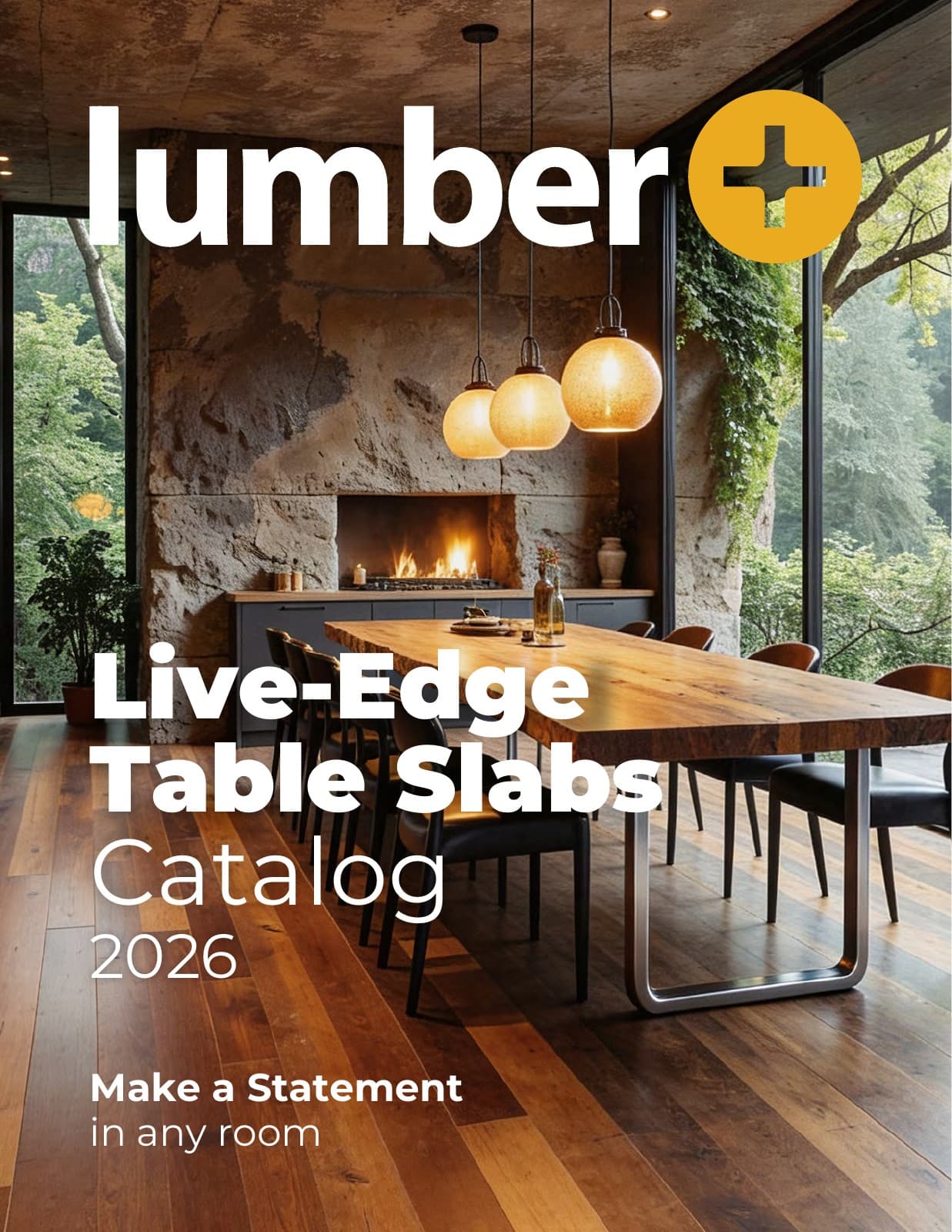
Request the current Lumber Plus live-edge slab catalog and speak with our team about available species, dimensions, and individual slab details. To get a material quote, please provide your project dimensions, exact profile preferences, and ZIP code. We can also confirm current availability and service options for your area.
Request a material quote →