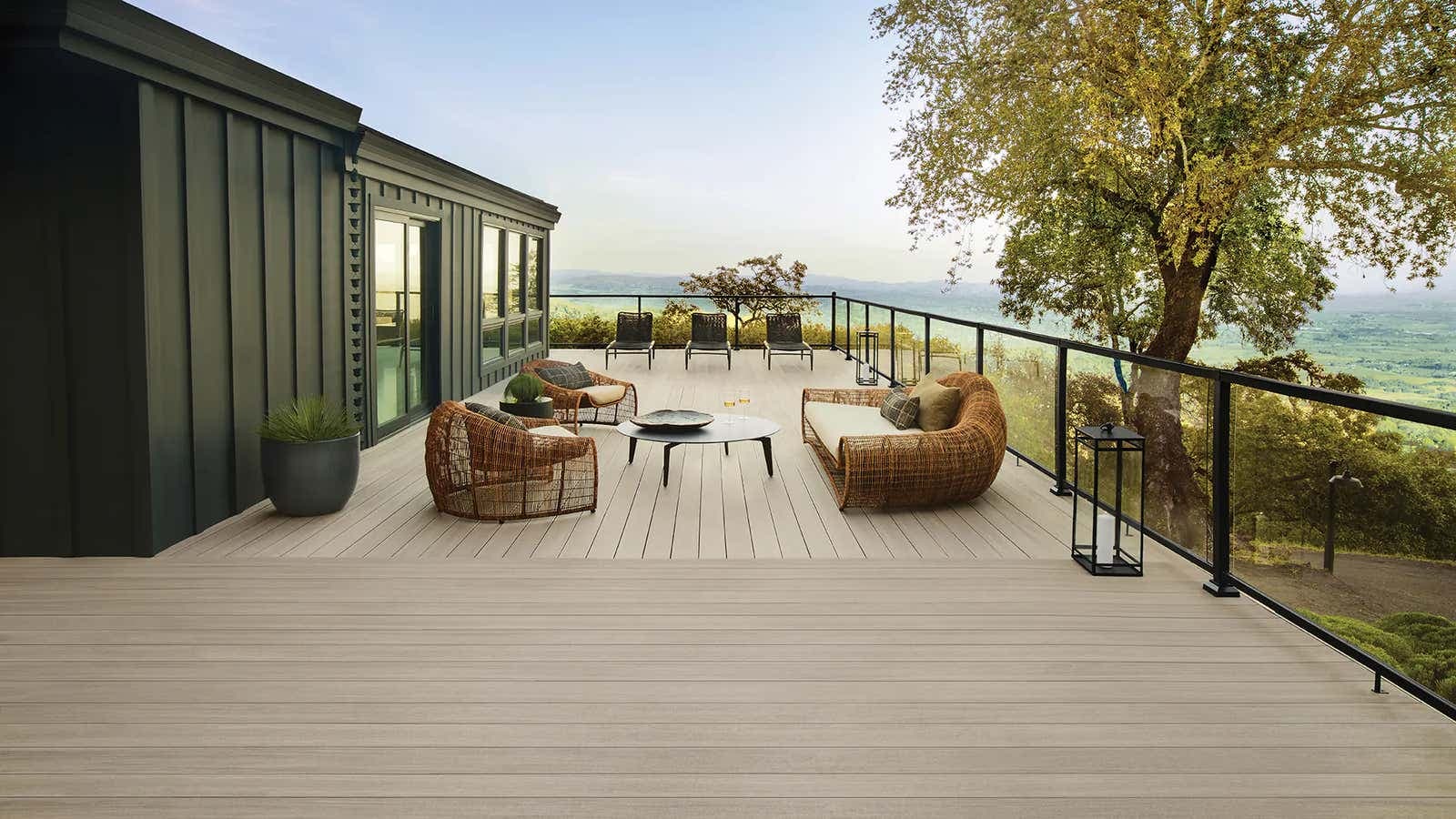
Understanding Composite Decking for Small Areas
Composite decking, typically made from a blend of recycled wood fibers and plastic, provides a consistent and low-maintenance surface that can be particularly advantageous in smaller outdoor areas. Unlike natural wood, composite boards offer uniform color and grain, which can contribute to a cleaner, more expansive feel in limited spaces. The material's resistance to rot, splinters, and insect damage means less upkeep, allowing you to enjoy your compact deck without extensive seasonal tasks.
Brands like Trex, TimberTech, and Fiberon offer various collections with different finishes, colors, and board profiles. For a compact space, considering lighter colors can help reflect light and make the area appear larger, while darker tones can create a cozier, more intimate atmosphere. The choice of board width can also impact the visual flow; narrower boards might create a sense of length, while wider boards can make a small area feel more substantial. Many composite options are designed to be cooler underfoot, a benefit for sun-exposed compact decks.
Maximizing Usable Space with Layout and Design
In compact outdoor areas, the decking layout plays a significant role in how functional and spacious the area feels. Straight board layouts running perpendicular to the house can visually extend the space. Alternatively, diagonal layouts can add visual interest and a sense of depth, diverting the eye across the deck rather than directly to its edges. For very small or irregularly shaped areas, consider how the board direction can define different zones, even if they are only large enough for a single chair or a small plant.
Picture-frame borders can also be effective in compact designs, creating a defined edge that frames the main decking area. This can add a finished look and help delineate the deck from surrounding landscaping or structures. When planning, account for necessary board spacing as specified by the manufacturer to ensure proper drainage and material movement. This small detail is important for the longevity and appearance of your deck.
Choosing the Right Board Profile and Fasteners
Composite decking comes in different profiles, including solid and scalloped (hollow or partially hollow) boards. For compact spaces, the choice of profile might be less about structural load (assuming a properly constructed subframe) and more about aesthetics and weight, particularly for elevated decks or balconies with weight restrictions. Solid boards offer a more substantial feel, while scalloped boards can be lighter.
Hidden fastening systems are often a preferred choice for composite decking, especially in smaller areas where a seamless surface can enhance the perception of space and cleanliness. These systems secure the boards from the side, leaving the deck surface free of visible screws. Face-fastening, using color-matched screws, is another option, though the visible fasteners can sometimes detract from a minimalist aesthetic. Always confirm fastener compatibility with your chosen decking product.
Integrating with Existing Structures and Landscaping
For a compact outdoor space, the deck often needs to integrate seamlessly with existing elements such as house walls, paving, or landscaping. Consider how the deck height will transition to adjacent surfaces. A flush transition can create a continuous flow, making the entire area feel larger. If the deck is elevated, planning for steps that are proportional to the space is important – overly wide or deep steps can quickly consume valuable square footage.
Fascia and edge finishes are critical for a polished look, especially where the deck edge is visible. Coordinating these trim pieces with the main decking color or choosing a contrasting shade can enhance the design. Think about how planters, built-in seating, or small water features might be incorporated without overcrowding the space, using the deck as a foundation for these elements.
Hypothetical Project Example: A 10x8 Foot Urban Patio Deck
Imagine a compact 10-foot by 8-foot urban patio space that needs a new deck. To maximize the feeling of openness and create distinct zones for a small bistro table and two chairs, we select a light-colored composite decking from the Trex Enhance® Naturals collection, in 'Coastal Bluff' (a light tan shade).
The deck will be laid with boards running along the 10-foot length, visually extending the patio away from the house. For an 8-foot width, this means 8-foot long boards. If boards are 5.5 inches wide, approximately 17-18 boards would be needed for the main deck area (8 feet / 5.5 inches = 17.45 boards). Given the typical 12-foot or 16-foot board lengths available, we would purchase 10-foot boards to avoid excessive waste and minimize seams. For a 10-foot by 8-foot area, we would calculate 10 feet / (5.5 inches / 12 inches/foot) = 21.8 boards. Rounding up, we would need 22 boards of 8-foot length for the main decking. If we opted for 12-foot length boards to minimize cuts for the 10-foot run, we would need 12-foot boards. We would then cut 2 feet off each for the 8-foot width. This would require 10 feet / (5.5 inches / 12 inches/foot) = 21.8 boards, so 22 boards of 12-foot length. The offcuts from the 12-foot boards could be used for a picture frame border if desired. A hidden fastening system would be used for a clean surface.
For a clean edge, we would add fascia boards around the perimeter. If the deck is slightly raised, a single step, no wider than necessary, would be incorporated. This careful planning ensures that the small patio feels larger, more functional, and visually appealing without being cluttered.
Before you order
- Consider the overall size and shape of your compact outdoor space.
- Evaluate composite decking options for color, finish, and board profile.
- Determine the optimal board layout (straight, diagonal) to enhance the sense of space.
- Plan for hidden fasteners to create a seamless deck surface.
- Decide on fascia and trim details for a finished look.
- Account for transitions to adjacent structures and landscaping.
- Consider the impact of furniture and planters on available deck space.
Confirm installation details, approved uses and warranty terms in the current instructions for the exact product and profile. Your installer should verify the substrate, structure and applicable project requirements.
This is a planning guide for projects in Harrisburg, PA. Ask our team to confirm availability, delivery to your ZIP code and which branch can support your order.
Questions to help you decide
Can composite decking be installed directly over concrete for a patio?
While composite decking generally requires a supportive subframe for proper ventilation and drainage, specific systems like decking tiles or low-profile joists might allow for installation over a concrete patio. It's crucial to consult the manufacturer's installation guidelines for the specific product you choose to ensure proper assembly, ventilation, and drainage.
What colors work best for making a small deck feel larger?
Lighter colors tend to reflect more light, which can make a compact space feel more open and expansive. White, light gray, and lighter tan shades are often good choices. However, darker colors can create a sophisticated and cozy atmosphere, which might be desirable for a more intimate setting. Consider the overall aesthetic of your home and the amount of sunlight the deck receives.
How do I maintain composite decking in a small space?
Composite decking is known for its low maintenance. Typically, an annual wash with soap and water is sufficient to keep it clean. For compact spaces, this simplicity is a significant advantage, as you won't need to dedicate extensive time or effort to staining or sealing. Always refer to the manufacturer's specific cleaning recommendations for your chosen product to avoid damage and maintain any warranties.
Plan Your Compact Composite Decking Project
Ready to transform your small outdoor area? Request a material quote today. Provide your project dimensions, desired composite decking profile, and project ZIP code to confirm current availability and service options. Visit our decking page at /decking/composite to explore options from Trex, TimberTech, and Fiberon, and complementary products like /decking, /decking/hardwood, /decking/hardwood/ipe, and /decking/pvc.
Request a material quote →