Understanding Buffalo's Climate for Porch Ceilings
Buffalo's climate presents distinct challenges and opportunities for outdoor building materials. With cold, snowy winters and humid summers, materials used for porch ceilings and soffits need to be able to resist moisture, temperature fluctuations, and potential freeze-thaw cycles. Selecting materials that are dimensionally stable and resistant to decay is a key consideration for longevity.
The prevailing weather patterns also influence material finish and maintenance. While a natural wood finish can be beautiful, it may require more frequent attention in a climate with significant seasonal changes compared to a pre-finished or composite option. Ventilation is also critical, especially for soffits, to prevent moisture buildup in the roof structure.
Popular Material Options for Porch Ceilings
Several material categories offer distinct advantages for porch ceilings and soffits. Each type brings a unique look, performance characteristic, and maintenance profile.
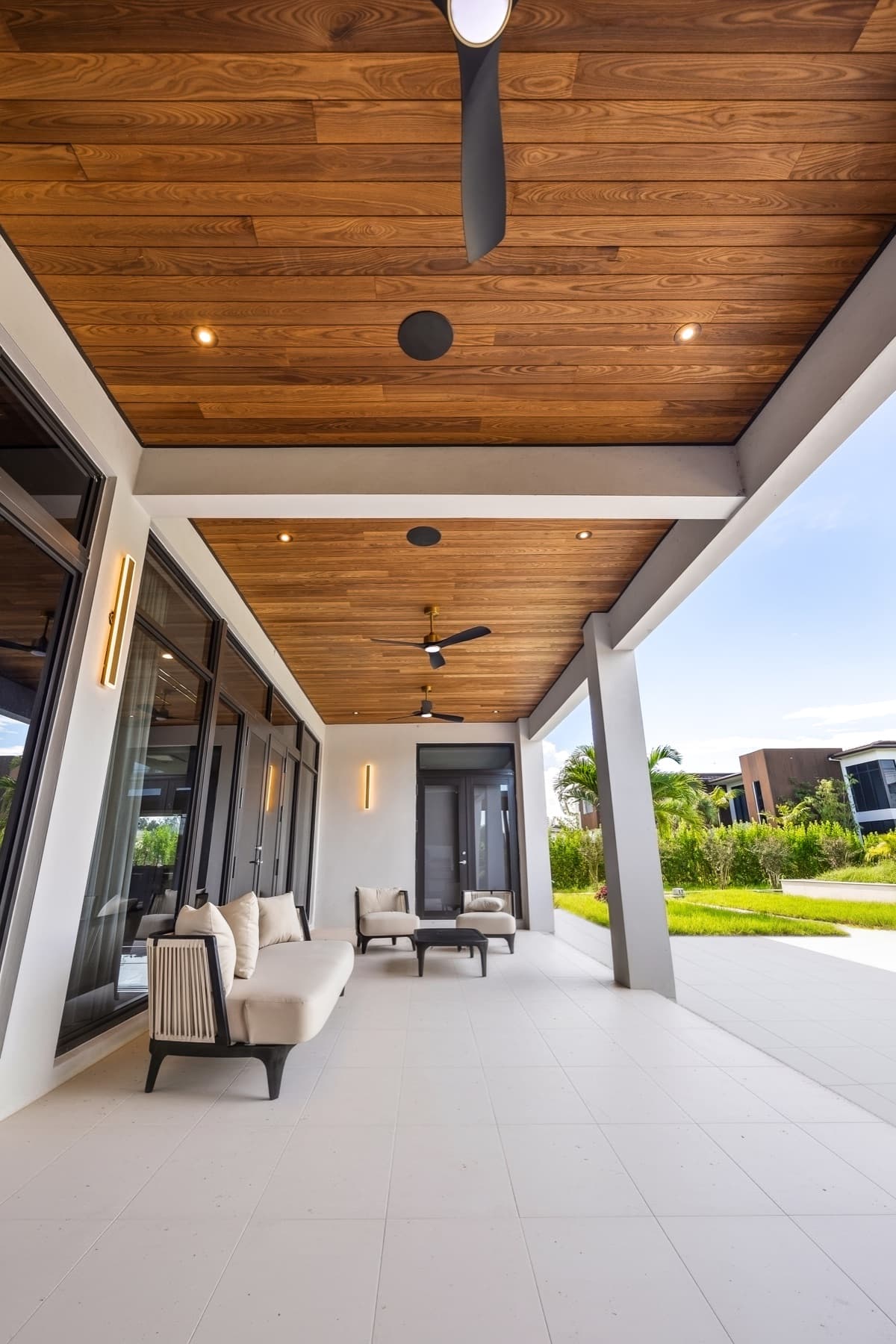
Thermally Modified Wood: This wood undergoes a heat treatment process that enhances its stability and resistance to moisture and decay. Species like thermally modified Ayous or Ash offer a natural wood appearance with improved durability, making them suitable for exposed outdoor applications. They tend to be lighter in weight than some hardwoods. (S1)
Hardwood Options: Brazilian hardwoods such as Ipe, Cumaru, and Garapa are known for their natural density and resistance to insects and rot. They offer rich, deep colors and can provide a luxurious aesthetic. However, their weight and density can influence installation considerations. (S1)
Composite Materials: Norx composite ceiling and soffit boards offer a low-maintenance alternative, often available in various colors and finishes, including those mimicking natural wood. These materials are engineered for consistency and resistance to environmental factors, which can be a significant advantage in areas with challenging weather. (S1)
Accoya: This acetylated wood product offers enhanced durability and stability through a modification process. It provides a natural wood look with performance benefits, suitable for applications where resistance to rot and insect attack is important. (S1)
Coordinating Proportions and Aesthetics
The size and style of your porch should guide your material selection. A grand, traditional porch might benefit from the classic appeal of a wide-plank hardwood, while a modern entryway could be complemented by the clean lines of a thermally modified wood or a sleek composite. Consider the existing architectural elements of your Buffalo home, such as siding, trim, and roofing, to ensure a cohesive look.
The depth of the porch and the height of the ceiling also play a role. Lighter-colored materials can help brighten a deeper porch, while darker tones can create a more intimate feel on a spacious one. The direction of the ceiling boards can also influence the perceived length or width of the space.
Integrating Lighting and Ventilation
Proper lighting and ventilation are essential for any porch ceiling. For ventilation, soffit panels often include perforations or are designed to work with continuous vents to allow air circulation into the attic space, which is critical for roof health, especially in Buffalo's climate. Ensure that any ceiling material chosen can accommodate necessary ventilation components without compromising structural integrity or aesthetic.
For lighting, recessed fixtures are a popular choice for porch ceilings, providing ambient light without obstructing the space. When selecting materials, verify that they are compatible with the planned lighting fixtures, including considerations for heat dissipation and ease of installation. Always consult with a qualified electrician for wiring and fixture installation.
Hypothetical Project Example: A 10' x 8' Porch Ceiling
Consider a hypothetical Buffalo home with a front porch measuring 10 feet wide by 8 feet deep. The homeowner desires a natural wood look that is durable and relatively low maintenance. They are considering thermally modified Ayous in a 1x6 (nominal) profile, which typically measures about 5.125 inches wide for coverage. The porch ceiling is flat and will have two recessed light fixtures.
To calculate the material needed for the 10' x 8' (80 sq ft) ceiling: The 8-foot depth requires boards cut to length. The 10-foot width will determine the number of boards. A 1x6 nominal board has 5.125 inches of coverage. Ten feet is 120 inches. Dividing 120 inches by 5.125 inches/board gives approximately 23.4 boards. To ensure full coverage and account for potential cuts and waste, purchasing 24 boards of 8-foot length would be a reasonable starting point. This provides 24 x 8 = 192 linear feet of material. It is always recommended to add 10-15% for waste and cuts. For the two recessed lights, specific cutouts will need to be made in the boards during installation. This example assumes standard installation with appropriate framing and fasteners. Final quantities should always be confirmed with a detailed take-off plan.
This approach balances the desire for natural aesthetics with the need for materials that perform well in Buffalo's varied weather, while accounting for practical installation needs.
Before you order
- Assess your porch's exposure to sun, rain, and snow.
- Consider the existing architectural style of your home.
- Determine your preference for natural wood aesthetics versus low-maintenance composites.
- Plan for integrated lighting and ventilation requirements.
- Review material specifications for dimensional stability and weather resistance.
- Factor in the weight of the material and its impact on installation and support structure.
- Estimate quantities with a waste factor (typically 10-15%).
Confirm installation details, approved uses and warranty terms in the current instructions for the exact product and profile. Your installer should verify the substrate, structure and applicable project requirements.
This is a planning guide for projects in Buffalo, NY. Ask our team to confirm availability, delivery to your ZIP code and which branch can support your order.
Questions to help you decide
What is the best material for a porch ceiling in Buffalo's winter?
Materials that offer high dimensional stability and resistance to moisture and decay are ideal for Buffalo's winters. Thermally modified wood and composite materials like Norx are good choices as they are engineered to withstand temperature fluctuations and humidity without significant warping or rotting. Hardwoods like Ipe also offer excellent natural durability.
Do I need to ventilate my porch ceiling?
If your porch ceiling is also the soffit for your main roof structure, ventilation is crucial. Proper soffit ventilation allows air to circulate, preventing moisture buildup in the attic and helping to regulate roof temperatures. Even for non-attic spaces, good air circulation can help extend the life of the ceiling material by reducing humidity.
How do I maintain a wood porch ceiling?
Maintenance depends on the type of wood and desired finish. Natural hardwoods may be allowed to weather to a silver-gray patina or can be periodically cleaned and re-oiled to maintain their original color. Thermally modified woods often require less maintenance than untreated wood but can also benefit from occasional cleaning and sealing. Composite materials generally require only periodic cleaning with soap and water.
Ready to Plan Your Porch Ceiling Project?
For a material quote tailored to your project dimensions, exact profile preferences, and ZIP code, please contact us. We can help confirm current availability and service options for your Buffalo, NY project.
Request a material quote →