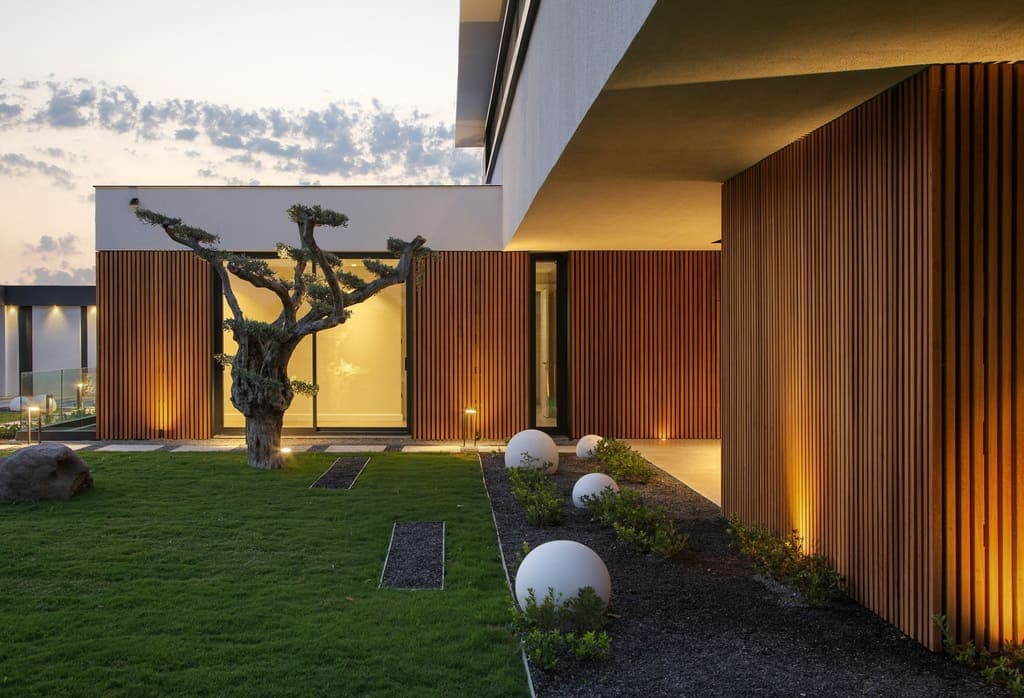
Understanding Thermally Modified Wood for Wall Applications
Thermally modified wood undergoes a process of heat and steam treatment that alters its cellular structure. This process aims to reduce the wood's ability to absorb moisture and enhance its dimensional stability. For covered patio walls, where direct rainfall and harsh UV exposure are mitigated, these properties contribute to a material that is less prone to warping, cupping, or swelling compared to untreated wood.
While thermally modified wood is known for its improved stability, it is important to note that it is still a natural wood product. Its suitability for wall applications depends on selecting appropriate profiles and ensuring proper installation that accounts for environmental factors, even in a covered setting. The inherent color of thermally modified wood often develops a rich, darker tone, which can be maintained with a finish or allowed to gradually weather to a silver-gray patina if left unfinished.
Selecting the Right Profile for Covered Patio Walls
The profile of the thermally modified wood plays a key role in both the appearance and the installation of your covered patio walls. Common profiles include tongue and groove, shiplap, and various channel or board-on-board designs. For covered patio walls, a tongue and groove profile can create a tight, seamless appearance, while shiplap offers a more defined shadow line. Channel profiles can provide a modern, open-joint look, but may require a backing material for a finished aesthetic.
Consider the desired visual effect and the level of protection needed. For example, if the covered patio is still susceptible to wind-driven rain from certain directions, a profile that offers better overlap or a tighter fit might be preferable. Conversely, if the wall is well-protected and ventilation is a priority, a profile with more pronounced gaps could be considered. Available profiles for thermally modified wood, such as those from the NORX brand, often include options suitable for both vertical and horizontal installation.
Installation Considerations for Helena's Climate
Helena, MT, experiences distinct seasonal changes, including cold winters and warm summers. While covered patio walls are protected from direct weather, temperature fluctuations can still affect wood materials. Proper installation should account for potential movement. Ensure adequate ventilation behind the wall cladding, even in a covered application, to prevent moisture accumulation and promote air circulation.
A rainscreen-like assembly, using furring strips to create an air gap between the thermally modified wood and the wall substrate, is generally recommended. This air gap helps manage any incidental moisture and allows the wood to acclimate to ambient conditions more effectively. Fasteners should be corrosion-resistant and appropriate for the wood species and profile. Consult manufacturer guidelines for specific fastener types and spacing. For thermally modified wood, a typical installation might involve face-fastening or concealed fastening, depending on the chosen profile and desired aesthetic. Always pre-drill holes to minimize the risk of splitting, especially near board ends.
Finishing Options: Preserving or Patinating
Thermally modified wood can be left unfinished to weather naturally to a silver-gray patina, or it can be finished to maintain its original color or achieve a specific look. For covered patio walls, where UV exposure is reduced but not eliminated, an unfinished material will still gradually change color over time. The rate of patination might be slower and less uniform than on fully exposed surfaces.
If you prefer to preserve the wood's initial rich brown tones or introduce a specific color, an exterior-grade oil-based finish or stain is typically recommended. These finishes penetrate the wood fibers, offering UV protection and helping to repel moisture. Water-based finishes may also be suitable, but always verify compatibility with thermally modified wood and the specific product. Regular maintenance, as recommended by the finish manufacturer, will be necessary to sustain the appearance and protective qualities over time. This might involve cleaning and reapplication every few years, depending on the product and exposure.
Worked Example: Designing a Covered Patio Wall
Consider a hypothetical covered patio in Helena, MT, with a wall section measuring 10 feet wide by 8 feet high. The homeowner desires a modern look with defined shadow lines and has selected a thermally modified wood shiplap profile, 5.5 inches wide (nominal, with a 5-inch exposed face).
To calculate the number of boards needed: The wall height is 8 feet (96 inches). With a 5-inch exposed face per board, 96 inches / 5 inches/board = 19.2 boards. Since partial boards are not typically purchased as such, 20 boards will be needed for the height. For the 10-foot (120-inch) width, if standard 12-foot length boards are used, each board will provide sufficient length, allowing for trimming and potential end-matching. Therefore, 20 boards, each 12 feet long, would cover the 10x8-foot wall section. This calculation assumes minimal waste and straight cuts. It is always prudent to add a waste factor (typically 5-10%) for cuts, mistakes, and future repairs. For this project, purchasing 22 boards (10% waste) would be a reasonable approach.
A dark, penetrating oil finish would be applied to enhance the wood's natural color and provide UV protection, with reapplication planned every 2-3 years.
Before you order
- Confirm the specific thermally modified wood species and profile are approved for wall applications.
- Evaluate the level of protection the covered patio provides from direct rain and sun.
- Determine if a natural weathered look or a finished appearance is desired.
- Plan for a rainscreen assembly with adequate ventilation behind the wall cladding.
- Select appropriate corrosion-resistant fasteners for the wood species and local conditions.
- Calculate material quantities, including a waste factor for cuts and potential repairs.
- Review manufacturer installation guidelines for specific spacing, fastening, and clearance requirements.
- Consider the long-term maintenance commitment for your chosen finish or if leaving it unfinished.
Confirm installation details, approved uses and warranty terms in the current instructions for the exact product and profile. Your installer should verify the substrate, structure and applicable project requirements.
This is a planning guide for projects in Helena, MT. Ask our team to confirm availability, delivery to your ZIP code and which branch can support your order.
Questions to help you decide
Can thermally modified wood be used for any covered patio wall?
Thermally modified wood is suitable for many covered patio wall applications, but it's crucial to confirm the specific product profile and manufacturer's recommendations for vertical cladding. Ensure the covered area provides sufficient protection from constant direct moisture, and always plan for proper ventilation behind the boards.
Does thermally modified wood require a finish on a covered patio wall?
No, it does not strictly require a finish. Thermally modified wood can be left unfinished to weather naturally to a silver-gray patina. However, applying an exterior-grade finish can help maintain its original color, offer additional UV protection, and may simplify cleaning. The choice depends on your aesthetic preference and maintenance commitment.
How do I clean thermally modified wood on a covered patio wall?
For routine cleaning, a soft brush or cloth with water is often sufficient to remove dust and light debris. For more stubborn dirt or mildew, a mild soap solution and gentle scrubbing can be used, followed by a thorough rinse. Avoid harsh chemicals or high-pressure washers, which can damage the wood fibers or finish. Always test any cleaning solution on an inconspicuous area first.
Ready to Enhance Your Helena Patio with Thermally Modified Wood?
Request a material quote with your project dimensions, exact profile, and ZIP code to confirm current availability and service options. Our team can help you select the right thermally modified wood for your covered patio walls.
Request a material quote →