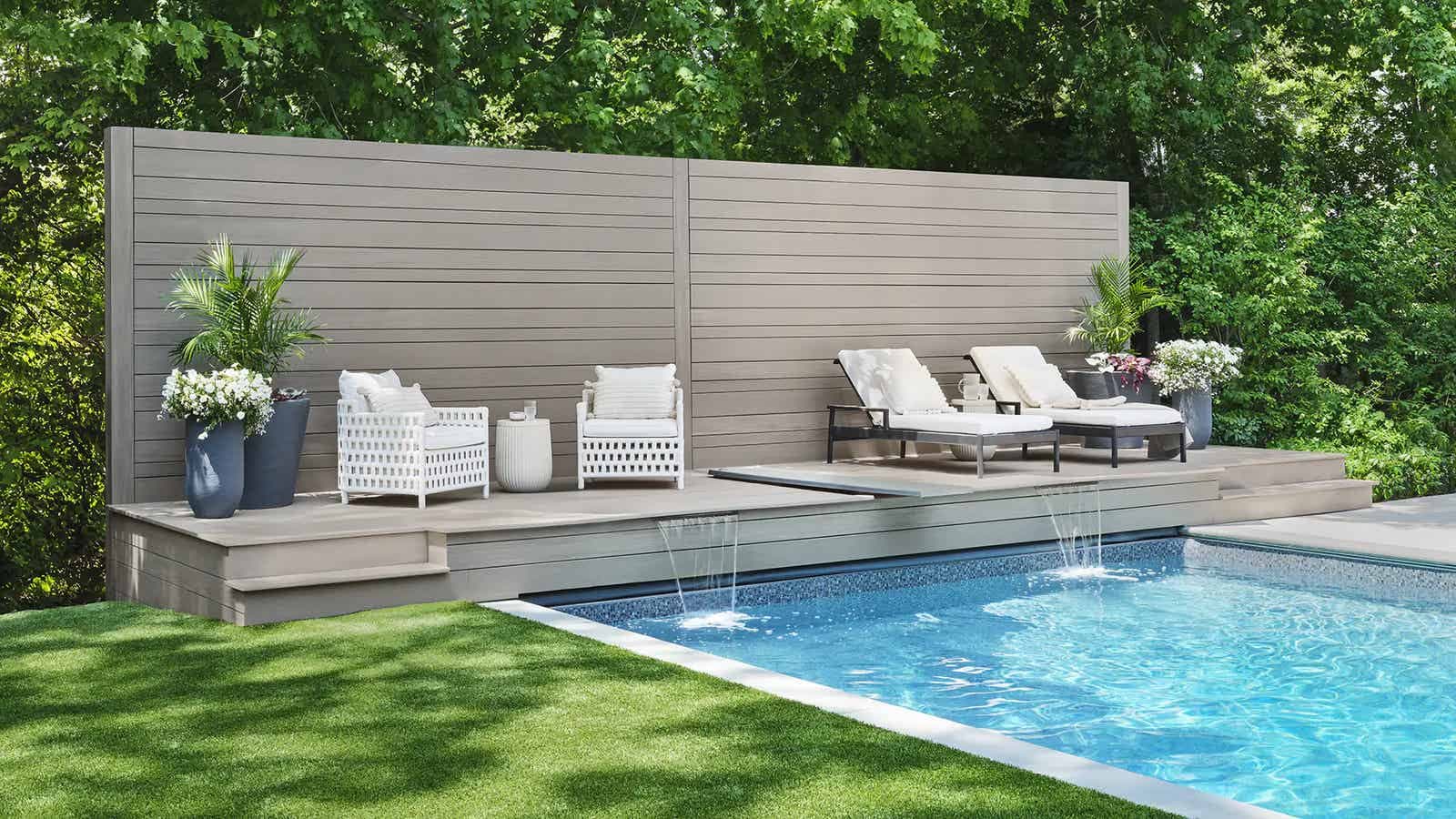
Understanding PVC Decking for Wet Environments
PVC decking is a fully synthetic product, meaning it contains no wood fibers. This composition is crucial for areas like pool terraces, where boards are regularly exposed to water, chlorine, and pool chemicals. The absence of wood fiber eliminates concerns about swelling, staining, or rot that can affect other decking materials in consistently wet conditions. This inherent waterproof quality extends throughout the core of the board.
This characteristic makes PVC decking a suitable choice for environments where boards may frequently be wet, such as pool surrounds, docks, and even covered porches where weather can impact both the top and underside of the deck. Its resistance to moisture also means it can be a practical option for areas that may experience standing water after heavy rain or during pool use.
Material Selection: Appearance and Performance
When selecting PVC decking for your Spokane pool terrace, consider both the aesthetic appeal and the specific performance characteristics. Leading manufacturers offer PVC boards with advanced capping designed to mimic the look of natural wood, featuring deep wood grain patterns and a range of color options. These collections, such as Vintage, Landmark, and Harvest, provide diverse design possibilities.
Beyond appearance, the capping also contributes to the board's resistance to stains from common spills like grease and wine. Certain color options are engineered to mitigate heat absorption, which can be an important consideration for pool areas exposed to direct sunlight, helping to maintain a more comfortable surface temperature. It is advisable to review specific product specifications for heat-mitigating properties.
Design Considerations for a Pool Terrace
Designing a pool terrace with PVC decking involves more than just selecting boards. Consider the overall layout, including transitions to other hardscaping or landscaping elements. PVC decking can be used to create a seamless flow around the pool, and its lighter weight compared to hardwood or some composite options can simplify handling during installation, particularly for larger areas.
Think about drainage and how water will naturally flow off the deck surface. While PVC itself is waterproof, proper substructure and deck design are still essential to prevent water from pooling underneath the deck or against the house foundation. Edge finishes and fascia boards should be selected to complement the main decking and provide a clean, finished look around the pool perimeter.
Installation Planning and Substructure
The installation of PVC decking around a pool requires careful planning of the substructure to ensure proper support and ventilation. Even though the decking boards are waterproof, adequate airflow beneath the deck helps manage moisture and maintain the integrity of the underlying frame. Always follow manufacturer guidelines for joist spacing and fastening systems.
Hidden fasteners are often preferred for PVC decking to create a smooth, uninterrupted surface, which can be beneficial in a barefoot area like a pool terrace. If face-fastening is used, ensure the fasteners are approved for PVC and installed according to specifications to prevent issues like dimpling or stress cracks. Consult with your installer regarding the specific requirements for your chosen PVC decking product.
Maintenance and Longevity
One of the key benefits of PVC decking for a pool terrace is its low-maintenance nature. The capped polymer surface is designed to shed common stains and can typically be cleaned with soap and water. This ease of cleaning is particularly advantageous in a poolside setting where splashes and spills are common.
While PVC decking is engineered for durability and resistance to fading and staining, routine cleaning helps maintain its appearance over time. Always consult the manufacturer's cleaning instructions for your specific product to ensure compatibility with cleaning agents and methods. This proactive approach helps preserve the deck's aesthetic and functional qualities.
Worked Example: A Spokane Pool Terrace Project
Imagine a hypothetical pool terrace project in Spokane, WA, where a homeowner is replacing an aging concrete patio around a rectangular pool. The area to be decked measures 20 feet by 15 feet, forming a perimeter around the pool.
To calculate the required boards: the total area is 20 feet * 15 feet = 300 square feet. Dividing the total area by the coverage per board (300 sq ft / 5.5 sq ft/board) suggests approximately 54.5 boards. However, to account for cuts, waste, and a picture-frame border (if desired), a contingency of 10-15% is typically added. For this example, let's round up to 60 boards for the main field.
For a picture-frame border around the 20x15 foot area, additional boards would be needed. The perimeter is (20+15)*2 = 70 linear feet. If a single border board is used, 70 linear feet / 12 feet/board = approximately 5.8 boards. Rounding up to 6-7 boards for the border, considering miter cuts and waste. This hypothetical example illustrates the need to factor in both area coverage and linear footage for borders and specific design elements, always buying full modules.
Before you order
- Verify local building codes and permit requirements for decking around pools in Spokane, WA.
- Confirm the specific PVC decking product's suitability for continuous wet exposure and chemical resistance.
- Evaluate heat-mitigating color options for sun-exposed areas of the pool terrace.
- Plan the substructure design, ensuring proper joist spacing, ventilation, and drainage.
- Select compatible fastening systems (hidden or face-fastened) and confirm installation instructions.
- Consider edge treatments, fascia boards, and stair components to match the chosen decking.
- Review manufacturer's cleaning and maintenance guidelines for poolside environments.
- Account for cut waste and design elements (like borders) when calculating material quantities.
Confirm installation details, approved uses and warranty terms in the current instructions for the exact product and profile. Your installer should verify the substrate, structure and applicable project requirements.
This is a planning guide for projects in Spokane, WA. Ask our team to confirm availability, delivery to your ZIP code and which branch can support your order.
Questions to help you decide
Is PVC decking slippery when wet?
While PVC decking is designed for outdoor use, any surface can become slippery when wet, especially around a pool. Specific product lines may offer different surface textures. It is always advisable to exercise caution on any wet surface. For specific slip resistance data, consult the manufacturer's product specifications.
Can PVC decking be installed directly on concrete?
PVC decking typically requires a substructure (joists) to allow for proper ventilation and drainage beneath the boards. It is not generally designed for direct installation onto a solid surface like concrete without an underlying frame. Always refer to the manufacturer's installation guide for approved methods and substructure requirements.
How do I clean chlorine or pool chemical spills from PVC decking?
PVC decking is generally resistant to common pool chemicals. For spills, it is best to clean them promptly with soap and water. Always refer to the specific manufacturer's cleaning instructions for your PVC decking product, as recommended cleaning agents and methods can vary. Avoid abrasive cleaners or harsh solvents unless explicitly approved by the manufacturer.
Ready to Plan Your PVC Decking Pool Terrace?
Request a material quote with your project dimensions, desired PVC decking profile, and ZIP code to confirm current availability and service options. Explore our full range of decking products, including hardwood and composite options, to find the best fit for your Spokane outdoor space.
Request a material quote →