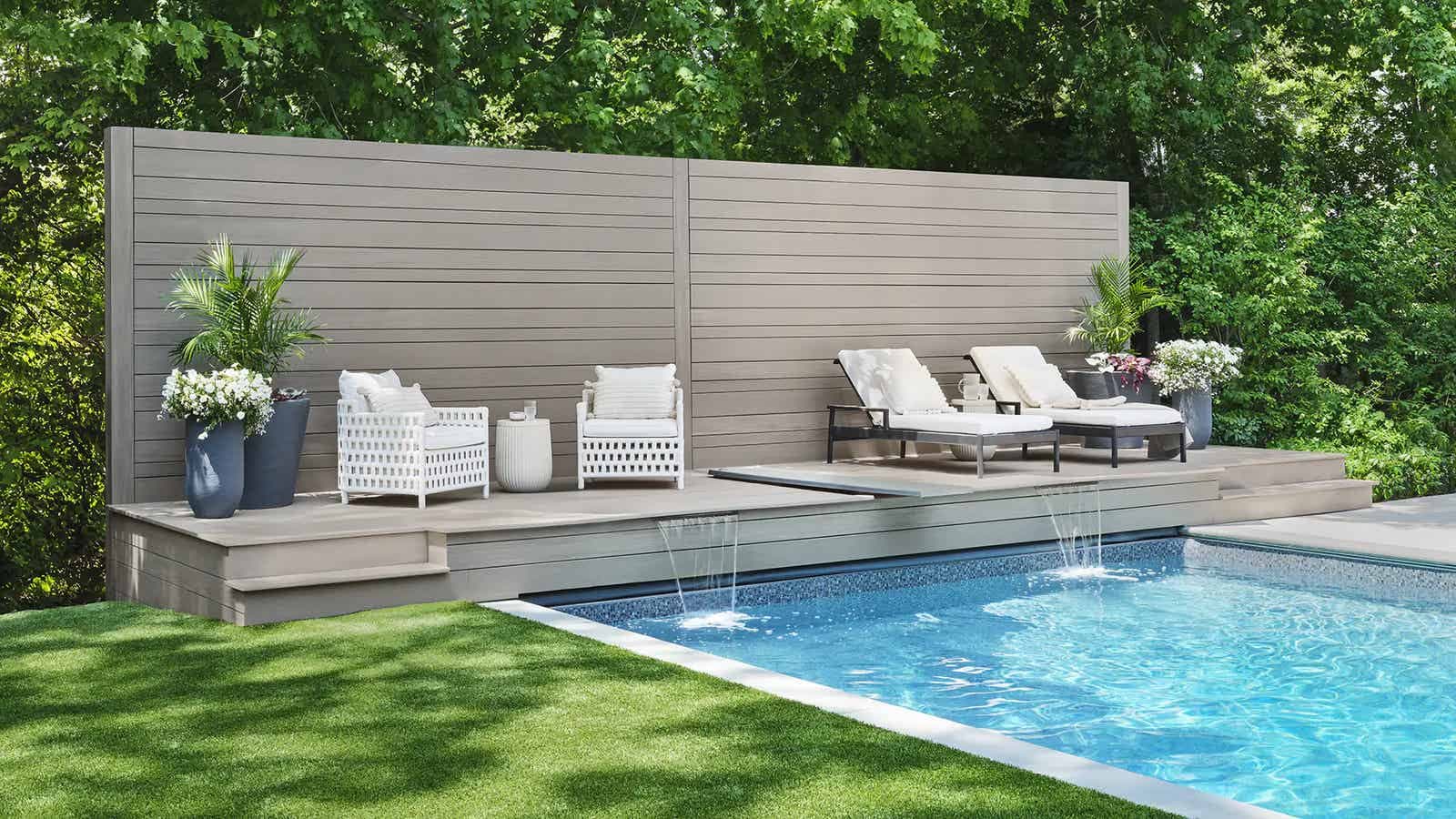
Why PVC Decking for Pool Terraces?
PVC decking is a 100% synthetic material, meaning it contains no wood fibers. This composition is a primary reason for its suitability around water. Unlike wood or composite materials that can absorb moisture, PVC decking is engineered to be waterproof to its core. This characteristic helps prevent issues such as swelling, staining, or rot that can occur in consistently wet environments like a pool terrace.
The resistance to moisture makes PVC decking a practical choice for areas exposed to splashes, standing water, and even salt spray if applicable, without compromising the material's integrity over time. Its advanced capping technology further enhances its performance, helping it shed liquids and resist common poolside stains from things like sunscreen or beverages. This material is designed to offer a surface that can be wiped clean with soap and water.
Additionally, PVC decking is often lighter than comparable hardwood or composite options. This can simplify handling during installation and potentially reduce structural load considerations, which can be a factor for certain deck designs.
Key Characteristics of PVC Decking for Wet Areas
One of the defining features of PVC decking is its inherent resistance to water. This makes it a preferred material for 'splash zones' around pools and other areas where boards may consistently be wet.
Many PVC decking lines feature advanced capping that encases the core material. This capping is designed to resist stains from common poolside substances like grease, wine, or chlorine-treated water. This protective layer also contributes to easier cleaning and maintenance, allowing for simple soap and water cleanup.
The weight of PVC decking is another practical consideration. Its lighter weight compared to hardwood or some composite options can make installation more efficient and may be an advantage for certain structural requirements, such as elevated decks or those built over existing structures.
Designing Your Santa Fe Pool Terrace with PVC Decking
When planning a pool terrace in Santa Fe, several design elements become particularly important. The intense sun exposure in the region means considering board colors and finishes that offer heat-mitigating properties.
Consider the layout of your decking in relation to the pool's edge. Picture-frame borders can provide a finished look and define the perimeter. Ensure that any transitions between the decking and other hardscaping, such as coping or paving, are carefully planned for both aesthetics and safety. Board widths and lengths should be chosen to minimize seams and optimize the visual flow of the deck.
Ventilation beneath the deck is crucial, especially in a poolside environment where moisture can be present. Proper airflow helps to ensure the longevity of the deck structure and prevents moisture buildup. Consult product guidelines for specific ventilation requirements for PVC decking installations.
Worked Example: PVC Decking for a Rectangular Pool Terrace
Let's consider a hypothetical pool terrace project for a rectangular pool measuring 15 feet by 30 feet. The homeowner wants a PVC deck surround that extends 4 feet out from all sides of the pool.
First, calculate the total area of the deck. The pool dimensions with the 4-foot extension on all sides become (15 + 4 + 4) feet by (30 + 4 + 4) feet, which is 23 feet by 38 feet. The total deck area is 23 ft * 38 ft = 874 square feet.
Next, subtract the pool's area from the total deck area: 15 ft * 30 ft = 450 square feet. So, the decking material needed covers 874 sq ft - 450 sq ft = 424 square feet.
Assume we select PVC decking boards that are 5.5 inches wide and available in 16-foot lengths. To estimate the number of boards, we can calculate the linear footage. For a 4-foot wide section around the 30-foot long sides, we need roughly 30 ft * 2 sides = 60 linear feet of pool edge. For the 4-foot wide section around the 15-foot long sides, we need roughly 15 ft * 2 sides = 30 linear feet of pool edge. The perimeter of the pool is 90 linear feet.
If boards are laid perpendicular to the pool's long edge for the 4-foot extension, each board covers 5.5 inches (0.458 ft) of width. For a 30-foot length, you'd need 30 ft / 0.458 ft/board = approximately 66 boards of 4-foot length. However, boards are sold in fixed lengths. If using 16-foot lengths, you'd cut each 16-foot board into four 4-foot sections, with 0 feet of offcut. For the 424 square feet, if using a 5.5-inch wide board (0.458 ft), you need 424 sq ft / 0.458 ft = 925.7 linear feet of board. If boards are 16 feet long, this would be 925.7 / 16 = approximately 58 boards. Always add 10-15% for cuts, waste, and future repairs. So, 58 boards * 1.15 = 67 boards of 16-foot length.
This is a simplified calculation and does not account for specific board layouts, trim, or fastening details. It's essential to create a detailed cut plan and factor in waste for any cuts that do not yield reusable offcuts. Always confirm final quantities with your supplier based on your detailed project plan.
Maintenance and Longevity of PVC Decking
PVC decking is known for its low maintenance requirements compared to traditional wood. Its synthetic nature means it doesn't require sanding, staining, or sealing. Regular cleaning with soap and water is typically sufficient to maintain its appearance, especially in a poolside setting where splashes and spills are common.
The material's resistance to rot, insects, and decay contributes to its long-term durability. Many PVC decking products come with written fade and stain coverage, which can provide peace of mind regarding the deck's appearance over time. This is particularly relevant in Santa Fe, where strong sunlight can be a factor.
For optimal longevity, ensure that the deck substructure is also well-maintained and that proper ventilation is established beneath the deck to prevent moisture buildup in the under-deck area. Following the manufacturer's specific cleaning and care instructions is crucial to preserve the deck's finish and performance.
Before you order
- Confirm local building codes and permits required for deck construction around a pool.
- Evaluate existing sub-structure for compatibility with PVC decking weight and fastening systems.
- Consider the pool's dimensions and desired deck extension for accurate material quantity estimation.
- Choose PVC decking color and finish, keeping Santa Fe's sun exposure and heat mitigation in mind.
- Plan for proper ventilation beneath the deck to manage moisture from the pool environment.
- Select appropriate fasteners (hidden or face-fastened) and ensure compatibility with chosen PVC boards.
- Factor in fascia boards, trim, and any other finishing elements for a complete look.
- Review manufacturer-specific installation guidelines, particularly for board spacing and fastening in wet areas.
- Plan for regular cleaning and maintenance as per manufacturer recommendations.
- Obtain a detailed material quote based on your project dimensions, desired profile, and ZIP code.
Confirm installation details, approved uses and warranty terms in the current instructions for the exact product and profile. Your installer should verify the substrate, structure and applicable project requirements.
This is a planning guide for projects in Santa Fe, NM. Ask our team to confirm availability, delivery to your ZIP code and which branch can support your order.
Questions to help you decide
Is PVC decking slippery when wet?
The level of slip resistance can vary between product lines and finishes. It is always recommended to review specific product specifications for details on slip resistance, especially for poolside applications.
How does PVC decking withstand Santa Fe's sun?
PVC decking is engineered to be durable in various climates, including those with intense sun. Many products feature UV inhibitors and advanced capping that help resist fading and staining from sun exposure. Some manufacturers offer heat-mitigating color options designed to keep the surface cooler. Always check the specific fade and stain warranties provided by the manufacturer for the product you select.
Can PVC decking be installed directly on concrete around a pool?
Installing PVC decking directly on concrete or an existing patio requires specific installation methods to ensure proper drainage and ventilation. It is generally not recommended to lay decking boards directly on a solid surface without a proper substructure or sleepers to allow for airflow and water runoff. Consult the manufacturer's installation guide for approved methods for installing over concrete or existing surfaces to prevent moisture trapping and ensure the longevity of your deck.
Ready to Plan Your PVC Pool Terrace?
Request a material quote with your project dimensions, exact profile, and ZIP code to confirm current availability and service options for PVC decking. Our team can help you select the right materials for your Santa Fe pool terrace project.
Request a material quote →