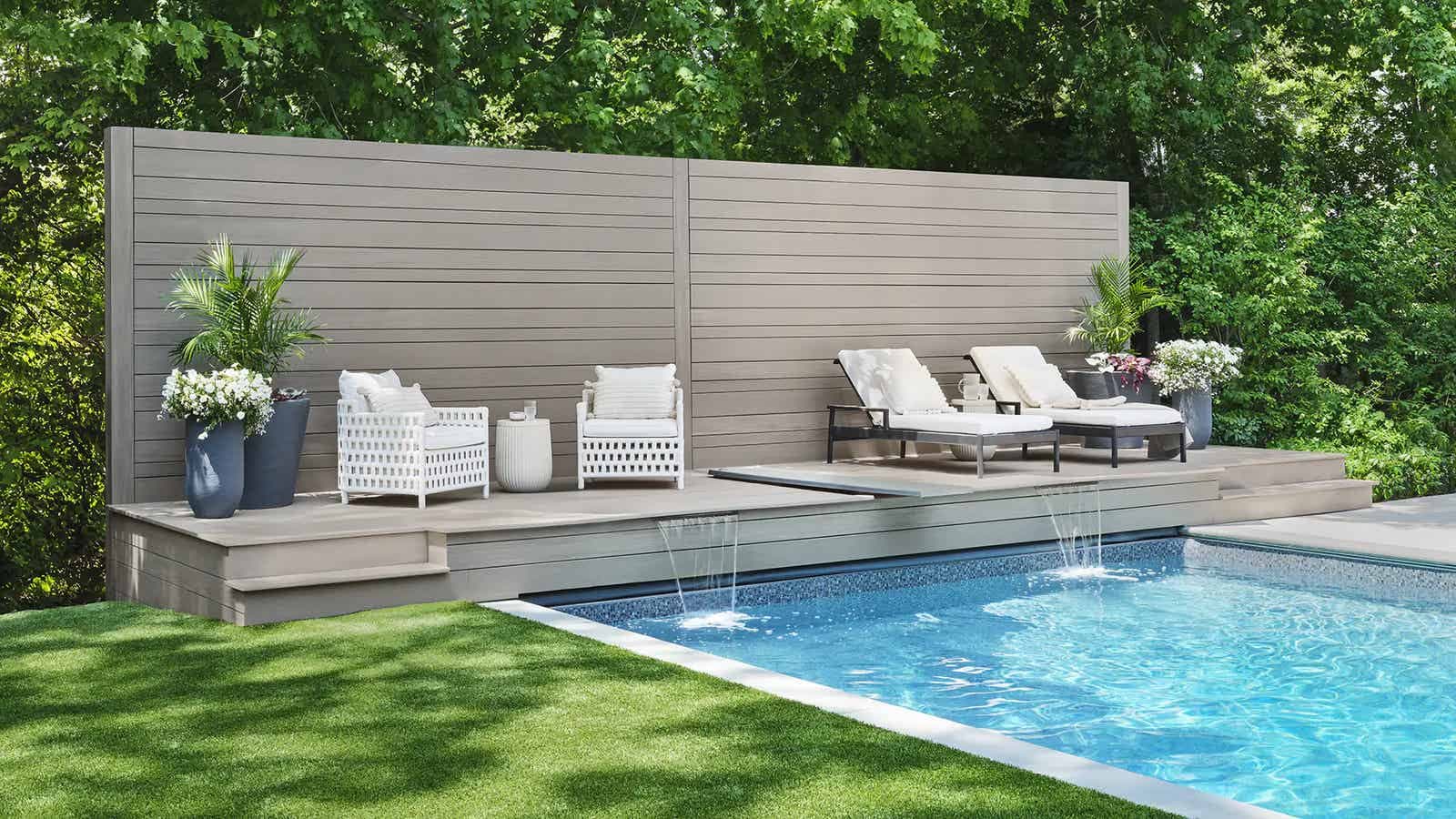
Why PVC Decking Excels in Poolside Environments
The primary advantage of PVC decking for a pool terrace is its inherent resistance to water. Composed entirely of synthetic materials, it does not contain wood fibers that can swell, rot, or degrade when exposed to prolonged moisture, standing water, or even salt spray, if applicable. This makes it a reliable choice for splash zones and other areas around a pool where wet conditions are common.
This waterproof quality also contributes to the material's low maintenance profile. PVC decking sheds water efficiently and is designed to resist staining from common poolside spills like grease or wine. Routine cleaning typically involves just soap and water.
Design Options and Aesthetic Appeal
Modern PVC decking offers a range of aesthetic options, including collections that mimic the deep wood grain looks of traditional timber. Brands like TimberTech Azek provide various colors and textures within their Vintage, Landmark, and Harvest collections, allowing you to achieve a sophisticated appearance that complements your home's style. These advanced capped polymer boards are designed for visual appeal while retaining their practical benefits.
When planning your pool terrace, consider how the decking color will interact with the surrounding landscape and your home's exterior. Some PVC decking options are designed with heat-mitigating colors, which can be a consideration for surfaces exposed to direct sunlight, helping to keep the deck more comfortable underfoot.
Installation Considerations for a Pool Terrace
PVC decking is known for being lighter than many hardwood and even some composite decking materials. This lighter weight can facilitate easier handling during installation, which may be a factor in project timelines. While PVC boards are durable, proper installation, including adequate ventilation beneath the deck, is essential to ensure long-term performance and prevent moisture buildup in the sub-structure.
Always follow the manufacturer's specific installation guidelines for board spacing and fastening. For a pool terrace, ensuring proper drainage away from the house and pool structure is critical to prevent water accumulation that could affect foundations or landscaping over time.
Maintenance and Longevity
A significant benefit of PVC decking around a pool is its ease of maintenance. The advanced capping on many PVC boards means they resist common stains and can be cleaned with basic household cleaning solutions like soap and water. This contrasts with wood decks that often require regular sealing, staining, or painting to protect against moisture and UV damage.
While PVC decking is designed for durability, establishing a routine cleaning schedule can help maintain its appearance over time. Always consult the manufacturer's cleaning recommendations to ensure compatibility with specific products and to avoid inadvertently damaging the surface.
Cost-Benefit Analysis for Your Richmond Home
When evaluating PVC decking for your Richmond pool terrace, consider the long-term value. While the initial material cost might be higher than some traditional wood options, the reduced maintenance requirements and extended lifespan can lead to lower ownership costs over time. The material's resistance to rot, insect damage, and fading contributes to its durability and sustained appearance without the need for frequent repairs or extensive upkeep.
Factor in the labor savings associated with less maintenance, and the waterproof nature of PVC decking can offer peace of mind, especially in a high-moisture environment like a pool surround.
Worked Example: Planning a 300 sq ft Pool Terrace with PVC Decking
Let's consider a hypothetical pool terrace project for a Richmond, VA home, measuring approximately 15 feet by 20 feet, totaling 300 square feet. For this project, we'll assume using standard PVC decking boards that are 5.5 inches wide and available in 12, 16, and 20-foot lengths.
First, determine the layout. For a 15x20-foot area, running boards parallel to the 20-foot dimension would minimize seams. Each 5.5-inch wide board covers 0.458 feet in width. To cover the 15-foot width, you would need approximately 15 feet / 0.458 feet/board = 32.75 boards. Rounding up, you would plan for 33 full boards.
If using 20-foot lengths, each board covers 20 feet * 0.458 feet = 9.16 square feet. Therefore, 33 boards * 20 feet = 660 linear feet. This would provide 33 boards, each 20 feet long, covering the 15-foot width with minimal waste on length, assuming a straight run.
Total linear footage needed for 33 boards at 20 feet each is 660 linear feet. When ordering, it's prudent to include a waste factor, typically 5-10%, to account for cuts, mistakes, or future repairs. For this project, adding 5% would mean ordering approximately 693 linear feet of PVC decking. This would translate to 35 boards of 20-foot length.
Remember to also account for fascia boards for the perimeter, which would typically match the decking material. For a 15x20-foot deck, the perimeter is (15+20)*2 = 70 linear feet. You would need additional fascia boards to cover this perimeter, considering available lengths and any necessary cuts.
Before you order
- Assess pool terrace exposure: Will the area receive full sun, partial shade, or be consistently wet?
- Review local building codes: Confirm any specific requirements for pool decking in Richmond, VA.
- Consider color and heat mitigation: Select lighter colors if direct sun exposure is a concern for foot comfort.
- Plan for drainage: Ensure the deck design facilitates proper water runoff away from structures.
- Account for ventilation: Verify that the sub-structure allows for adequate airflow beneath the PVC decking.
- Budget for long-term value: Compare initial material costs with anticipated maintenance and longevity.
- Confirm manufacturer's installation guidelines: Adhere strictly to spacing, fastening, and support requirements.
- Choose complementary trim and fascia: Select matching or coordinating pieces for a finished look.
Confirm installation details, approved uses and warranty terms in the current instructions for the exact product and profile. Your installer should verify the substrate, structure and applicable project requirements.
This is a planning guide for projects in Richmond, VA. Ask our team to confirm availability, delivery to your ZIP code and which branch can support your order.
Questions to help you decide
Is PVC decking slippery when wet?
However, any wet surface carries a risk of slipping, so caution should always be exercised around a pool. Some manufacturers offer specific surface finishes designed to enhance grip.
Can PVC decking be installed directly over a concrete slab?
Installing PVC decking directly over a concrete slab is possible, but it requires specific considerations for ventilation and drainage. A sleeper system or a pedestal system is typically used to create an air gap between the decking and the concrete, preventing moisture buildup and allowing for proper airflow. Direct contact without an air gap is generally not recommended as it can trap moisture.
How does PVC decking withstand the Richmond, VA climate?
PVC decking is well-suited for the climate in Richmond, VA, which experiences a range of temperatures and humidity. Its synthetic composition makes it resistant to moisture, rot, and insect damage, which are common concerns in humid environments. The material is also designed to resist fading from UV exposure, helping to maintain its color over time despite sunny summers.
Ready to Plan Your PVC Pool Terrace?
For your Richmond, VA project, request a material quote with your project dimensions, desired PVC decking profile, and ZIP code. We can help confirm current availability and service options for your specific needs.
Request a material quote →