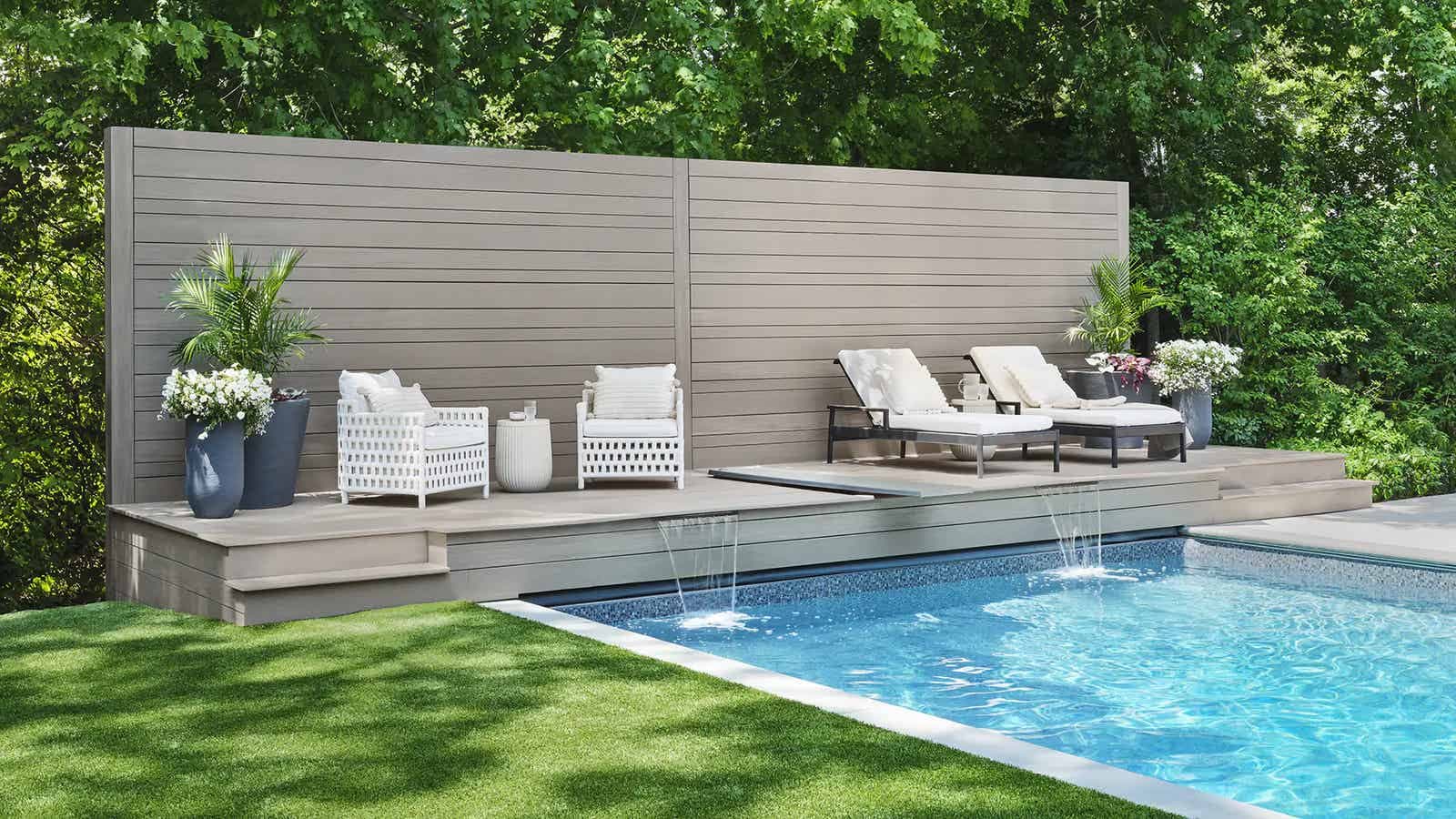
Why PVC Decking for Pool Terraces?
PVC decking is a 100% synthetic material, meaning it contains no wood fiber. This composition is crucial for pool surrounds where boards are routinely exposed to standing water, splashes, and pool chemicals. Unlike wood or even wood-composite alternatives, PVC boards are waterproof to the core, which helps prevent swelling, staining, or rot.
The advanced capping on PVC boards is designed to shed grease and wine, making cleanup straightforward with soap and water. Manufacturers like Azek offer PVC decking lines that are specifically marketed for docks and pool decks, highlighting their suitability for areas where boards will frequently be wet. This inherent resistance to moisture and common pool-related exposures makes PVC a low-maintenance option for a pool terrace.
Additionally, PVC decking is often lighter than hardwood or composite options, which can facilitate easier handling and installation, especially in larger projects or those with access challenges.
Understanding Water Exposure and Drainage
A pool terrace experiences significant water exposure, not just from splashes but also from rainwater. While PVC decking is waterproof, proper drainage beneath and around the deck remains essential. Preventing water from pooling on or under the deck helps maintain a clean environment and prevents issues like mildew growth on surfaces or structural components.
Careful planning of the deck's slope and the surrounding landscaping is important to direct water away from the structure. Even though PVC boards resist water absorption, continuous pooling can leave mineral deposits or facilitate the growth of algae on the surface, requiring more frequent cleaning. The design should allow for adequate airflow and drainage to help the deck dry efficiently.
Considering Board Profiles and Finishes
PVC decking is available in various collections, such as TimberTech Azek's Vintage, Landmark, and Harvest lines, which offer different aesthetics, including deep wood looks. When selecting a profile, consider the desired aesthetic for your Oklahoma City pool area. Smooth or textured finishes can impact both appearance and tactile feel underfoot.
Some PVC decking options also offer heat-mitigating color choices. While no decking material eliminates heat absorption entirely in direct sun, selecting lighter colors or those specifically engineered to reflect more sunlight can contribute to a cooler surface temperature, which can be a comfort factor for bare feet around a pool.
Maintenance for a Poolside PVC Deck
One of the key advantages of PVC decking for a pool terrace is its low maintenance. The material is designed to resist staining and fading. Routine cleaning typically involves soap and water to remove dirt, pool chemicals, and any spills. Promptly cleaning up spills, especially those containing oils or strong dyes, helps maintain the deck's appearance over time.
For specific cleaning product compatibility, it is always recommended to consult the manufacturer's guidelines for the chosen PVC decking product. While PVC is durable, using abrasive cleaners or harsh chemicals not approved by the manufacturer could potentially affect the surface finish.
Example: Estimating PVC Decking for a Rectangular Pool Terrace
Let's consider a hypothetical rectangular pool terrace project in Oklahoma City, measuring 16 feet by 20 feet, where the decking boards will run parallel to the 20-foot side. We'll use 12-foot long PVC decking boards, which are typically 5.5 inches wide.
First, calculate the total area: 16 ft * 20 ft = 320 square feet.
Next, determine how many boards are needed to cover the 16-foot width. Since each board is 5.5 inches (or approximately 0.458 feet) wide, 16 ft / 0.458 ft/board = approximately 34.93 boards. We need to round up to 35 boards to cover the width.
Each board is 12 feet long. Since the deck length is 20 feet, each 12-foot board will cover only part of the length. For a 20-foot run, you will need to use two 12-foot boards per row, with an 8-foot section cut from the second board. This means each 20-foot row will require two 12-foot boards.
Therefore, for 35 rows, you will need 35 rows * 2 boards/row = 70 boards. This calculation does not account for waste from cuts or potential for reusable offcuts from the 4-foot remainder of the second board (12 ft - 8 ft = 4 ft) if the layout allows. Always add a small percentage (e.g., 5-10%) for cuts, waste, and error. For this example, 70 boards * 1.05 (5% waste) = 73.5, rounding up to 74 boards.
This is a simplified calculation. Actual projects require precise measurements, a detailed cut plan, and consideration of any picture framing, stair components, or fascia boards, which would require additional material. Always confirm exact board dimensions and recommended spacing with the product manufacturer before ordering.
Before you order
- Confirm local building codes and permits required for deck construction in Oklahoma City.
- Assess the existing site conditions, including soil type, drainage, and sun exposure.
- Determine the desired aesthetic and color palette for the pool terrace.
- Verify the specific PVC decking product's slip resistance and heat mitigation properties.
- Plan for proper deck ventilation and drainage to prevent water accumulation.
- Consider edge finishing options, such as fascia boards or trim.
- Estimate material quantities, including boards, fasteners, and substructure components.
- Review manufacturer's installation guidelines for board spacing and fastening.
- Understand the recommended cleaning and maintenance procedures for the chosen PVC decking.
- Obtain a detailed quote for all materials, including delivery to your Oklahoma City project location.
Confirm installation details, approved uses and warranty terms in the current instructions for the exact product and profile. Your installer should verify the substrate, structure and applicable project requirements.
This is a planning guide for projects in Oklahoma City, OK. Ask our team to confirm availability, delivery to your ZIP code and which branch can support your order.
Questions to help you decide
Is PVC decking slippery around a pool?
While PVC decking is designed for wet environments, any surface can become slippery when wet, especially with pool chemicals or algae present. Many PVC decking products offer textured surfaces to enhance traction. It's important to keep the deck clean and refer to the manufacturer's specific product information regarding slip resistance ratings.
Can PVC decking get hot in the Oklahoma City sun?
All decking materials can absorb heat from direct sunlight. PVC decking, particularly darker colors, can get warm. However, many PVC decking lines offer lighter color options or utilize technology designed to reflect more sunlight, potentially resulting in a cooler surface temperature compared to traditional materials. Checking specific product specifications for heat-mitigating properties is advisable.
How do I clean pool chemical spills from PVC decking?
PVC decking is generally resistant to many common spills. For pool chemical spills, it's best to rinse the area immediately with water and then clean with mild soap and water. Always avoid abrasive cleaners or harsh chemicals unless explicitly approved by the decking manufacturer, as these could damage the surface finish. Regular cleaning helps prevent the buildup of residues.
Ready to Plan Your Oklahoma City Pool Terrace with PVC Decking?
Request a material quote today. Provide your project dimensions, desired PVC decking profile, and ZIP code to confirm current availability and service options for your Oklahoma City project.
Request a material quote →