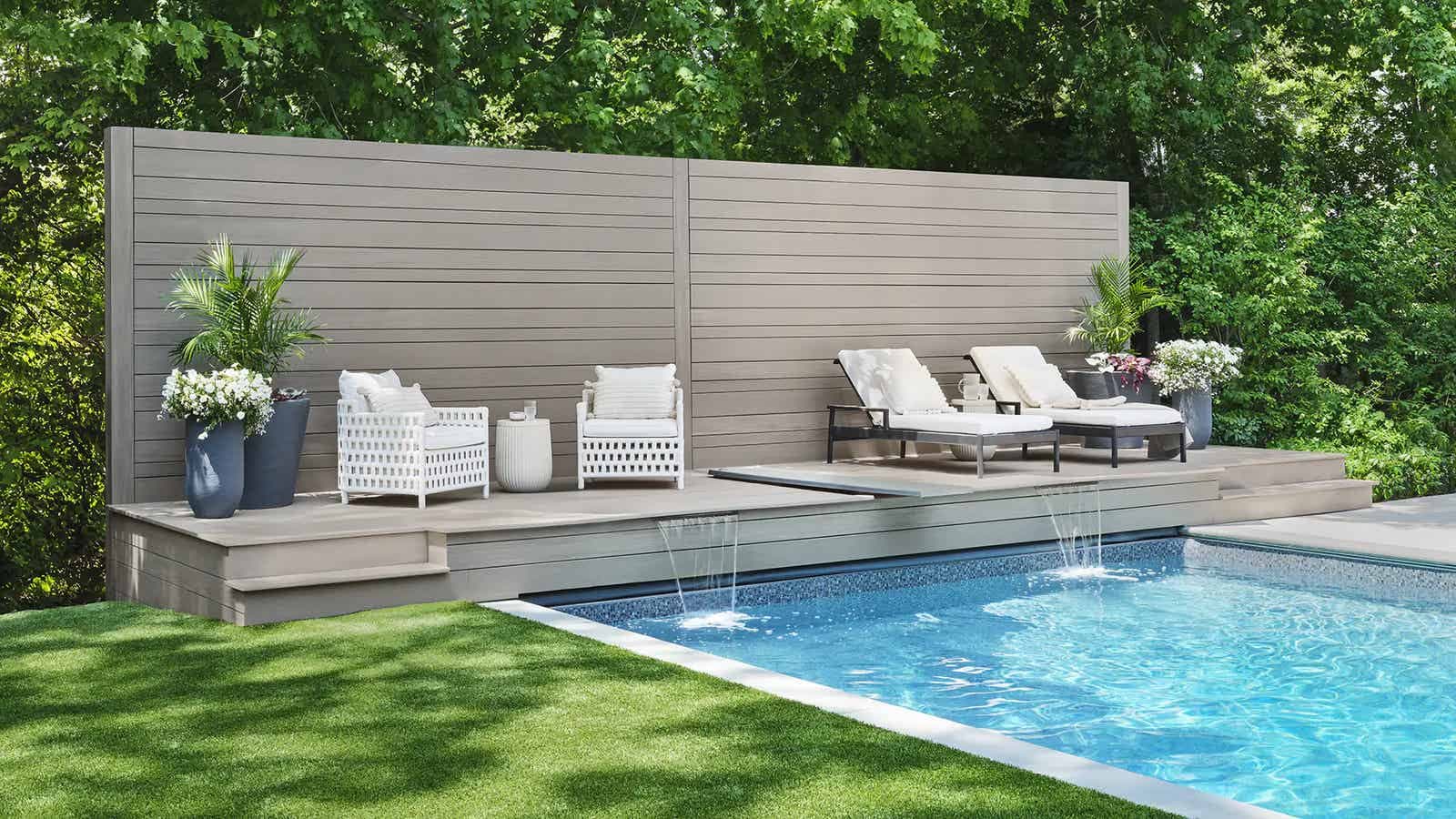
Why PVC Decking Excels for Pool Terraces
PVC decking is a 100% synthetic material, meaning it contains no wood fibers. This fundamental difference gives it distinct advantages when exposed to water, pool chemicals, and salt spray. Unlike wood or even some composite materials, PVC boards are waterproof to the core, which prevents swelling, staining, or rot, even in consistently wet environments.
The fully synthetic composition makes PVC decking a default choice for areas where boards are frequently wet, such as pool surrounds, docks, and even covered porches that experience weather from multiple directions. Its resistance to moisture makes it particularly suitable for coastal regions where humidity and salt air are prevalent, minimizing concerns about material degradation over time.
Another practical benefit is its lighter weight compared to hardwood and many composite options. This can facilitate easier handling during installation, potentially simplifying the project, especially for larger terraces or elevated structures.
Key Characteristics of PVC Decking for Wet Applications
PVC decking is designed to shed water and resist staining from common outdoor spills like grease and wine. Its advanced capping technology allows it to be wiped clean with soap and water, simplifying routine maintenance. This is particularly valuable around a pool where spills and splashes are frequent.
Manufacturers like TimberTech Azek offer lines of PVC decking, such as their Vintage, Landmark, and Harvest collections, which feature deep wood-grain aesthetics in a capped polymer format. These options provide the look of natural wood without the associated maintenance concerns in wet environments.
While PVC decking is durable, it's important to note that specific heat-mitigating color options are available. In sunny coastal locations, darker colors can absorb more heat. Checking these options can help in selecting a surface that remains more comfortable underfoot during peak sun exposure.
Planning Your Pool Terrace with PVC Decking: A Hypothetical Example
Consider a hypothetical pool terrace project for a 15-foot by 20-foot area adjacent to a swimming pool. The homeowner desires a durable, low-maintenance surface that complements a modern aesthetic and can withstand constant splashing and coastal weather.
For this 300 square foot area, using 12-foot long PVC decking boards, each 5.5 inches wide, would require careful layout planning. To minimize waste and seams, one might consider a primary board direction parallel to the longer 20-foot dimension. Each 12-foot board covers approximately 5.5 inches x 12 feet = 5.5 inches x 144 inches = 792 square inches, or 5.5 square feet (accounting for board width and length).
For a 15-foot width, approximately 32 boards (15 feet / 5.5 inches per board = 180 inches / 5.5 inches 32.7) would be needed for each 12-foot section of the 20-foot length. This means roughly 32 boards of 12-foot length. For the remaining 8 feet of the 20-foot length, another set of 32 boards cut to 8 feet would be needed, or 32 full 12-foot boards with 4-foot offcuts. To cover the full 20-foot length using 12-foot boards, you would need to plan for seams. If running boards along the 20-foot length, you'd need 33 boards for the 15-foot width (15 ft * 12 in/ft / 5.5 in/board 32.7 boards, round up to 33). For the 20-foot length, you could use one 12-foot board and one 8-foot board per run, requiring 33 x 2 = 66 boards (33 x 12ft and 33 x 8ft sections). If 20-foot boards are not available, careful seam placement is crucial. Always factor in cutting waste and allow for extra boards, typically 5-10%, depending on the complexity of the cuts.
Beyond the primary decking, consider coordinating fascia and trim boards for a finished edge around the pool. These elements are critical for both aesthetics and to protect the underlying structure. Ensure proper ventilation beneath the deck is maintained, especially in humid coastal climates, to prevent moisture buildup.
Installation and Structural Considerations for Pool Decks
While PVC decking is lightweight and easy to handle, its installation requires attention to manufacturer guidelines regarding joist spacing, fastening methods, and board gapping. These details are crucial for ensuring the deck's longevity and structural integrity.
For pool terraces, proper drainage is paramount. The deck design should allow water to shed away from the pool and surrounding structures. Consider the slope of the sub-structure and the spacing between boards to facilitate water runoff.
Hidden fastening systems are often preferred for pool decks to create a smooth, barefoot-friendly surface, reducing the risk of snags or exposed screws. Always confirm the compatibility of your chosen fasteners with the specific PVC decking product.
Maintenance and Longevity in Coastal Environments
One of the significant advantages of PVC decking for coastal pool terraces is its low maintenance. It resists fading and staining, often backed by manufacturer warranties for these aspects. Regular cleaning with soap and water is typically sufficient to remove dirt, salt residue, and pool chemical splashes.
In a coastal environment, salt spray can accumulate on surfaces. Routine rinsing with fresh water can help prevent the buildup of salt crystals, which can be abrasive over time. Always refer to the manufacturer's specific cleaning instructions for compatible products.
While PVC decking is durable, inspecting your deck periodically for any debris, especially after storms, and ensuring clear drainage paths will contribute to its long-term performance.
Complementary Products for Your Pool Terrace
To complete your pool terrace project, consider other materials that complement PVC decking. For instance, [Hardwood Decking](/decking/hardwood) can be used for pergolas or accent features away from direct splash zones, offering a natural contrast. [Ipe Decking](/decking/hardwood/ipe) specifically, known for its density and durability, might be suitable for structural elements or furniture if a natural wood look is desired.
For other decking areas that might not be directly around the pool but are part of the larger outdoor living space, [Composite Decking](/decking/composite) offers another low-maintenance option. Explore the full range of [Decking](/decking) materials to find the best fit for each specific application within your project.
Before you order
- Confirm local building codes and regulations for pool deck construction.
- Measure the total area and dimensions of your pool terrace accurately.
- Select PVC decking with appropriate heat-mitigating colors for sunny coastal exposure.
- Verify joist spacing requirements for your chosen PVC decking product.
- Choose a compatible fastening system (e.g., hidden fasteners) for a smooth surface.
- Plan for proper drainage and ventilation beneath the deck.
- Consider fascia and trim boards for a finished edge.
- Factor in cutting waste and order at least 5-10% extra material.
- Review manufacturer's cleaning and maintenance guidelines for salt and chlorine exposure.
Confirm installation details, approved uses and warranty terms in the current instructions for the exact product and profile. Your installer should verify the substrate, structure and applicable project requirements.
This is a planning guide for projects in Ocean City, MD. Ask our team to confirm availability, delivery to your ZIP code and which branch can support your order.
Questions to help you decide
Is PVC decking slippery when wet?
However, any wet surface, especially around a pool, can be slippery. Always exercise caution on wet decks. Some manufacturers may offer specific surface textures or finishes that enhance slip resistance; it is important to review the product specifications.
How does PVC decking withstand salt water and chlorine?
PVC decking is inherently resistant to moisture, including salt water and chlorinated pool water. Regular rinsing with fresh water is recommended to prevent salt or chemical residue buildup on the surface.
Does PVC decking get hot in the sun?
All decking materials can absorb heat from the sun. PVC decking, especially in darker colors, can get warm. However, many manufacturers offer 'heat-mitigating' or 'cooler' color options specifically designed to reflect more sunlight and reduce surface temperature. When planning for a sunny coastal pool terrace, selecting lighter colors or those with heat-reducing properties can contribute to a more comfortable surface underfoot.
Ready to Plan Your PVC Pool Terrace?
Request a material quote today. Provide your project dimensions, desired PVC decking profile, and ZIP code to confirm current availability and service options for your coastal pool terrace project.
Request a material quote →