Evaluating Your Existing Deck Frame
The first step in any deck renovation is a thorough inspection of the existing frame. Hardwood decking, while exceptionally durable itself, relies on a sound substructure for proper support and longevity. Look for signs of rot, insect damage, or significant warping in joists, beams, and ledger boards. Pay close attention to areas where wood meets the ground, near water sources, or where fasteners penetrate the material. Any compromised structural elements will need repair or replacement before new decking can be installed.
Verify that your current framing is level and plumb. Hardwood boards require a stable and even surface for correct installation and to prevent future issues. Also, consider the spacing of your joists. Consult the manufacturer's recommendations for your chosen hardwood species and profile to ensure compatibility. If your joist spacing is too wide, additional blocking or sistering of joists may be necessary.
Comparing Hardwood Decking Species: Ipe vs. Cumaru
When considering hardwood for your Tallahassee deck renovation, two species frequently stand out: Ipe and Cumaru. Both are tropical hardwoods renowned for their density, durability, and natural resistance to various environmental factors, making them well-suited for Florida's climate.
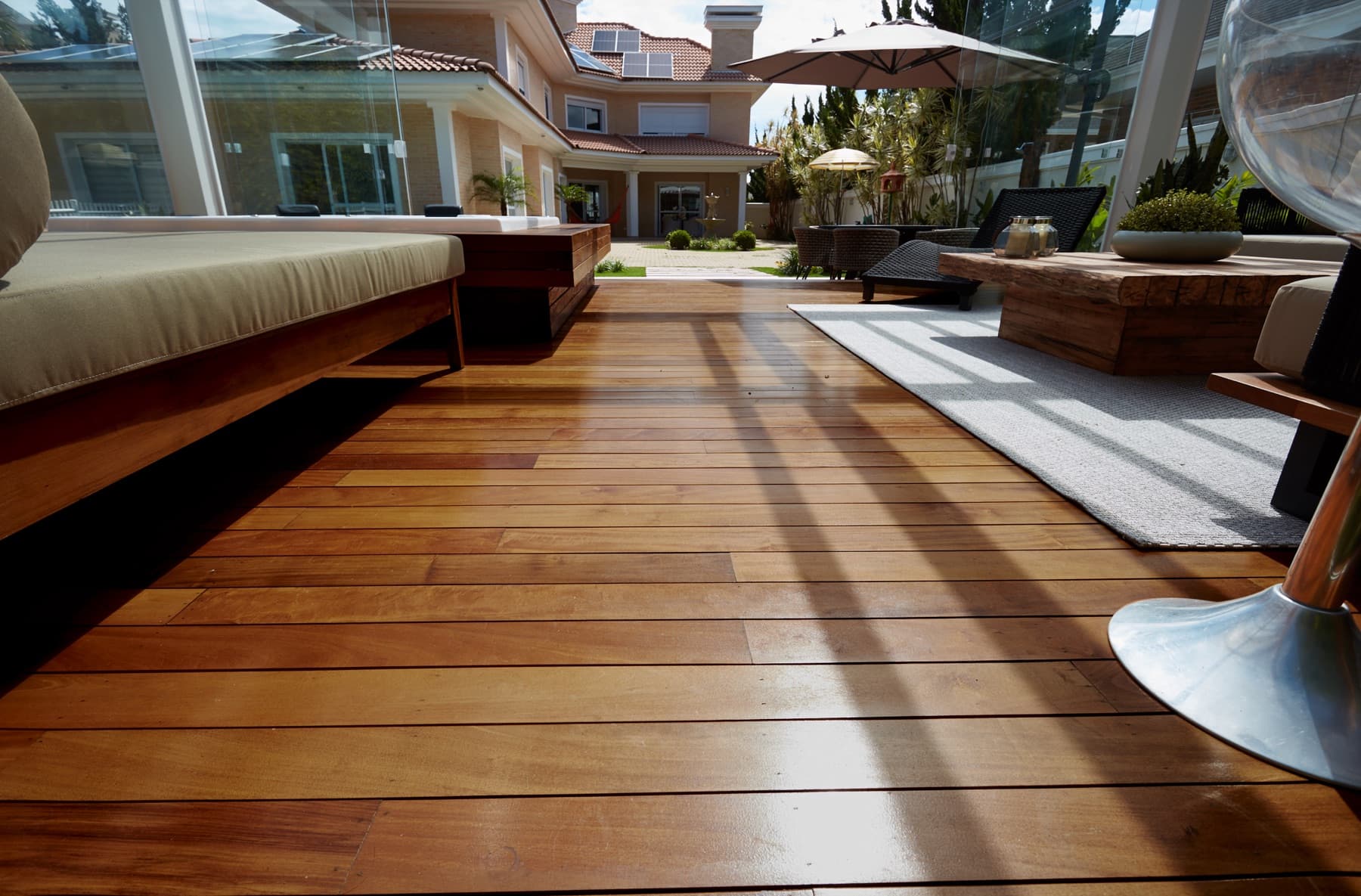
Ipe, also known as Brazilian walnut, is often considered the benchmark for hardwood decking. Ipe lumber typically ranges from reddish-brown to olive-brown and can last for decades with proper care. It also holds a Class A fire rating, which can be a significant factor for some projects.
Cumaru, another Brazilian hardwood, offers similar benefits with a slightly different profile. Cumaru is resistant to termites and weather changes, and its natural oils protect it from cracking or warping. When worked, Cumaru can emit a subtle scent of cinnamon and vanilla. It shares Ipe's Class A fire resistance, making it a robust choice for demanding outdoor applications.
Both Ipe and Cumaru can be left untreated to weather to a silvery-gray patina, or they can be regularly sealed with a UV-blocking oil to maintain their original rich color. The choice between them often comes down to specific aesthetic preferences and budget considerations, as Ipe generally represents a higher price tier than Cumaru.
Beyond Ipe and Cumaru, other Brazilian hardwoods like Garapa and Tigerwood also offer distinct advantages. Garapa provides a golden tone and is often considered a value pick, while Tigerwood features a dramatic, striped grain. Each species brings its own unique appearance and characteristics to a project.
Understanding Board Profiles and Lengths
Hardwood decking is available in various profiles and lengths, which can influence both the aesthetics and installation of your renovated deck. Standard profiles often include nominal 1x4, 1x6, and 5/4x6 boards. The choice of profile can affect the overall scale and visual rhythm of your deck surface.
Lengths typically range from 3 to 24 feet. Utilizing longer boards can minimize the number of butt joints, creating a more continuous and streamlined appearance. However, longer lengths may require more careful planning for delivery and handling. It's important to confirm the current availability of specific profiles and lengths as they can vary. Planning your layout with available lengths helps optimize material usage and reduce waste.
Fastening Systems for Hardwood Decking
The fastening system you choose for your hardwood decking impacts both the deck's appearance and its long-term stability. Two primary methods are face fastening and hidden fastening.
Face fastening involves screwing or nailing boards directly through the face of the deck board into the joists below. This method is generally robust and reliable, but the fasteners are visible. Specialized stainless steel screws designed for hardwoods are often recommended to prevent staining and ensure adequate holding power.
Hidden fastening systems offer a smooth, fastener-free deck surface. These systems typically involve clips or fasteners that attach to the side grooves of the deck boards or secure them from underneath. Hidden fasteners can provide a cleaner aesthetic but often require specific grooved board profiles and may have different installation considerations regarding board spacing and ventilation. Always ensure the chosen hidden fastening system is compatible with your selected hardwood species and profile, and follow the manufacturer's installation guidelines meticulously.
Worked Example: Renovating a 200 sq ft Deck in Tallahassee
Let's consider a hypothetical deck renovation project in Tallahassee, FL. After inspecting the frame, you find it to be in good structural condition. You decide to replace the existing decking with 1x6 (nominal size) Ipe hardwood boards, aiming for a consistent, rich brown appearance.
Assuming it is, you'll need to calculate the quantity of boards. A nominal 1x6 board is typically 5.5 inches wide. To cover a 10-foot width (120 inches), you'd need approximately 120 inches / 5.5 inches per board = 21.8 boards. Rounding up, you'd plan for 22 boards across the width. For the 20-foot length, you would aim for boards as close to 20 feet as possible to minimize butt joints. If 20-foot lengths are available, you would need 22 boards, each 20 feet long. This totals 440 linear feet.
To calculate the board footage (bf), a common unit for hardwood lumber, for 1x6 boards (which are actually 3/4" thick x 5 1/2" wide): (0.75 inches x 5.5 inches x 20 feet x 12 inches/foot) / 144 = 6.875 board feet per 20-foot board. So, 22 boards x 6.875 bf/board = 151.25 board feet. It's always advisable to add 10-15% for waste, cuts, and potential future repairs. For this project, you might order around 170-175 board feet of 1x6 Ipe in 20-foot lengths.
For fastening, you opt for a hidden fastening system to maintain a clean aesthetic. You would need to ensure the Ipe boards selected are compatible with the chosen hidden clips and factor in the quantity of clips required based on the joist spacing and board length. For maintenance, you plan for an annual cleaning and application of a UV-blocking oil to preserve the Ipe's reddish-brown hue, understanding that skipping the oil will allow it to naturally weather to a silvery-gray.
Before you order
- Inspect existing deck frame for rot, insect damage, and structural integrity.
- Verify joist spacing is compatible with chosen hardwood decking profile.
- Determine desired hardwood species (e.g., Ipe, Cumaru, Garapa, Tigerwood) based on aesthetics, durability, and budget.
- Select preferred board profile (e.g., 1x4, 1x6, 5/4x6) and confirm availability of lengths.
- Choose between face fastening or a compatible hidden fastening system.
- Calculate estimated material quantities, including waste factor.
- Plan for delivery logistics and on-site storage of hardwood materials.
- Consider long-term maintenance preferences (oiling for color retention vs. natural graying).
Confirm installation details, approved uses and warranty terms in the current instructions for the exact product and profile. Your installer should verify the substrate, structure and applicable project requirements.
This is a planning guide for projects in Tallahassee, FL. Ask our team to confirm availability, delivery to your ZIP code and which branch can support your order.
Questions to help you decide
How does Tallahassee's climate affect hardwood decking?
Tallahassee's humid, subtropical climate with warm temperatures and significant rainfall means that outdoor materials need to be highly resistant to moisture, rot, and insects. Hardwoods like Ipe and Cumaru are naturally dense and contain oils that provide excellent resistance to these conditions, making them well-suited for the local environment. They can withstand weather changes without significant warping or cracking, outperforming many other materials in such demanding conditions.
Can I reuse my existing deck frame with hardwood decking?
You can often reuse an existing deck frame, provided it is structurally sound and meets current building codes. A thorough inspection for rot, insect damage, and overall stability is crucial. Additionally, verify that your joist spacing is appropriate for the hardwood decking you choose, as some dense hardwoods may require closer support than lighter decking materials. Any necessary repairs or modifications to the frame should be completed before installing new hardwood boards.
What maintenance is required for hardwood decking in Tallahassee?
Hardwood decking, such as Ipe or Cumaru, is generally low maintenance. A simple annual cleaning with soap and water to remove dirt and debris is usually sufficient. If you prefer to maintain the wood's original rich color, applying a UV-blocking oil annually or bi-annually is recommended. If left untreated, the wood will naturally weather to a beautiful silvery-gray patina over time, which does not affect its structural integrity. This natural weathering can be a desirable aesthetic for many homeowners.
Ready to Transform Your Tallahassee Deck?
Request a material quote for your hardwood decking project. Provide your project dimensions, desired hardwood profile, and ZIP code to confirm current availability and service options for your Tallahassee, FL renovation.
Request a material quote →