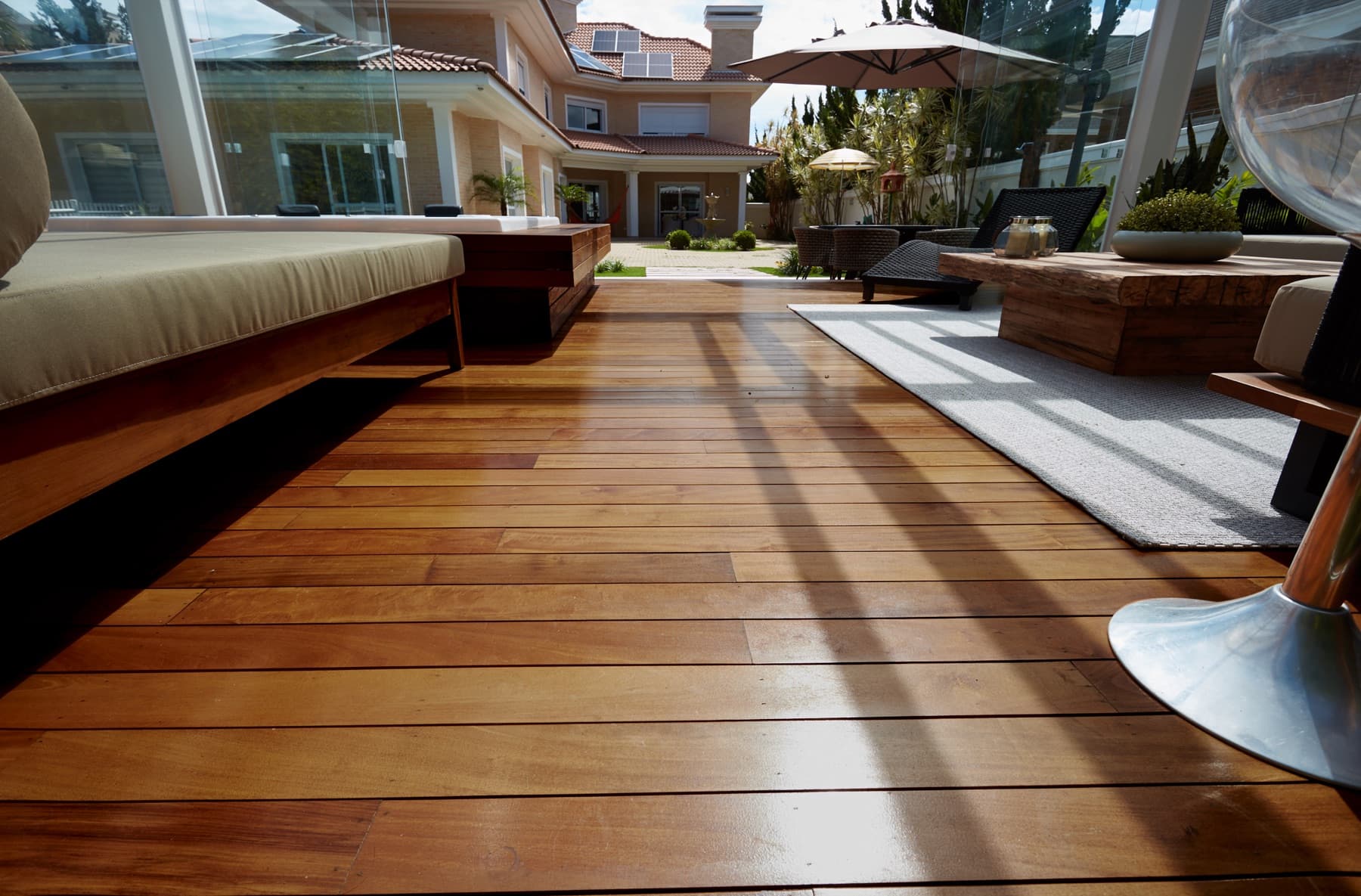
Evaluating Your Existing Deck Frame for Hardwood Decking
The first step in any deck renovation is a thorough inspection of the existing substructure. Hardwood decking, especially dense species like Ipe and Cumaru, is heavier than many common decking materials. Your existing joists, beams, and footings must be in sound condition and adequately sized to support the increased load.
Check for any signs of rot, insect damage, or structural instability. Pay close attention to joist spacing; most hardwood decking requires specific spacing for optimal performance and to prevent sagging. If your current joist spacing is wider than recommended for hardwood, you may need to add blocking or sister new joists to meet the requirements. Consult a qualified professional to ensure your frame can safely accommodate hardwood decking.
Also, consider the existing deck's height and ledger board attachment. Hardwood boards typically have a nominal thickness, and ensuring a smooth transition from your home to the renovated deck is important for accessibility and aesthetics. Review the ledger board connection to the house for secure fastening and proper flashing to prevent moisture intrusion.
Why Choose Hardwood Decking for Your Fargo Renovation?
Hardwood decking offers distinct advantages for renovation projects in regions like Fargo, where durability and resistance to varying weather conditions are important. Species such as Ipe and Cumaru are known for their inherent density and strength.
Ipe, also known as Brazilian walnut, is a dense, durable hardwood with natural resistance to rot, insects, and mold. It maintains its structural integrity through weather changes and offers a reddish-brown to olive-brown appearance. Cumaru is another very durable tropical hardwood, resistant to termites and weather changes, known for its stiffness, strength, and hardness. Both species can offer a long service life with appropriate care.
Unlike some synthetic options, these hardwoods do not require chemical treatments to achieve their resistance properties. They can be maintained with an annual wash, and an optional oil application can help preserve their original color, or they can be allowed to weather to a silvery-gray patina without structural compromise.
Comparing Ipe and Cumaru for Your Project
When selecting hardwood for your deck renovation, Ipe and Cumaru are two prominent choices, each with specific characteristics that might influence your decision.
Ipe is often considered a benchmark for hardwood decking. It exhibits minimal movement post-installation and has a rich color range from reddish-brown to olive-brown. Its density contributes to its resistance to mold and termites. Ipe is available in various profiles and lengths, typically from 1"x2" to 6"x6" dimensions and lengths from 3 to 24 feet. It can be air-dried (AD) or kiln-dried (KD).
Cumaru is also a very durable tropical hardwood, offering similar resistance to termites and weather changes. It provides stiffness, strength, and hardness. When worked, Cumaru can emit a scent of cinnamon and vanilla. Both Ipe and Cumaru are dense and durable, making them suitable for demanding outdoor applications. Your choice may come down to specific aesthetic preferences and project budget considerations.
Consider the desired finished look. Ipe offers a bold grain and a range of rich brown tones, while Cumaru also presents a strong grain and can have slightly warmer, reddish-brown hues. Both will naturally weather to a silver-gray if left unoiled.
Planning Your Deck Renovation: A Hypothetical Example
Let's consider a hypothetical deck renovation project in Fargo, ND. You've inspected the frame and confirmed it's sound and capable of supporting hardwood. You plan to use 1x6 (nominal size) Ipe decking boards.
First, calculate the total square footage: 12 feet * 16 feet = 192 square feet. Hardwood decking is typically sold by the linear foot. To estimate the linear footage needed for 1x6 boards, you would calculate how many 5.5-inch (actual width) boards fit across the 12-foot width. 12 feet * 12 inches/foot = 144 inches. 144 inches / 5.5 inches/board = approximately 26.18 boards. You'd round up to 27 boards for the width. Then, multiply this by the deck's length: 27 boards * 16 feet = 432 linear feet. Always add a waste factor, typically 10-15%, for cuts and potential imperfections. So, 432 linear feet * 1.15 (15% waste) = 496.8 linear feet. You would likely order around 500 linear feet of 1x6 Ipe boards.
For a deck with a picture-frame border, calculate the perimeter separately. For a 12x16 foot deck, the perimeter is (12+16)*2 = 56 linear feet. These boards would be cut to specific lengths. The remaining interior boards would be calculated based on the reduced area. This example assumes straight decking with no diagonal patterns or complex cuts, which would require a more detailed takeoff plan.
Installation and Maintenance Considerations
Installing hardwood decking, especially dense species like Ipe, requires specific tools and techniques. Due to its hardness, pre-drilling pilot holes is generally necessary for fasteners to prevent splitting. Hidden fastening systems are available for a clean, fastener-free surface, but face-fastening with appropriate screws is also common.
Ensure adequate ventilation beneath your deck to prevent moisture buildup, which can affect any decking material. Proper board spacing is also critical to allow for drainage and air circulation. Refer to the manufacturer's specific guidelines for board spacing, as this can vary by product and local climate conditions.
For maintenance, a simple annual cleaning with soap and water is typically sufficient. If you prefer to retain the rich, natural color of Ipe or Cumaru, applying a UV-blocking oil or sealer annually or biennially is recommended. If left untreated, the wood will naturally weather to a silver-gray patina without impacting its structural integrity.
Before you order
- Assess existing deck frame condition (joists, beams, footings) for rot, damage, and load capacity.
- Verify current joist spacing against hardwood decking requirements; plan for additional blocking if needed.
- Measure the total square footage and specific dimensions of your deck renovation area.
- Decide on the preferred hardwood species (e.g., Ipe for ultimate durability, Cumaru for a balance of performance and value).
- Determine desired board profile and length availability for your chosen species.
- Plan for fastening methods (hidden or face-fastened) and ensure compatibility with your chosen hardwood.
- Consider the finished aesthetic: natural weathering to silver-gray or maintaining original color with UV-blocking oil.
- Calculate linear footage needed, including a waste factor for cuts and adjustments.
- Confirm local building codes and ventilation requirements for deck structures in Fargo, ND.
Confirm installation details, approved uses and warranty terms in the current instructions for the exact product and profile. Your installer should verify the substrate, structure and applicable project requirements.
This is a planning guide for projects in Fargo, ND. Ask our team to confirm availability, delivery to your ZIP code and which branch can support your order.
Questions to help you decide
How long does hardwood decking typically last in an environment like Fargo, ND?
With proper installation and care, hardwood decking species like Ipe can last up to 75 years, and Cumaru over 25 years. Their natural density and resistance to rot and insects contribute to their longevity, even with exposure to varying seasonal conditions.
Does hardwood decking require special maintenance for Fargo's winters?
Hardwood decking, particularly dense species, is resistant to weather changes. For winter exposure, general deck maintenance, such as clearing snow and ice promptly, is advisable. An annual cleaning is recommended, and applying a UV-blocking oil can help preserve the wood's original color, though it will naturally weather to a silvery-gray if left unoiled without impacting its structural integrity.
Can I install hardwood decking over my existing joist spacing if it's wider than recommended?
It is not recommended to install hardwood decking over joists spaced wider than the manufacturer's specifications. Doing so can lead to deck board sag or instability. You may need to add additional blocking or sister new joists to meet the required spacing for your chosen hardwood decking to ensure structural integrity and longevity.
Ready to Renovate Your Fargo Deck with Hardwood?
Request a material quote with your project dimensions, desired hardwood profile, and ZIP code. Our team can help confirm current availability and service options for your renovation project.
Request a material quote →