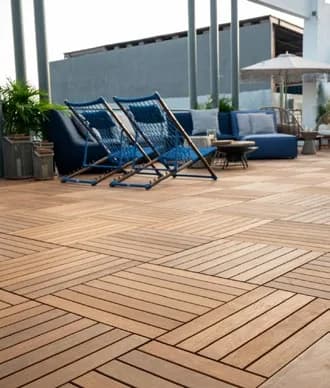
Understanding 'Uneven' Surfaces for Deck Tiles
An "uneven surface" can refer to several conditions, each requiring a different approach for Cumaru deck tile installation. It could mean minor variations in height across a concrete slab, significant slopes for drainage, or localized depressions and humps. It might also include soft spots in a gravel base or a deck frame that has settled inconsistently.
For deck tile installations, the goal is typically a flat, stable, and uniformly supported surface. This is because deck tiles, especially those designed for direct placement or attachment to a grid, rely on consistent support to prevent rocking, cracking, or uneven wear over time. Understanding the specific type of unevenness on your project site is the first step in planning.
Direct Placement on Moderately Uneven Surfaces
For minor inconsistencies, such as slight dips or rises of less than 1/4 inch over several feet, Cumaru deck tiles might be placed directly on the surface if the unevenness is gradual. However, this approach has limitations. The tiles may follow the contours of the substrate, leading to a surface that is not perfectly level. This can be acceptable for certain aesthetic preferences or low-traffic areas where a perfectly flat surface isn't critical.
It is crucial that any direct placement still provides full and stable support for each tile. Gaps underneath tiles can lead to movement, noise, and potential damage over time. If the unevenness creates unsupported areas under the tiles, it is generally recommended to address the substrate first.
Using Pedestal Systems for Significant Unevenness
For more significant variations in surface height, particularly on rooftops, terraces, or over existing concrete slabs with drainage slopes, a pedestal system is often the most effective solution. Pedestals are adjustable supports that elevate the deck tiles above the substrate, creating a level surface.
These systems allow for precise leveling, accommodating slopes and localized unevenness by adjusting the height of individual pedestals. This also creates a void beneath the tiles, which can be beneficial for drainage and concealing utilities. When using a pedestal system, the underlying surface does not need to be perfectly level, but it must be stable and capable of bearing the load of the pedestles, tiles, and any anticipated live loads (people, furniture, planters).
Addressing Substrate Issues: Repair vs. Concealment
It is important to distinguish between concealing unevenness and repairing structural or significant substrate defects. While pedestal systems can compensate for variations in height, they are not a substitute for repairing a damaged or unstable substrate.
For instance, if a concrete slab has significant cracks, spalling, or is actively settling, these issues should be addressed by a qualified professional before installing any deck tile system. Similarly, a wooden deck frame with rotten joists or an unstable gravel base requires repair to ensure the long-term integrity of the installation. Cumaru deck tiles are designed to sit on a stable foundation, whether that's a prepared sub-surface or an adjustable support system.
Example: Planning for a Sloping Concrete Patio
Consider a hypothetical concrete patio measuring 10 feet by 12 feet, which has a consistent slope of 1/4 inch per linear foot for drainage, running along its 12-foot length. This means one end of the patio is 3 inches lower than the other (12 feet * 1/4 inch/foot = 3 inches).
Directly placing 24 x 24 inch Cumaru deck tiles on this surface would result in the deck tiles following the slope, creating a noticeably pitched surface. To achieve a level walking surface, an adjustable pedestal system would be suitable. This approach allows the tiles to appear flat and level for outdoor furniture and foot traffic.
For this 10x12 foot area, 60 Cumaru 24x24 inch deck tiles would be needed (120 sq ft / 4 sq ft per tile = 30 tiles, multiplied by 2 to account for potential cuts and waste, depending on layout and edge treatment).
Before you order
- Assess the degree and type of unevenness: Is it minor, gradual, or significant?
- Determine if the substrate is structurally sound and stable, or if repairs are needed.
- Consider the desired outcome: Do you need a perfectly level surface, or is a slight contour acceptable?
- Evaluate installation methods: Is direct placement feasible, or is a pedestal system required?
- Account for drainage: Ensure water can still flow away from the structure beneath the tiles.
- Factor in the height of the new deck: Will it impact door thresholds or adjacent surfaces?
- Review product specifications for Cumaru deck tiles and any chosen support system for compatibility.
Confirm installation details, approved uses and warranty terms in the current instructions for the exact product and profile. Your installer should verify the substrate, structure and applicable project requirements.
Questions to help you decide
Can Cumaru deck tiles hide large cracks in a concrete slab?
While Cumaru deck tiles can cover the appearance of large cracks, they do not address the underlying structural issue. If a concrete slab has significant cracks, it indicates a potential structural problem that should be evaluated and repaired by a professional before installing any deck tile system. Covering structural defects without repair can lead to further damage to the slab and the deck tile installation over time.
Do I need a vapor barrier if my surface is uneven?
A vapor barrier is generally not a primary solution for unevenness. Its purpose is to manage moisture. If your uneven surface is prone to moisture accumulation or sits directly on the ground, a vapor barrier or proper drainage solution beneath the deck tiles might be necessary to prevent moisture-related issues for the sub-surface. Consult local building practices and a professional to assess specific moisture control needs for your project.
What is the maximum height difference a pedestal system can accommodate?
The maximum height difference a pedestal system can accommodate varies significantly by manufacturer and specific product. Many adjustable pedestal systems can handle height differences ranging from less than an inch up to several inches, and some specialized systems can go even higher. Always refer to the specifications of the specific pedestal product you intend to use for its exact adjustable range and load-bearing capacity.
Ready to Plan Your Cumaru Deck Tile Project?
Request a material quote with your project dimensions, desired Cumaru deck tile profile (12x12 or 24x24), and ZIP code. Confirm current availability and service options for your location.
Request a material quote →