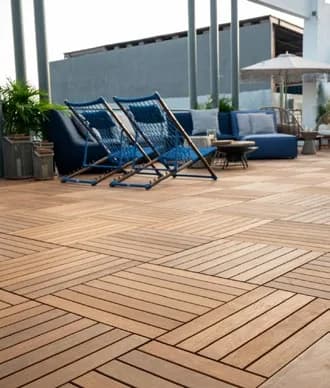
Cumaru Deck Tiles: The Foundation of Your Pattern
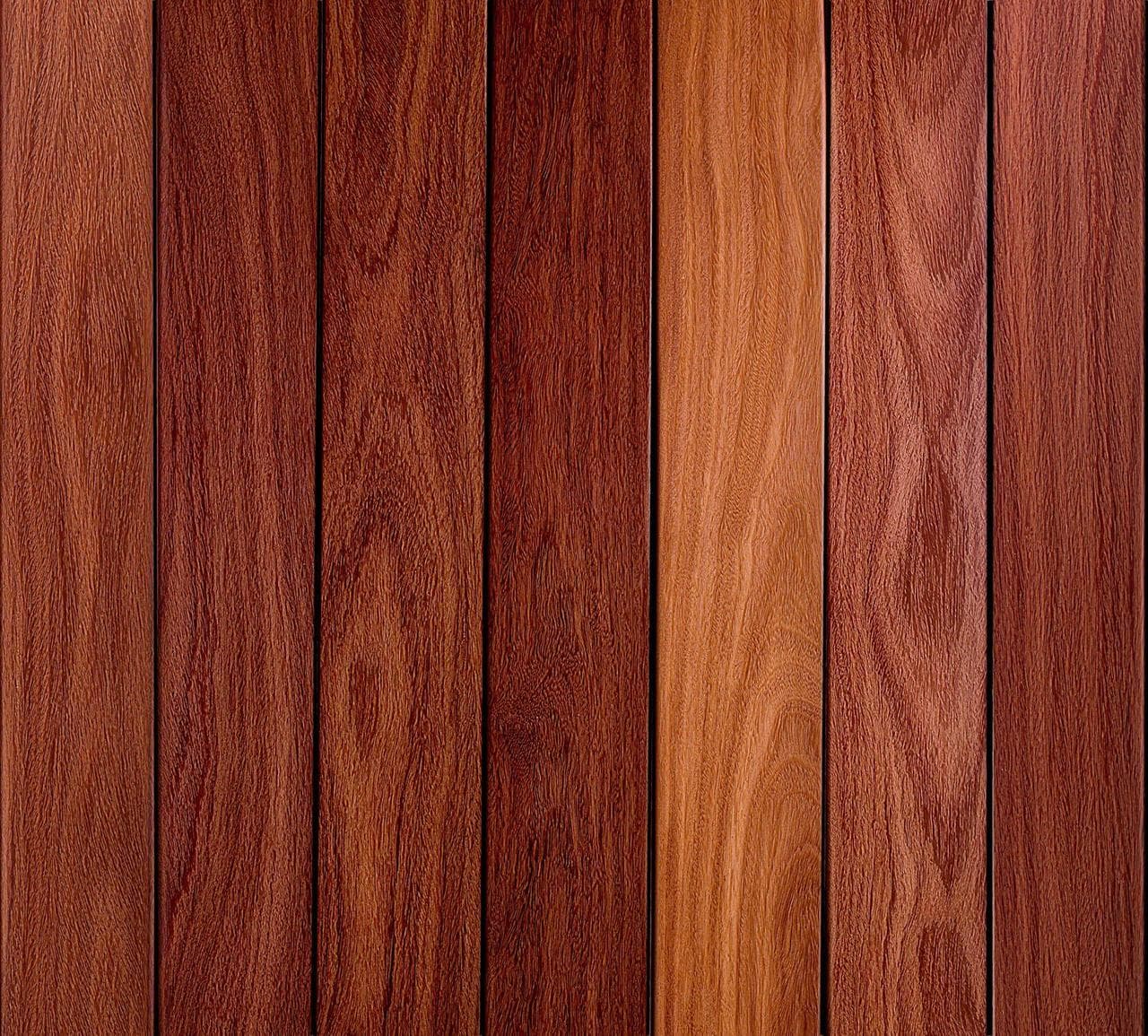
Cumaru deck tiles offer a rich reddish-brown grain with the strength and character of tropical hardwood, providing a durable and attractive surface for outdoor areas. Available in two primary sizes, 12" x 12" and 24" x 24", these square modules are designed for ease of installation and versatility. The choice of tile size can significantly influence the visual scale of your chosen pattern, with smaller tiles creating more visible grid lines and larger tiles offering a more expansive look.
Each 12" x 12" tile covers approximately 1 square foot, while a 24" x 24" tile covers 4 square feet. This modularity makes them suitable for various applications, from compact balconies to large rooftop terraces. The inherent color variation and grain of Cumaru wood mean that even a simple pattern will have natural visual interest, but thoughtful pattern direction can enhance this further.
The Straight Layout: Classic and Streamlined
The straight layout, also known as a stack bond, involves arranging Cumaru deck tiles in a simple grid, with all tiles aligned in the same direction. This pattern creates clean, parallel lines that can emphasize the linearity of a space or guide the eye towards a particular focal point, such as an expansive view or an architectural feature.
This layout is often the most straightforward to install, as it minimizes complex cuts and maintains a consistent visual flow. It's an excellent choice for modern or minimalist designs where simplicity is key. For smaller spaces, a straight layout can make the area appear larger and more organized. With Cumaru's distinct grain, aligning the planks within each tile consistently can create a subtle, unified texture across the entire surface.
The Alternating Layout: Dynamic and Engaging
An alternating layout, sometimes called a checkerboard or rotating pattern, involves rotating adjacent Cumaru deck tiles by 90 degrees. This creates a visually dynamic effect where the wood grain within each tile runs perpendicularly to its neighbors, resulting in a varied play of light and shadow.
This pattern adds visual interest and can help break up large, monotonous surfaces. It's particularly effective with Cumaru's reddish-brown tones, as the alternating grain directions can highlight the natural variations in the wood. While slightly more complex to plan than a straight layout due to the rotation, the installation itself remains relatively simple, requiring no additional cutting for the pattern itself. This pattern is well-suited for spaces where you want to add a touch of sophistication and movement without introducing entirely different materials.
Zoned Layouts: Defining Areas with Pattern
Zoned layouts involve using different patterns or pattern directions within distinct areas of a larger space. For example, you might use a straight layout in a dining area and an alternating layout in a lounge area, or orient the straight pattern differently to delineate pathways.
This approach is ideal for large terraces or multi-functional outdoor rooms where you want to create visual separation without physical barriers. Zoned layouts can help define gathering spaces, walkways, or areas for specific activities. Planning a zoned layout requires careful measurement and consideration of how transitions between patterns will appear. It might also lead to more cuts at the boundaries between zones, which should be factored into your material estimate.
Worked Example: Planning an Alternating Pattern for a 10' x 12' Terrace
Let's consider a hypothetical 10-foot by 12-foot terrace where you want to install 24" x 24" Cumaru deck tiles in an alternating pattern. The total area is 120 square feet.
Each 24" x 24" tile covers 4 square feet. To cover the area, you would theoretically need 120 sq ft / 4 sq ft per tile = 30 tiles. However, we need to account for cuts and potential waste.
The terrace dimensions are 120 inches by 144 inches. Since the tiles are 24 inches square, the 10-foot (120-inch) width will perfectly fit 120 / 24 = 5 tiles. The 12-foot (144-inch) length will perfectly fit 144 / 24 = 6 tiles. This means you will have a perfect grid of 5 tiles by 6 tiles, totaling 30 tiles, with no edge cuts required for the main field.
For an alternating pattern, every other tile is rotated 90 degrees. Since the dimensions are perfectly divisible, each tile remains a full 24" x 24" module. In this ideal scenario, you would purchase exactly 30 tiles. However, it's always prudent to add a small percentage (e.g., 5-10%) for cuts around obstacles, future replacements, or unforeseen issues. For this project, ordering 32 tiles would provide a small buffer.
If your dimensions were not perfectly divisible by 24 inches, you would need to plan cuts for the perimeter. For instance, if the terrace was 10' x 13', the extra foot (12 inches) in length would require cuts. You would lay 6 full tiles along the 12-foot section and then cut the 7th tile in half (or from a full tile) to cover the remaining 1-foot section. The offcut could potentially be used elsewhere if it meets the minimum usable size.
Considerations for Pattern Planning and Installation
When planning your Cumaru deck tile pattern, consider the following:
Substrate and Support: Ensure your underlying surface is level, stable, and provides adequate drainage. Whether using a pedestal system or laying directly on a prepared surface, the foundation is critical for the longevity and appearance of any pattern.
Edge Treatments: How will your chosen pattern terminate at the edges of your space? Will you use a border tile, trim, or simply let the pattern end? This impacts the finished look and potential cutting requirements.
Obstacles: Plan how your pattern will work around fixed elements like columns, planters, or drains. These will almost certainly require precise cuts and may interrupt the visual flow of your chosen pattern. It's often helpful to sketch out your layout in advance.
Material Waste: Complex patterns or those requiring many perimeter cuts will generally result in more material waste. Always add an overage to your material order to account for cuts and potential mistakes. A typical recommendation is 5-10% extra, depending on the complexity of the layout and the irregularity of the space.
Future Access: If the area beneath the deck tiles requires occasional access (e.g., for drains or utilities), plan your pattern to allow for easy removal of specific tiles without disrupting the entire layout.
Before you order
- Determine the overall dimensions of your project area.
- Choose your Cumaru deck tile size (12" x 12" or 24" x 24").
- Sketch out potential layout patterns (straight, alternating, zoned) to visualize the effect.
- Consider how the pattern will interact with the shape of your space and any fixed obstacles.
- Estimate the number of full tiles required, then calculate cuts for edges and obstacles.
- Add a waste factor (typically 5-10%) to your total tile count.
- Plan for edge finishes and transitions between different zones if applicable.
- Verify the suitability of your substrate and support system for the chosen tile and pattern.
Confirm installation details, approved uses and warranty terms in the current instructions for the exact product and profile. Your installer should verify the substrate, structure and applicable project requirements.
Questions to help you decide
Can I combine different Cumaru deck tile sizes in one pattern?
While Cumaru deck tiles are available in 12"x12" and 24"x24" sizes, combining them in a single pattern can be challenging. The different module sizes would require careful planning to maintain a cohesive look and ensure proper support. It's generally simpler to stick to one size for a unified pattern, though creative designers might achieve interesting effects with careful planning and custom cuts.
Does the pattern direction affect the durability or stability of the Cumaru deck tiles?
The aesthetic pattern direction (straight, alternating, zoned) itself does not inherently affect the durability or stability of the Cumaru deck tiles, assuming they are installed correctly on a stable and level substrate. The crucial factors for durability are proper installation, adequate support beneath each tile, and consistent maintenance. The pattern is primarily a visual choice.
How do I calculate the number of tiles needed for a complex pattern?
For complex patterns, it's highly recommended to create a detailed scaled drawing of your project area. Lay out the tiles virtually, marking where full tiles, half tiles, and custom cuts will be needed. Calculate the total square footage and then divide by the square footage of a single tile to get a base number. Then, add extra tiles for all perimeter cuts, cuts around obstacles, and a general waste factor (e.g., 10-15% for complex layouts). This visual planning helps minimize ordering errors.
Ready to Design Your Outdoor Space with Cumaru Deck Tiles?
Request a material quote with your project dimensions, exact Cumaru deck tile profile, and ZIP code. We can confirm current availability and service options for your chosen design.
Request a material quote →