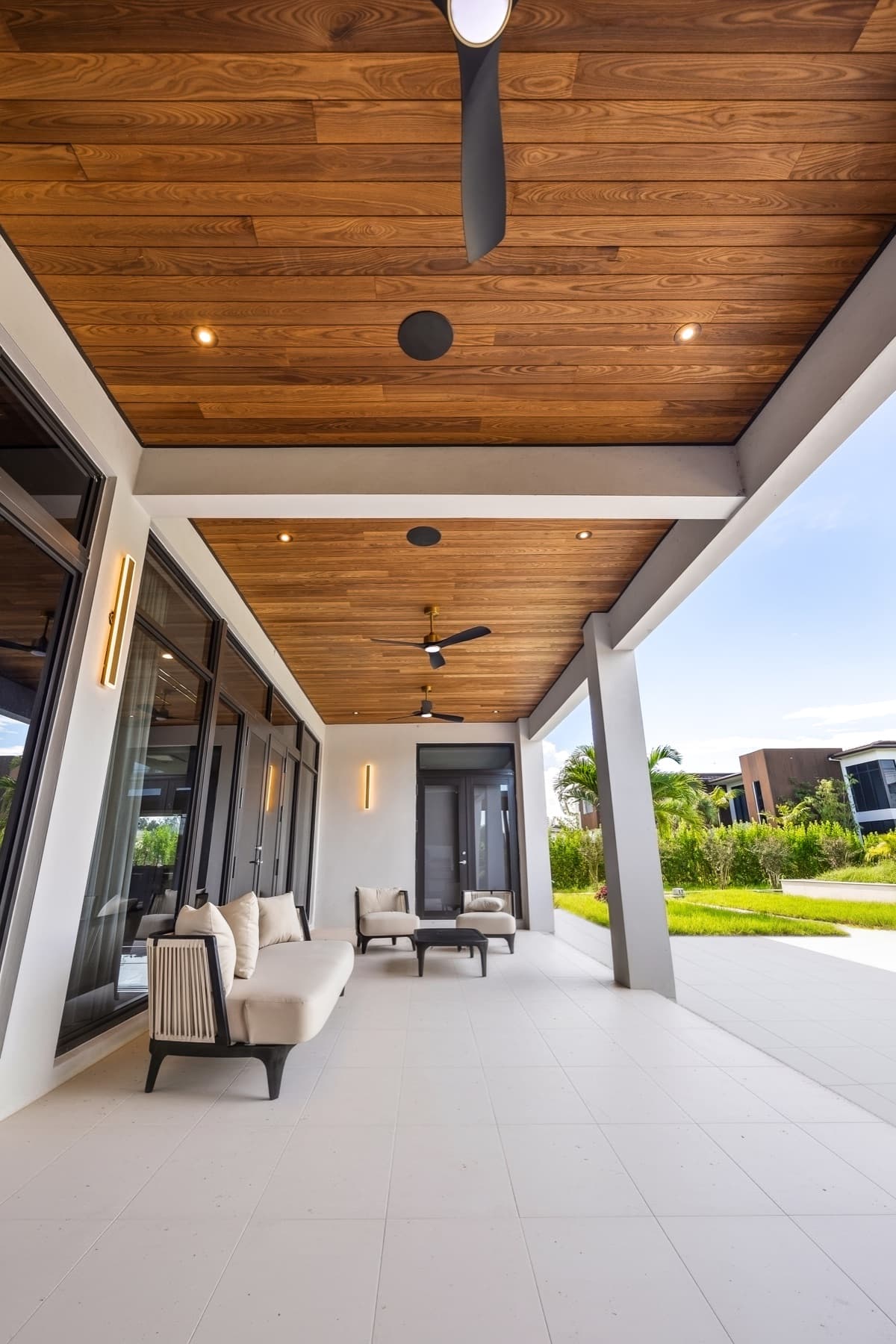
Understanding Your Porch: Open Air vs. Enclosed
Before selecting materials, consider the exposure level of your porch. An open-air porch, directly exposed to the elements, will require materials with higher weather resistance compared to a screened or fully enclosed porch. Trenton's climate, with its warm, humid summers and cold winters, means that even covered porches can experience significant temperature fluctuations and humidity.
For open porches, materials must withstand direct rain, snow, and UV exposure. Enclosed porches offer more protection, allowing for a wider range of material choices, but still require resistance to humidity and temperature changes that can occur within the covered space.
Material Options for Porch Ceilings and Soffits
Lumber Plus offers a variety of materials suitable for porch ceilings and soffits, each with distinct characteristics:
Thermally Modified Wood: Options like Scandinavian thermally modified wood, Ayous, and Ash offer enhanced stability and resistance to moisture. The thermal modification process alters the wood's cellular structure, making it less prone to expansion, contraction, and decay. This makes it a suitable choice for exterior applications like porch ceilings and soffits. It provides a natural wood aesthetic that can be stained or left to weather naturally. You can explore these options at our Thermally Modified Wood collection.
Hardwoods: Brazilian hardwoods such as Ipe, Cumaru, Garapa, Angelim, Jatoba, and Tigerwood are known for their natural density and durability. These woods offer rich colors and distinctive grain patterns, providing a premium look. They are naturally resistant to decay and insects, making them a strong candidate for exposed porch ceilings. Regular maintenance, such as oiling, can help preserve their original color.
Norx Composite: Norx composite ceiling and soffit boards offer a low-maintenance alternative to natural wood. These engineered materials are designed for exterior use, providing consistent color and resistance to rot, insects, and splitting. Norx is available in various finishes, including those that mimic the appearance of wood, offering design flexibility without the need for periodic sealing or staining. Explore Norx options here: /brands/versatex (Note: Versatex is a brand that may offer similar products, but Norx is a distinct composite product mentioned in sources).
Maximo Accoya: Accoya is acetylated wood, which undergoes a non-toxic modification process to enhance its durability and dimensional stability, similar to thermally modified wood but through a different chemical process. It offers excellent performance for demanding exterior applications and can be painted or stained. Accoya is a premium choice for longevity and low maintenance.
Coordinating with Porch Proportions and Lighting
The size and height of your porch will influence material and finish choices. For smaller porches, lighter-colored materials or those with a finer grain can help create a more open and inviting feel. On larger porches, darker woods or more pronounced grain patterns can add a sense of grandeur and definition.
Lighting integration is crucial. Recessed lighting, surface-mounted fixtures, or even ceiling fans with lights need to be planned in conjunction with the ceiling material. Ensure that the chosen material can accommodate the necessary cutouts and support the weight of fixtures. For wood ceilings, consider how wiring will be routed and concealed. For composite panels, verify compatibility with fixture installation methods.
The Role of Soffits in Roof Ventilation
Beyond aesthetics, soffits play a critical role in your home's roof ventilation system. Proper soffit ventilation allows for a continuous airflow from the eaves into the attic, which helps to regulate attic temperature and prevent moisture buildup. This is particularly important in Trenton's climate, where both summer heat and winter condensation can be concerns.
When selecting soffit materials, ensure they are compatible with your roof's ventilation strategy. This may involve using vented soffit panels or ensuring that solid soffit panels are installed in a way that does not obstruct existing ventilation openings. Consult with a roofing professional to confirm that your chosen soffit material and installation method will maintain adequate airflow.
Worked Example: A 10' x 12' Trenton Porch Ceiling
Let's consider a hypothetical Trenton porch measuring 10 feet by 12 feet, requiring a new ceiling. The homeowner desires a natural wood look with good durability to withstand local weather.
Assumptions:
1. Ceiling area: 10 ft x 12 ft = 120 square feet.
2. Chosen material: Thermally Modified Ayous, 5.5-inch wide boards (net coverage, assuming a standard tongue-and-groove profile).
3. Board length: Available in 8-foot and 12-foot lengths.
4. Installation direction: Parallel to the 10-foot dimension, meaning 12-foot boards will run across the 12-foot length.
Calculation:
Number of boards needed across the 10-foot width: (10 feet * 12 inches/foot) / 5.5 inches/board = 21.82 boards. Round up to 22 boards.
Total boards: 22 boards * 1 (for length) = 22 boards of 12-foot length.
Consider waste: It is prudent to add 10-15% for cuts, potential mistakes, and future repairs. For this project, let's add 10% waste: 22 boards * 1.10 = 24.2 boards. Round up to 25 boards.
Therefore, 25 boards of 12-foot Thermally Modified Ayous, 5.5 inches wide, would be a reasonable purchase quantity for this project. This calculation does not account for specific trim pieces or complex perimeter details, which would require separate measurement.
Before you order
- Assess porch exposure: Is it open-air, screened, or enclosed?
- Consider Trenton's climate: Humidity, temperature swings, and precipitation.
- Evaluate material options: Thermally modified wood, hardwoods, or composite.
- Match material to aesthetic goals: Grain, color, and finish.
- Plan for lighting and fixtures: Ensure material compatibility and support.
- Verify roof ventilation: Soffit design must support attic airflow.
- Measure accurately: Account for area, board width, and waste factor.
- Consider maintenance: Natural wood typically requires more maintenance than composite.
Confirm installation details, approved uses and warranty terms in the current instructions for the exact product and profile. Your installer should verify the substrate, structure and applicable project requirements.
This is a planning guide for projects in Trenton, NJ. Ask our team to confirm availability, delivery to your ZIP code and which branch can support your order.
Questions to help you decide
What is the best material for a porch ceiling in Trenton, NJ?
The 'best' material depends on your specific porch's exposure and your aesthetic and maintenance preferences. Thermally modified wood and hardwoods like Ipe offer natural beauty and durability for exposed porches. Norx composite provides a low-maintenance, consistent finish. All options are designed to perform well in Trenton's varied climate, but each has different characteristics regarding appearance, upkeep, and cost.
Do I need special ventilation for my porch soffit?
Yes, proper soffit ventilation is crucial for the health of your roof system. Soffits are part of the attic ventilation pathway, allowing cool air to enter and hot, moist air to exit through ridge vents. Obstructing this airflow can lead to moisture buildup, mold, and reduced roof lifespan. Always ensure your chosen soffit material and installation method support continuous, unobstructed airflow to your attic.
Can I paint or stain thermally modified wood?
Yes, thermally modified wood can be painted or stained. Its enhanced stability means it holds finishes well and is less prone to warping or cracking. You can choose to apply a clear sealant to preserve its natural color, stain it to achieve a different hue, or paint it to match your home's trim. Always use exterior-grade finishes and follow the manufacturer's recommendations for application.
Ready to Plan Your Trenton Porch Ceiling?
Request a material quote with your project dimensions, desired profile, and ZIP code. We can help confirm current availability and service options for your Trenton project. Visit our website to get started.
Request a material quote →