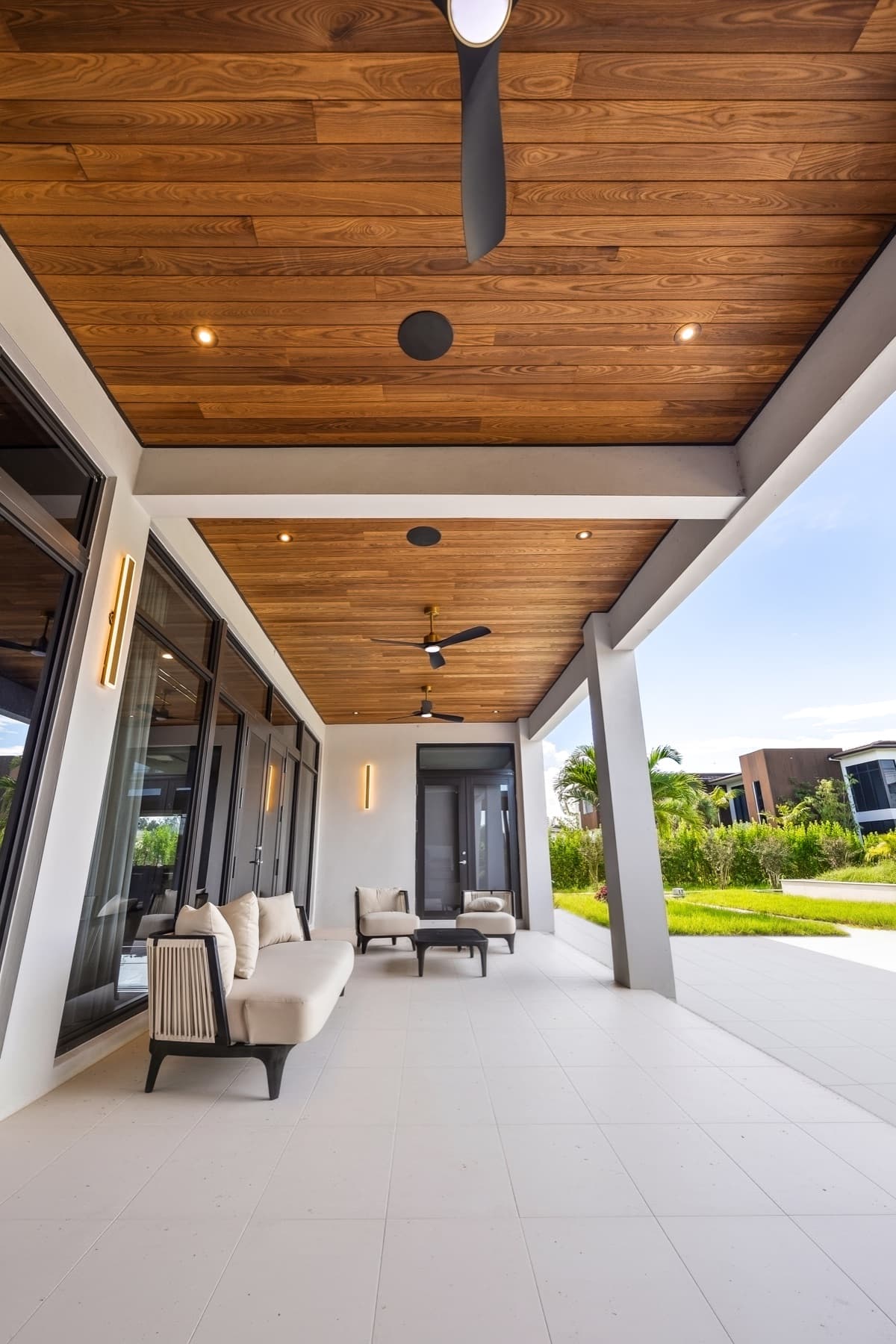
Understanding Porch Ceilings and Soffits
The porch ceiling is the underside of your porch roof, visible from below, while soffits are the exposed undersides of roof overhangs that extend beyond the exterior walls of your home. Both play a crucial role in the overall appearance of your porch and contribute to the building's envelope.
Beyond aesthetics, these elements are vital for protecting the structural components of your porch from weather exposure. Soffits, in particular, often incorporate vents to facilitate attic ventilation, which is important for managing heat and moisture within the roof structure, especially in a climate like Oklahoma City's. Carefully planning these components ensures both visual appeal and practical function.
Material Options for Porch Ceilings and Soffits
Several material types are suitable for porch ceilings and soffits, each offering distinct advantages in terms of appearance, durability, and maintenance. Your choice will often balance desired aesthetic with practical considerations.
Wood options, such as thermally modified wood or Brazilian hardwoods, provide a natural, warm aesthetic. Thermally modified wood, including Scandinavian thermally modified wood, Ayous, and Ash, is known for its stability and resistance to decay. Brazilian hardwoods like Ipe, Cumaru, Garapa, Angelim, and Jatoba offer rich colors and inherent durability. These are often chosen for their natural beauty and ability to complement traditional and contemporary designs.
Composite materials, such as the Norx collection, offer an alternative with specific advantages. These products are designed for consistency and often require less maintenance than some natural wood options, making them suitable for areas where minimizing upkeep is a priority. Maximo Accoya, an acetylated wood product, also presents a stable and durable option for ceiling and soffit applications, distinct from thermally modified wood.
Each material type has specific profiles and finishes available, allowing for customization to match your home's architectural style and your personal preferences.
Explore our full range of options at: [https://lumberplus.com/ceiling-and-soffit](https://lumberplus.com/ceiling-and-soffit)
Considering the Oklahoma City Climate
Oklahoma City experiences a humid subtropical climate with hot, often severe, summers and mild to cold winters. This climate presents specific challenges for exterior materials.
High humidity and temperature fluctuations can impact wood products, making material stability a key factor. Thermally modified wood and acetylated wood are engineered to offer enhanced dimensional stability, which can be beneficial in preventing warping or excessive movement. For natural hardwoods, proper installation techniques that account for natural movement are essential. Materials with good resistance to moisture and UV exposure will generally perform better and retain their appearance longer in this environment.
Ventilation in soffits is also critical. Effective soffit venting helps to reduce attic temperatures during hot summers, which can lower cooling costs and extend the life of your roof. It also helps prevent moisture buildup during humid periods, mitigating potential issues like mold or rot. Ensure that your chosen soffit material can accommodate adequate ventilation openings as required by local building practices.
Integrating Lighting and Other Fixtures
The porch ceiling often serves as a surface for integrating lighting fixtures, ceiling fans, and sometimes speakers. Planning these elements early is crucial for a cohesive design and proper installation.
When selecting materials, consider how easily they can be cut and routed to accommodate electrical boxes and wiring. For wood ceilings, careful planning of board layout can help conceal wiring and provide solid backing for fixtures. For composite materials, ensure that the product specifications support the intended application of fixtures.
The weight of fixtures should also be considered, ensuring adequate structural support above the ceiling material. Recessed lighting offers a clean, flush look, while surface-mounted fixtures or fans can become design features. Always consult with a qualified electrician for wiring and installation to ensure safety and compliance with local codes.
Worked Example: A 12x8 Foot Porch Ceiling
Let's consider a hypothetical porch in Oklahoma City with a ceiling area measuring 12 feet by 8 feet. The homeowner desires a natural wood look with good stability and low maintenance.
For this example, we'll select Thermally Modified Ayous ceiling boards. These are often available in standard widths, such as 5.5 inches (actual coverage) and various lengths. To cover a 12-foot length, we would select boards that are 12 feet or longer, minimizing butt joints. For the 8-foot width, we need to calculate the number of boards.
8 feet = 96 inches. If each board covers 5.5 inches, then 96 inches / 5.5 inches/board = approximately 17.45 boards. We would round up to 18 boards to ensure full coverage and account for any cuts. For the 12-foot length, this means we need 18 boards, each 12 feet long. Total lineal feet: 18 boards * 12 feet/board = 216 lineal feet. When ordering, it is prudent to add an additional 10-15% for waste, cuts, and potential future repairs. So, 216 lineal feet * 1.15 = approximately 248.4 lineal feet to purchase.
This calculation provides a baseline. Always confirm actual board dimensions and account for specific installation requirements, such as starter and end boards, and any trim details. For soffit areas, similar calculations would apply, ensuring proper ventilation cutouts are planned and supported.
Consider complementing your porch ceiling with [Thermally Modified Wood Decking](https://lumberplus.com/thermally-modified-wood) for a unified aesthetic.
Before you order
- Determine the primary function: aesthetic appeal, ventilation, or both?
- Evaluate material durability against Oklahoma City's climate (heat, humidity, storms).
- Consider maintenance requirements for chosen materials.
- Plan for integration of lighting, fans, and other fixtures.
- Verify compatibility with existing architectural style.
- Account for proper soffit ventilation if applicable.
- Calculate material quantities with a waste factor.
- Review local building codes and best practices for porch ceilings and soffits.
Confirm installation details, approved uses and warranty terms in the current instructions for the exact product and profile. Your installer should verify the substrate, structure and applicable project requirements.
This is a planning guide for projects in Oklahoma City, OK. Ask our team to confirm availability, delivery to your ZIP code and which branch can support your order.
Questions to help you decide
What is the difference between a porch ceiling and a soffit?
A porch ceiling is the finished underside of a covered porch roof, directly above the porch living space. Soffits are the undersides of roof overhangs that extend beyond the exterior walls of the house, often containing vents for attic ventilation.
Are certain wood types better for Oklahoma City's climate?
Wood types engineered for enhanced stability and resistance to moisture, such as thermally modified wood (e.g., Ayous, Ash) and acetylated wood (e.g., Maximo Accoya), can perform well in Oklahoma City's climate due to their reduced propensity for warping or decay when properly installed and maintained. Durable hardwoods like Ipe also offer excellent performance.
Do I need to ventilate my porch ceiling?
While the porch ceiling itself typically does not require ventilation, the soffit areas (if present as part of the main roof structure) are crucial for attic ventilation. Proper soffit venting helps manage heat and moisture in the attic space, which is important for roof longevity and energy efficiency, especially in Oklahoma City's hot summers.
Ready to Plan Your Porch Ceiling or Soffit Project?
Request a material quote with your project dimensions, desired profile, and ZIP code. We can help you confirm current availability and service options for your Oklahoma City project.
Request a material quote →