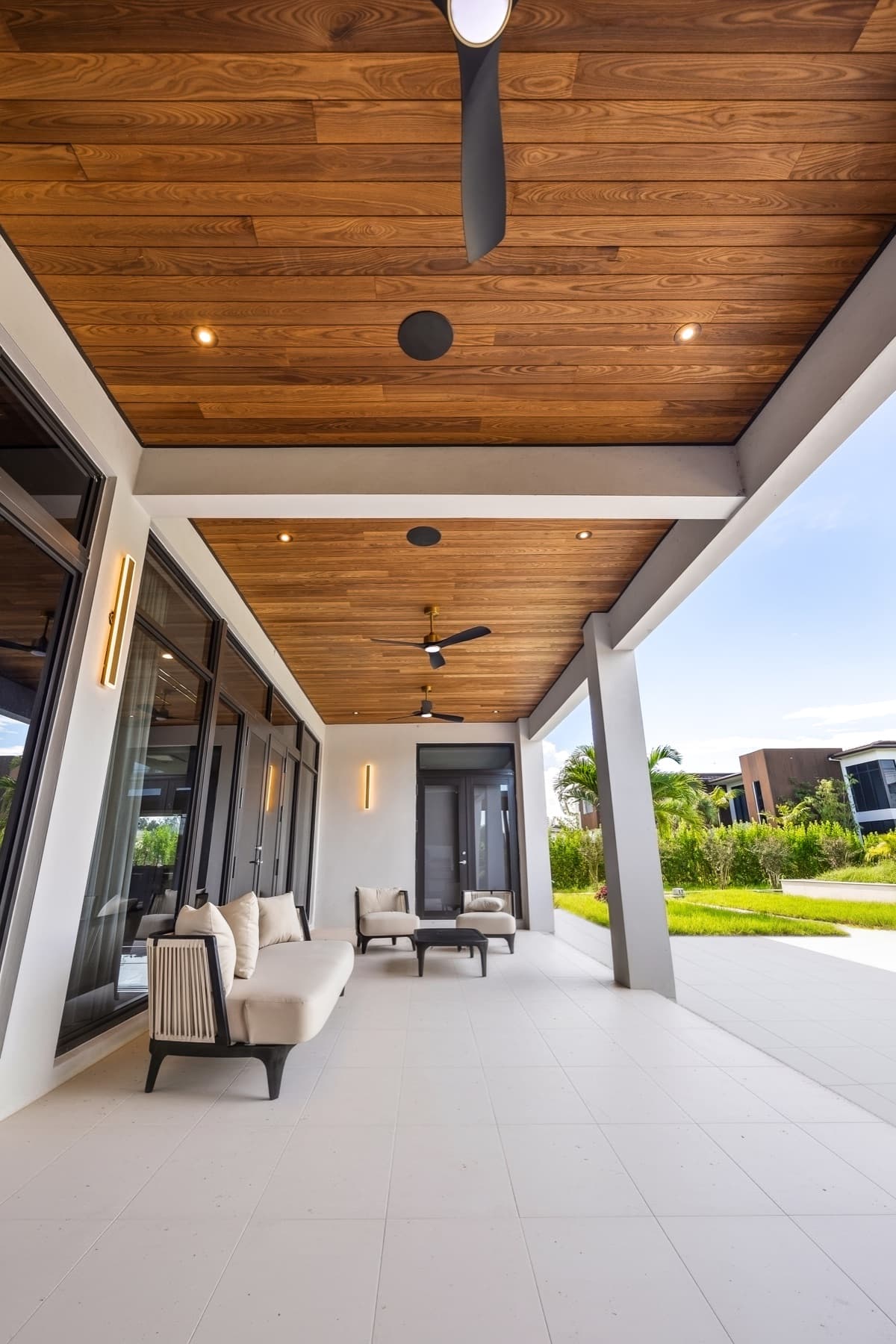
Understanding the Ocean City Coastal Environment
Ocean City's coastal climate presents specific challenges for exterior building materials. High humidity, salt spray, and fluctuating temperatures can accelerate wear and tear on less resilient products. When selecting porch ceiling and soffit materials, prioritize those known for their stability and resistance to moisture and decay.
Materials that perform well in these conditions typically include naturally durable hardwoods or engineered wood products designed for exterior use. These options can help ensure your porch ceiling maintains its appearance and structural integrity over time, minimizing maintenance needs.
Thermally Modified Wood for Coastal Porches
Thermally modified wood is a strong candidate for porch ceilings and soffits in coastal areas like Ocean City. This process uses heat and steam to alter the wood's cellular structure, enhancing its stability and making it less prone to expansion, contraction, and decay when exposed to moisture.
Lumber Plus offers Scandinavian Thermally Modified Wood, including Ayous and Ash, which provide a Nordic character or clean grain aesthetic. These products are suitable for porches, lanais, and eaves, offering a lightweight option for overhead applications. The modification process results in a darker, richer tone that can complement various architectural styles.
For specific product details, refer to the Thermally Modified Wood collection.
The Appeal of Brazilian Hardwoods
Brazilian hardwoods such as Ipe, Cumaru, Garapa, Angelim, Jatoba, and Tigerwood offer exceptional natural durability and a range of rich colors for porch ceilings and soffits. These woods are naturally dense and resistant to decay, insects, and moisture, making them well-suited for the demanding Ocean City environment.
Ipe and Cumaru can provide deep brown tones, while Garapa offers golden hues that can brighten a porch area. The inherent strength and beauty of these hardwoods contribute to a luxurious and long-lasting finish. They are often chosen for their straight, stable characteristics, making them suitable for soffit applications.
Explore the full range of Brazilian hardwoods available for your project.
Considering Maximo Accoya and Norx Composite Options
Maximo Accoya is an acetylated wood product that offers enhanced durability and stability, making it another viable choice for exterior applications. Acetylation alters the wood's chemical structure, improving its resistance to rot and dimensional changes, which is beneficial in humid coastal climates. Accoya can be finished to achieve various looks.
For those considering composite materials, the Norx collection offers composite ceiling and soffit options. These materials are engineered for consistency and low maintenance, providing an alternative to natural wood while still offering appealing aesthetics. Norx products are available in various finishes, such as Oxford Gray, which can provide a contemporary look.
Review the specific characteristics of Norx composite options and Accoya for your project needs.
Worked Example: Porch Ceiling Material Calculation
Let's consider a hypothetical porch in Ocean City, MD, measuring 16 feet wide by 8 feet deep. The project requires a thermally modified Ayous ceiling, with boards available in 5-inch nominal width (actual 4.5 inches) and random lengths up to 16 feet. We'll assume a standard installation with boards running perpendicular to the 8-foot depth.
First, calculate the total area: 16 feet * 8 feet = 128 square feet. Next, determine the number of board courses needed across the 16-foot width. With 4.5-inch actual width boards, and allowing for a small waste factor for cuts and fitting, we can estimate board coverage. 16 feet * 12 inches/foot = 192 inches. 192 inches / 4.5 inches/board = 42.67 boards. Round up to 43 boards for coverage. Since the boards are available in lengths up to 16 feet, and our depth is 8 feet, each 16-foot board can be cut in half, yielding two 8-foot sections.
Therefore, for 43 courses, you would need 43 / 2 = 21.5 full 16-foot boards. Always round up to the nearest whole board when purchasing, so 22 boards. This calculation does not account for specific cutting patterns for corners or integrated lighting, which would require additional material. It's always advisable to add a 10-15% waste factor for cuts, mistakes, and future repairs. For this project, a 10% waste factor would mean 22 * 1.10 = 24.2 boards, rounded up to 25 boards. Always confirm exact dimensions and waste factors with your installer.
This example provides a baseline. For precise material takeoffs, consider the exact profile dimensions, end-matching availability, and specific project details like angles or penetrations for lighting or fans.
Before you order
- Assess exposure to salt spray, humidity, and direct sun for your specific porch location.
- Consider the architectural style of your home and desired aesthetic (e.g., natural wood, painted, modern composite).
- Evaluate the weight of the material in relation to your porch's existing or planned structural support.
- Determine if ventilation is required in your soffit area and how the chosen material integrates with ventilation solutions.
- Plan for integrated lighting or fans, ensuring compatibility with the chosen ceiling material and installation method.
- Review maintenance requirements for each material option, considering the coastal environment.
- Obtain samples to confirm color, texture, and finish before making a final decision.
Confirm installation details, approved uses and warranty terms in the current instructions for the exact product and profile. Your installer should verify the substrate, structure and applicable project requirements.
This is a planning guide for projects in Ocean City, MD. Ask our team to confirm availability, delivery to your ZIP code and which branch can support your order.
Questions to help you decide
What is the best material for a porch ceiling in Ocean City's coastal climate?
Materials known for excellent moisture and decay resistance are ideal. Thermally modified woods like Ayous or Ash, durable Brazilian hardwoods such as Ipe or Cumaru, and acetylated wood like Accoya are strong contenders due to their enhanced stability and longevity in humid, salty conditions. Composite options like Norx also offer a low-maintenance solution.
Do I need special fasteners for coastal porch ceilings?
Yes, in coastal environments, it's critical to use corrosion-resistant fasteners. Stainless steel screws or nails are typically recommended to prevent rust and staining, which can compromise both the appearance and structural integrity of your porch ceiling over time. Always check manufacturer recommendations for specific products.
How do I account for roof ventilation when installing a porch soffit?
If your roof design relies on soffit ventilation, it's crucial to integrate vented soffit panels or maintain appropriate gaps with your chosen material to ensure continuous airflow into the attic space. Consult with your builder or a roofing professional to confirm ventilation requirements and ensure your soffit material choice supports proper roof performance without impeding airflow.
Ready to Transform Your Ocean City Porch?
Request a material quote with your project dimensions, desired profile, and ZIP code. We'll help you confirm current availability and service options for your Ocean City, MD project.
Request a material quote →