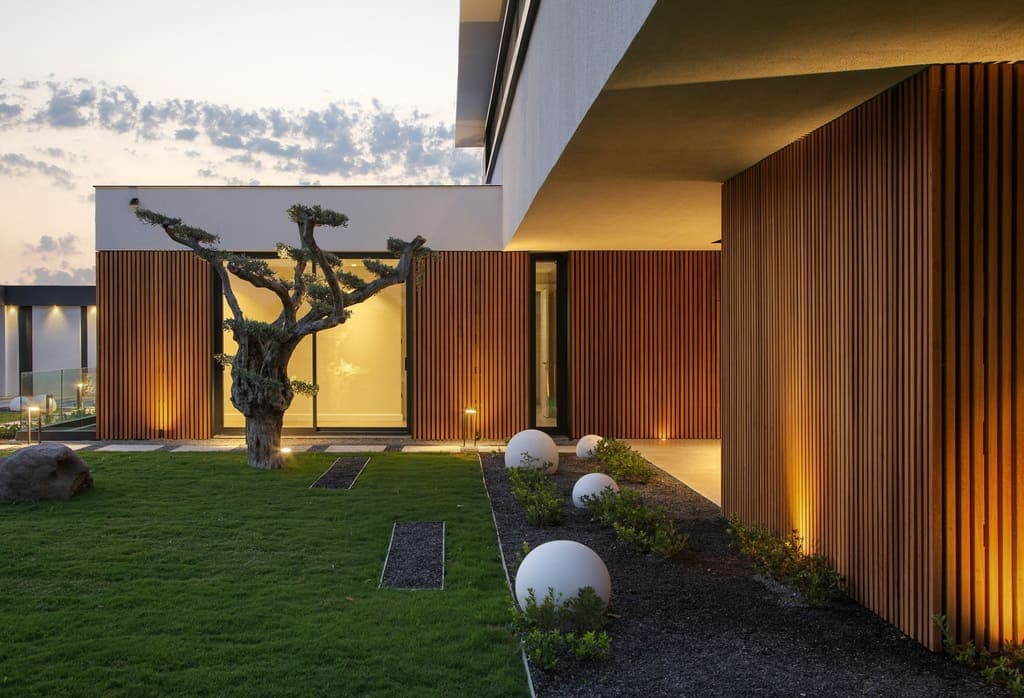
Why Thermally Modified Wood for Covered Patio Walls?
Thermally modified wood undergoes a high-temperature heat treatment process that alters its cellular structure. This process aims to reduce the wood's moisture absorption and increase its dimensional stability, which can be beneficial in environments with fluctuating humidity, such as a covered patio in Sarasota. The modification makes the wood less prone to expansion, contraction, and warping compared to untreated timber, contributing to a more stable and long-lasting wall surface.
While covered patios offer protection from direct rain and intense sun, they are still exposed to ambient humidity and indirect sunlight. The enhanced stability of thermally modified wood can help maintain the integrity and appearance of the wall cladding over time. It also offers a natural wood aesthetic, allowing for a range of finishes from natural, silvery-gray weathering to stained or painted looks.
Selecting the Right Species and Profile
Thermally modified wood is available in various species, each with unique grain patterns and characteristics. Popular options include thermally modified Pine and Ash, which offer distinct visual qualities. For covered patio walls, the choice of species often comes down to desired appearance and budget. Regardless of species, the thermal modification process aims to impart similar improvements in stability.
Profile selection is crucial for the final aesthetic and installation. Common profiles suitable for wall applications include tongue-and-groove (T&G), shiplap, and square-edge boards. Tongue-and-groove profiles create a tight, interlocking fit, often used for a smooth, continuous surface. Shiplap offers a distinctive shadow line and allows for some movement, while square-edge boards can be installed with a visible gap for a more open look. Consider how the profile will interact with the light on your patio and the overall architectural style.
Considering Exposure and Finish in Sarasota
Even under a covered patio, thermally modified wood in Sarasota, FL, will be exposed to high ambient humidity and indirect UV radiation. While the thermal modification process enhances stability, a suitable finish is recommended to protect the wood's surface, maintain its color, and prolong its aesthetic appeal. Finishes can range from transparent sealers that allow the wood to gray naturally, to semi-transparent stains that add color while letting the wood grain show through, or opaque paints for a solid color.
If a natural, weathered look is desired, the wood will gradually turn a silvery-gray when exposed to UV light. Applying a UV-inhibiting clear coat can help slow this process and provide an additional layer of protection against moisture. For those who prefer to maintain the wood's original tone or introduce a specific color, regular reapplication of stains or paints will be necessary, especially in a humid climate.
Attachment and Substructure for Wall Cladding
Proper attachment is essential for the longevity and appearance of thermally modified wood patio walls. The specific attachment method will depend on the chosen profile and the existing substructure. For most wall cladding, a furring strip system is recommended. This creates a cavity between the cladding and the structural wall, allowing for air circulation and drainage, which is particularly important in humid climates like Sarasota.
Furring strips should be adequately spaced and securely fastened to the structural wall. The thermally modified wood boards are then typically attached to these furring strips using corrosion-resistant fasteners. Hidden fastening systems, such as blind nailing through the tongue of T&G profiles, can provide a clean, fastener-free appearance. For shiplap or square-edge profiles, face-fastening with screws or nails may be necessary, and pre-drilling can help prevent splitting.
Hypothetical Project Example: Covered Patio Wall
Let's consider a hypothetical covered patio in Sarasota, FL, with a back wall section measuring 10 feet wide by 8 feet high that needs thermally modified wood cladding. We select thermally modified Ash in a 5.5-inch face-width tongue-and-groove profile. Each board is 12 feet long.
The wall area is 10 ft * 8 ft = 80 square feet. To calculate the number of boards needed, we first find the square footage per board. A 12-foot board with a 5.5-inch face width covers (12 ft * 12 in/ft) * 5.5 in = 144 in * 5.5 in = 792 square inches. Converting to square feet: 792 sq in / 144 sq in/sq ft = 5.5 square feet per board. Therefore, 80 sq ft / 5.5 sq ft/board = 14.54 boards. Always round up to ensure sufficient material, so 15 boards are needed for coverage, not accounting for waste.
For practical installation, especially with cuts, a waste factor of 10-15% is advisable. For this project, let's use a 15% waste factor: 15 boards * 1.15 = 17.25 boards. We would purchase 18 boards. If the 12-foot boards are cut to 8-foot lengths, each board yields one 8-foot piece and a 4-foot offcut. Depending on the layout and any openings, these offcuts might be reusable for shorter sections, reducing overall waste. However, for a simple wall, assume full board purchases for each vertical run.
This example assumes vertical installation. If horizontal, the 10-foot width would mean each 12-foot board would yield one 10-foot section with a 2-foot offcut, which could be used for smaller areas. The decision to install vertically or horizontally impacts the cut plan and waste factor.
Before you order
- Verify local building codes for wall cladding in covered outdoor spaces.
- Assess the level of exposure to indirect sun and humidity on your patio.
- Choose a thermally modified wood species (e.g., Ash, Pine) based on desired grain and color.
- Select a profile (T&G, shiplap, square-edge) for aesthetic and installation needs.
- Determine the desired finish: natural weathering, stain, or paint.
- Plan for a furring strip substructure to ensure air circulation and drainage.
- Select appropriate corrosion-resistant fasteners (hidden or face-fastened).
- Calculate material quantities, including a waste factor for cuts and errors.
- Consider how cut ends will be treated and sealed for protection.
Confirm installation details, approved uses and warranty terms in the current instructions for the exact product and profile. Your installer should verify the substrate, structure and applicable project requirements.
This is a planning guide for projects in Sarasota, FL. Ask our team to confirm availability, delivery to your ZIP code and which branch can support your order.
Questions to help you decide
Does thermally modified wood require sealing or finishing for covered patio walls?
While thermally modified wood is more stable than untreated wood, applying a finish or sealer is generally recommended for covered patio walls in Sarasota. This helps protect the surface from indirect UV exposure and humidity, maintaining its appearance and prolonging its aesthetic life. Unfinished wood will naturally weather to a silvery-gray over time.
Can thermally modified wood be installed directly onto a concrete block wall?
It is generally not recommended to install thermally modified wood directly onto a concrete block wall, especially in humid climates. A furring strip system should be used to create an air gap between the wood cladding and the concrete. This allows for air circulation, helps manage moisture, and provides a stable surface for fastening the wood boards.
What maintenance is needed for thermally modified wood covered patio walls?
Maintenance depends on the chosen finish. If left to weather naturally, periodic cleaning to remove dirt, mold, or mildew may be sufficient. If stained or painted, reapplication will be necessary over time, following the manufacturer's recommendations for the specific product used. Regular inspection for any signs of damage or wear is also advisable.
Request a Material Quote for Your Covered Patio Wall Project
Ready to enhance your Sarasota, FL covered patio with thermally modified wood? Contact us today to request a material quote. Provide your project dimensions, desired profile, and ZIP code to confirm current availability and service options.
Request a material quote →