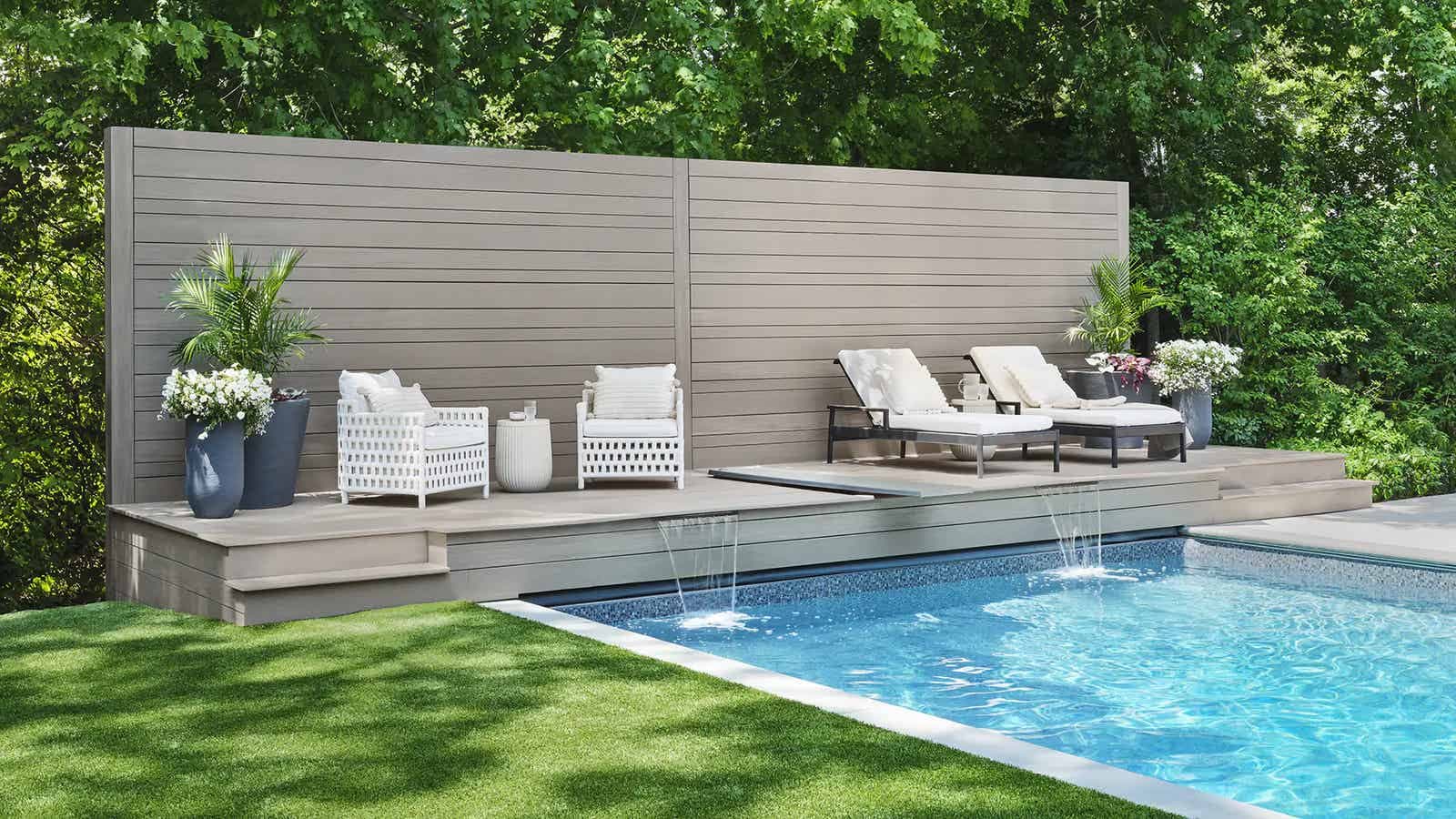
Why PVC Decking for Pool Terraces?
PVC decking is a 100% synthetic material, meaning it contains no wood fibers. This composition is a key advantage for pool terraces and other wet areas. This makes it a suitable choice for areas that are consistently wet.
The advanced capping on many PVC decking lines further enhances their suitability for poolside use. This protective layer helps the boards shed liquids like grease and wine, making them easier to clean. Many PVC options also offer heat-mitigating color choices, which can be a consideration for bare feet on a sunny Nashville day. These properties contribute to a low-maintenance deck surface that can withstand the demands of a pool environment.
Another benefit of PVC decking is its relatively light weight compared to hardwood and even some composite materials. This can translate to faster handling and installation, which may be a factor in your project timeline. It also contributes to its recyclability; PVC boards can often be reprocessed at the end of their life cycle.
Understanding PVC Decking Profiles and Appearance
PVC decking is available in various collections, often designed to mimic the appearance of natural wood with different grain patterns and color variations. For a pool terrace, you might consider collections that offer deeper wood looks or those with a more uniform, contemporary aesthetic. The choice of profile, such as grooved boards for hidden fasteners or solid boards for face fastening, will influence both the installation method and the finished look.
When selecting PVC decking, consider how the chosen color and finish will complement your home's exterior and pool area. Lighter colors can help reflect sunlight, potentially leading to a cooler surface, while darker tones might offer a richer aesthetic. Reviewing physical samples in the actual light conditions of your Nashville property can help in making an informed decision.
Planning for Water Management and Drainage
While PVC decking is waterproof, proper planning for water management and drainage beneath and around the deck is still crucial for any pool terrace. Ensure that the deck structure allows for adequate airflow and that water can drain away from the foundation and supporting elements. This prevents water from pooling underneath, which can lead to issues with the sub-structure over time, even with a waterproof deck surface.
Consider the slope of the underlying terrain and how rainwater or splashed pool water will be directed. Integrating proper grading or installing a drainage system can help protect your investment and ensure the longevity of the entire deck assembly. Consult with your installer or a local building professional about specific drainage requirements for your project.
Installation Considerations for Poolside PVC
Installing PVC decking around a pool requires attention to detail. Board spacing is important for proper drainage and to account for any thermal expansion and contraction, even if minimal. Always refer to the manufacturer's specific installation guide for the exact product you choose, as requirements can vary. This ensures the deck performs as intended and maintains its appearance.
Fastening methods are another key consideration. Hidden fasteners offer a clean, unblemished surface, which can be desirable for bare feet around a pool. Alternatively, face fastening with color-matched screws can be used, depending on the desired aesthetic and manufacturer recommendations. Ensure any fasteners used are appropriate for outdoor, wet environments and compatible with PVC decking to prevent corrosion or staining.
Maintenance and Cleaning for a Pool Terrace
One of the primary advantages of PVC decking for a pool terrace is its ease of maintenance. Capped polymer surfaces generally shed dirt and spills, making them easy to clean with soap and water. Regular cleaning helps prevent the buildup of grime, algae, or mildew, which can be more prevalent in humid or frequently wet environments like a pool area.
For specific cleaning instructions, always consult the decking manufacturer's guidelines. They can provide recommendations for cleaning products and methods that are safe and effective for your particular PVC decking product, helping to preserve its finish and appearance over time. Avoid abrasive cleaners or harsh chemicals unless explicitly approved by the manufacturer.
Worked Example: Designing a 10x15 Foot Pool Terrace
Let's consider a hypothetical pool terrace project in Nashville, measuring 10 feet by 15 feet, requiring PVC decking. We'll use a common PVC decking board size of 1 inch thick by 5.5 inches wide, available in 16-foot lengths.
First, calculate the total area: 10 ft * 15 ft = 150 square feet. To determine the number of boards needed, we need to consider the width of the boards. Each 5.5-inch wide board covers 0.458 feet (5.5 / 12).
For the 10-foot width, we need 10 feet / 0.458 feet per board = approximately 21.8 boards. Since boards are purchased as full units, you would need 22 boards.
Total boards needed: 22 boards * 16 feet/board = 352 linear feet. If we assume a typical waste factor of 5-10% for cuts and unforeseen issues, an additional 18-35 linear feet might be prudent, bringing the total to around 370-387 linear feet.
For a different layout, such as boards running parallel to the 15-foot side, each 16-foot board would be cut to 15 feet, leaving a 1-foot offcut. For the 15-foot width, we need 15 feet / 0.458 feet per board = approximately 32.7 boards. We would purchase 33 boards.
Total boards needed: 33 boards * 16 feet/board = 528 linear feet. This example illustrates how board orientation and available lengths impact the quantity purchased. Always plan your layout carefully to minimize waste and ensure you order enough material for cuts, especially for edge treatments or pattern changes. Remember to account for fascia boards and any trim pieces separately.
Before you order
- Verify local building codes and permits required for deck construction in Nashville, TN, especially around a pool.
- Assess existing site conditions: drainage, sun exposure, and sub-structure requirements for a pool terrace.
- Select a PVC decking collection that offers the desired aesthetic and heat-mitigating properties.
- Confirm manufacturer-specific installation guidelines for board spacing, fastening, and edge finishes.
- Plan for proper water management and drainage around and under the deck structure.
- Review cleaning and maintenance instructions for your chosen PVC decking product.
- Obtain accurate measurements for all deck surfaces, including stairs, fascia, and trim.
- Consider complementary products such as railings, lighting, and outdoor furniture that are suitable for a pool environment.
Confirm installation details, approved uses and warranty terms in the current instructions for the exact product and profile. Your installer should verify the substrate, structure and applicable project requirements.
This is a planning guide for projects in Nashville, TN. Ask our team to confirm availability, delivery to your ZIP code and which branch can support your order.
Questions to help you decide
Is PVC decking slippery when wet?
Many PVC boards feature embossed textures designed to mimic wood grain, which can help. However, always exercise caution on any wet surface, especially around a pool. Some manufacturers may offer specific lines with enhanced slip resistance; check product specifications.
Can PVC decking be installed directly over concrete around a pool?
PVC decking typically requires a structural frame underneath, similar to wood or composite decking, to ensure proper support, drainage, and ventilation. It is generally not designed to be installed directly onto a solid surface like concrete without a sub-structure. Consult the manufacturer's installation guide for specific framing requirements and clearances.
How does PVC decking withstand Nashville's sun and humidity?
PVC decking is engineered for outdoor exposure, including sun and humidity. Its synthetic composition means it won't absorb moisture or rot. The advanced capping on quality PVC boards is designed to resist fading and staining from UV exposure. However, like all outdoor materials, some degree of weathering can occur over a long period. Choosing lighter, heat-mitigating colors can help manage surface temperature in direct sun.
Ready to Plan Your PVC Pool Terrace?
For a material quote and to confirm current availability and service options for PVC decking in Nashville, provide your project dimensions, exact profile preferences, and ZIP code.
Request a material quote →