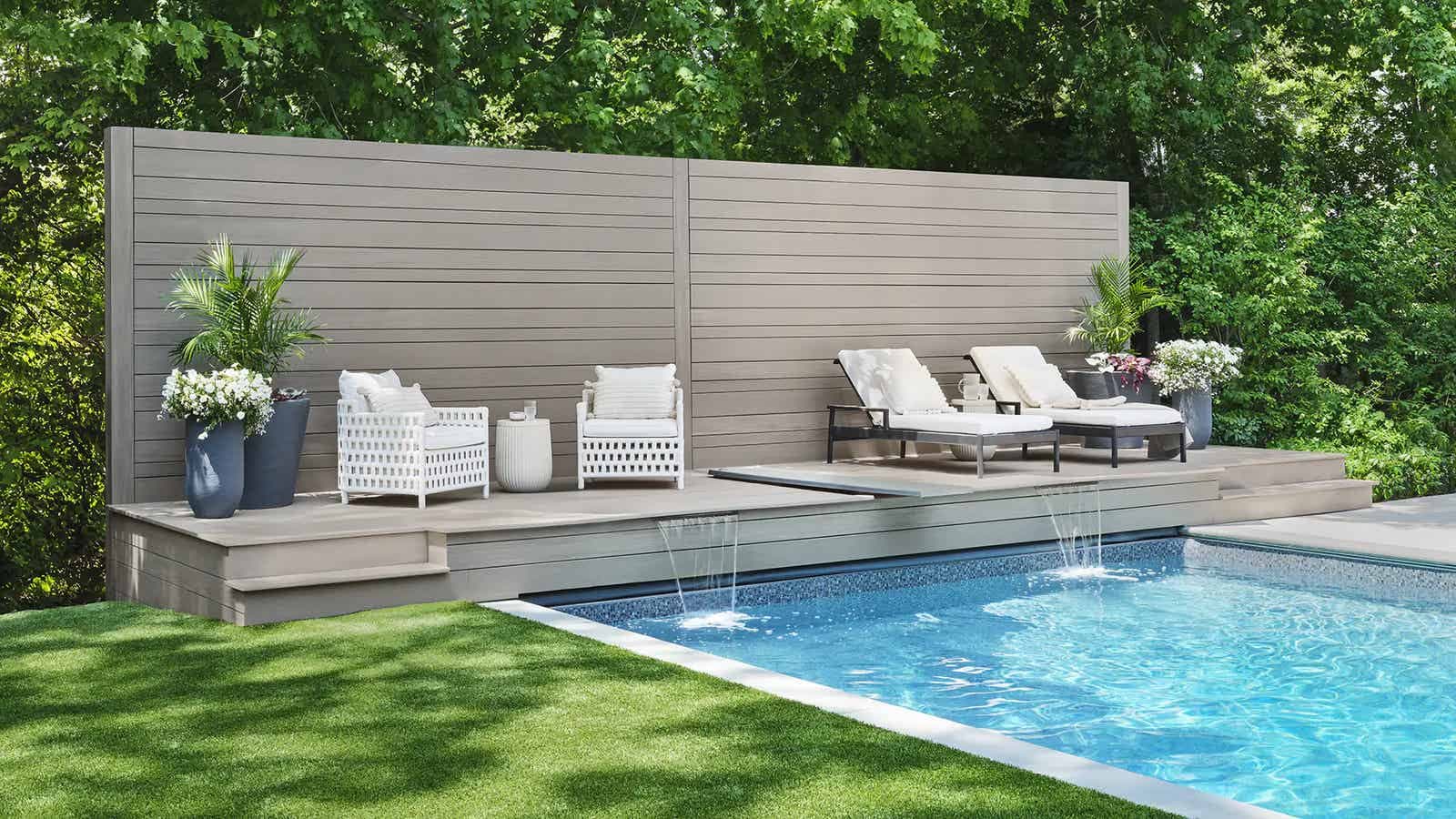
Why PVC Decking is Suited for Pool Terraces
PVC decking is engineered to be 100% synthetic, meaning it contains no wood fibers. This fundamental difference makes it inherently waterproof and resistant to swelling, staining, or rotting when exposed to standing water, splash zones, or even salt spray. For a pool terrace, where constant moisture is a given, this characteristic is a significant advantage.
Materials like TimberTech Azek PVC decking are designed as full PVC boards with advanced capping, making them a suitable choice where boards are expected to live wet. This includes pool surrounds and other areas that experience frequent water exposure. Its synthetic composition also contributes to its resistance to common pool chemicals, though specific cleaning instructions should always be followed.
Another benefit of PVC decking is its weight. It generally weighs less than many hardwood or composite decking options, which can simplify handling during installation and make it a practical choice for various project types, including ground-level or elevated pool decks.
Understanding Waterproofing and Durability
The 'waterproof to the core' nature of PVC decking means that moisture will not penetrate and compromise the board's integrity. This is crucial for a pool terrace, as traditional wood products can warp, splinter, or rot over time with continuous water exposure. The absence of wood fiber eliminates the primary cause of material degradation in wet environments.
Advanced capping on PVC boards provides an additional layer of protection. This cap is designed to resist stains from common spills, including grease and wine, which can be easily cleaned with soap and water. This stain resistance extends to pool-related marks, helping to maintain the appearance of your terrace over time.
The durability of PVC decking in a wet environment contributes to a lower maintenance profile compared to other materials. While no decking is entirely maintenance-free, PVC typically requires less intensive care to prevent water-related damage.
Planning for Edges and Fascia Around Your Pool
The edges of your pool terrace are critical for both aesthetics and safety. When planning with PVC decking, consider how the deck boards will terminate around the pool's coping and at the perimeter of the terrace. Manufacturers often offer matching fascia and trim boards that provide a clean, finished look, concealing the substructure and board ends.
For areas directly adjacent to the pool, ensuring a seamless transition from the coping to the decking is important. This often involves careful measurement and cutting of the decking boards to fit snugly against the pool's edge. The waterproof nature of PVC means that cut ends, when properly installed, will not be as vulnerable to moisture as cut wood.
Consider the use of a picture-frame border around the perimeter of your deck or pool area. This design choice can create a visually defined space and provide a distinct edge, enhancing the overall appearance of your pool terrace. Matching fascia boards will complete this look.
Cleaning and Maintenance for a Pool Terrace
Maintaining a PVC pool terrace primarily involves routine cleaning to remove dirt, debris, and any spills. The capped polymer surface of PVC decking is designed to shed common substances and can typically be cleaned with mild soap and water. This ease of cleaning is a significant benefit for pool areas, where spills and dirt are common.
For specific stains or heavier cleaning, always refer to the manufacturer's recommended cleaning products and methods. Using incompatible cleaners can potentially damage the surface finish. Regular sweeping or hosing down the deck can prevent the buildup of grime and keep the surface looking its best.
While PVC decking is resistant to rot and insect damage, it's still good practice to ensure proper drainage around your pool terrace to prevent standing water for extended periods, even though the material itself is waterproof. This helps keep the area clean and reduces the potential for slippery conditions from algae or mold growth on the surface.
Worked Example: Designing a 10x20-foot Pool Terrace
Let's consider a hypothetical pool terrace project in Carson City, NV, measuring 10 feet by 20 feet. This terrace will surround one side of an existing in-ground pool, connecting to a concrete patio. We'll use TimberTech Azek PVC decking in a standard 12-foot length, 5.5-inch width board.
First, calculate the total area: 10 feet * 20 feet = 200 square feet. For a layout running the 20-foot direction, each 12-foot board will cover 5.5 inches (0.458 feet) in width. To cover the 10-foot width, you'll need approximately 10 feet / 0.458 feet/board = 21.8 boards. Since boards are 12 feet long, you will need 22 boards for each 12-foot run. However, the terrace is 20 feet long, so each 12-foot board will only cover a portion, requiring cuts. For a simple calculation, if boards are laid parallel to the 20-foot length, each board is 20 feet long. Since boards are sold in 12-foot lengths, you will need to join boards to achieve the 20-foot length. This means each 20-foot run will require two boards (one 12-foot and one 8-foot section, with a cut from another 12-foot board).
A more efficient approach for a 10x20 foot deck with 12-foot boards: if boards are laid parallel to the 10-foot width, each board will be 10 feet long. You would get one 10-foot piece and one 2-foot offcut from each 12-foot board. To cover the 20-foot length (parallel to the pool) with 5.5-inch wide boards, you need 20 feet / 0.458 feet/board = 43.6 boards. Rounding up, you would need 44 boards, each cut to 10 feet. This means you would purchase 44 x 12-foot boards. The offcuts could be used for fascia or other small details, but for the main deck surface, you'd need 44 full-length boards.
For the fascia, let's assume a 20-foot length along the outer edge and two 10-foot lengths for the sides. This totals 40 linear feet of fascia. If fascia boards are 12 feet long, you would need 40 feet / 12 feet/board = 3.33 boards. Round up to 4 fascia boards. Always account for waste and cuts when ordering. This example assumes no complex angles or inlays.
Before you order
- Verify local building codes for pool deck materials and installations.
- Assess the primary exposure of the pool terrace to sun, shade, and prevailing winds.
- Confirm the desired aesthetic: color, grain pattern, and finish of the PVC decking.
- Determine the required board lengths and widths to minimize waste and optimize layout.
- Plan for fascia and trim boards to finish exposed edges and stair risers.
- Identify any special features, such as integrated lighting or planters, and how they interact with the decking.
- Confirm the subframe material and its compatibility with PVC decking installation requirements.
- Review manufacturer-specific installation guidelines for gapping and fastener type.
- Consider accessibility for maintenance, including cleaning and periodic inspections.
- Obtain a detailed material quote based on precise project dimensions and chosen profiles.
Confirm installation details, approved uses and warranty terms in the current instructions for the exact product and profile. Your installer should verify the substrate, structure and applicable project requirements.
This is a planning guide for projects in Carson City, NV. Ask our team to confirm availability, delivery to your ZIP code and which branch can support your order.
Questions to help you decide
Is PVC decking slippery when wet around a pool?
The level of slip resistance can vary between specific product lines and finishes. It is important to review product specifications for details on slip resistance and to consider walking surfaces when wet. Regular cleaning to prevent algae or mold growth can also help maintain traction.
Can PVC decking get hot in the sun, especially around a pool?
All decking materials, including PVC, can absorb and retain heat from direct sunlight. Lighter color options in PVC decking lines tend to stay cooler than darker colors. Some manufacturers offer "heat-mitigating" color options designed to reduce surface temperature. For a pool terrace in Carson City, which can experience significant sun exposure, selecting a lighter shade or a product specifically designed for cooler temperatures underfoot may be a consideration.
How do I clean pool chemicals or sunscreen spills from PVC decking?
PVC decking is generally resistant to staining from common pool chemicals and sunscreen. Most spills can be cleaned with mild soap and water using a soft brush or cloth. It is crucial to clean spills promptly to prevent any potential residue buildup. Always consult the specific manufacturer's cleaning guidelines for your chosen PVC decking product, as recommended cleaners and methods can vary.
Ready to Plan Your Carson City Pool Terrace with PVC Decking?
Request a material quote today. Provide your project dimensions, desired PVC decking profile, and ZIP code to confirm current availability and service options for your Carson City project. Our team can assist you in selecting the right materials for a durable and beautiful pool terrace.
Request a material quote →