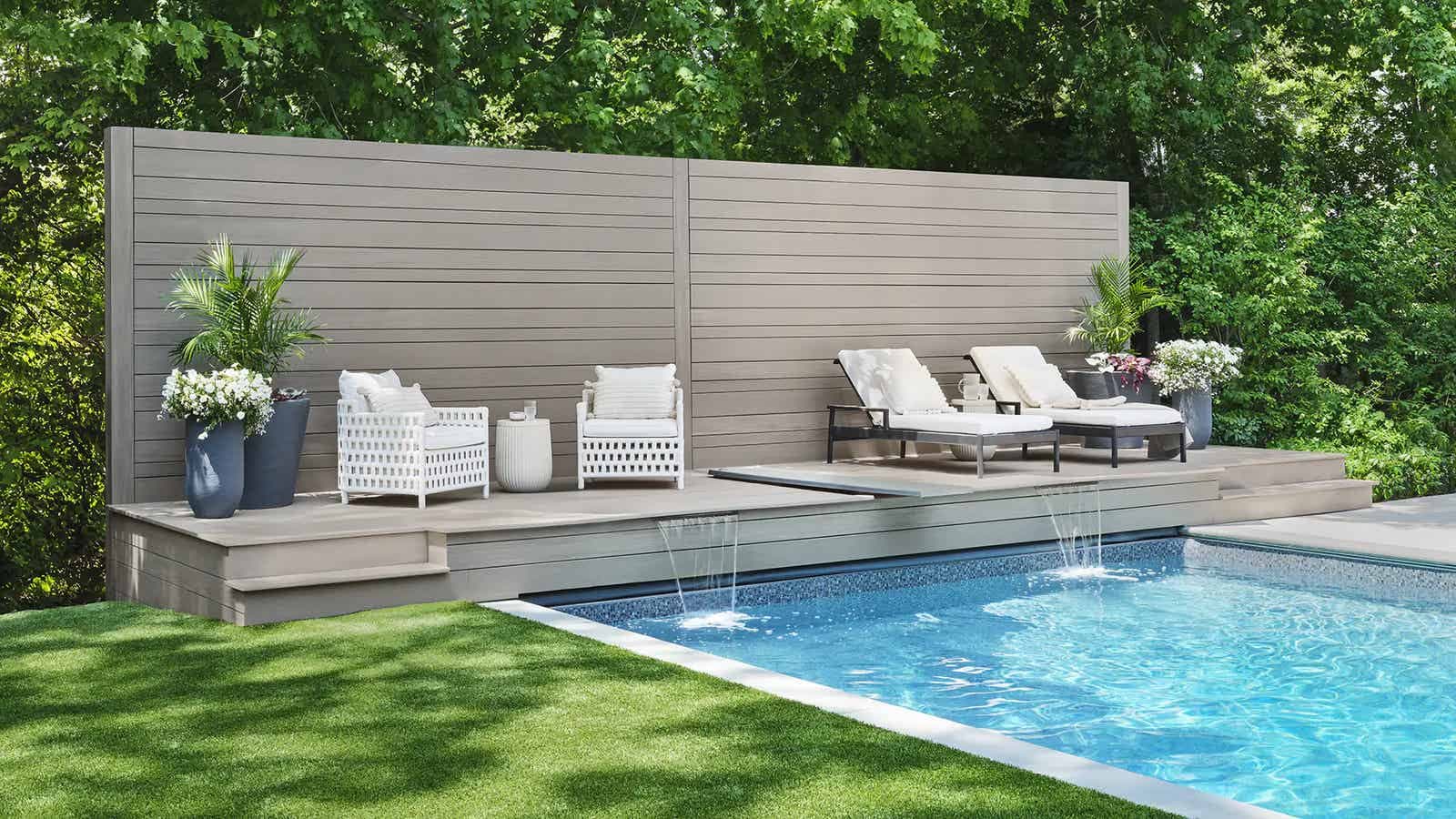
Understanding AZEK PVC Decking Collections and Aesthetics
AZEK PVC Decking is a premium capped polymer decking with zero wood content, offering a range of aesthetic choices across its three collections: Vintage, Landmark, and Harvest. Each collection features distinct grain patterns and color palettes, influencing the final look of your deck.
The Vintage Collection offers wire-brushed, low-gloss boards designed to mimic reclaimed wood, available in 5-1/2" and 7-1/4" widths. Colors like Coastline, Weathered Teak, and English Walnut are part of this collection. The Landmark Collection features cathedral grain patterns and multi-tonal color blends, such as Dark Hickory, American Walnut, and Castle Gate, typically in a 5-1/2" width. The Harvest Collection provides a cleaner, more subtle straight grain in solid classic tones like Slate Gray and Kona, also in a 5-1/2" width. Understanding these aesthetic differences is the first step in aligning product specifications with your design vision.
Board Profile and Dimensions: Thickness and Width
The board profile refers to the overall thickness and width of the decking boards. All AZEK PVC Decking boards maintain a consistent nominal thickness of 1 inch. The standard width across all collections is 5-1/2 inches. The Vintage Collection also offers a wider 7-1/4 inch option, allowing for varied design aesthetics and potentially fewer boards for larger areas.
Selecting the appropriate width impacts the visual scale of your deck. Wider boards can create a sense of expanse, while standard widths offer a more traditional look. Consider how these dimensions will interact with your deck's overall size and the visual lines you wish to create.
Available Lengths: Minimizing Seams and Waste
AZEK PVC Decking boards are available in specific lengths: 12 feet, 16 feet, and 20 feet. Choosing the correct board lengths is critical for minimizing the number of seams on your deck surface and reducing material waste. Longer boards are often preferred for larger decks to create a more continuous appearance.
For example, a 15-foot deep deck would require a 16-foot board, leaving a 1-foot offcut. If the design allows for reusing these offcuts, it can improve material efficiency. However, if a 12-foot board were chosen, it would necessitate a seam and an additional 3-foot cut from another board, increasing both material usage and labor.
Edge Options: Grooved for Hidden Fasteners or Square for Face Fastening
AZEK PVC Decking offers two primary edge options: grooved and square. Grooved edge boards are designed for use with hidden fastening systems, such as US4 hidden clips, which provide a clean, fastener-free deck surface. This option is generally preferred for a premium, uninterrupted aesthetic.
Square edge boards are intended for face fastening, where screws are driven directly through the board's surface into the joists. While face fastening can be a robust installation method, the fasteners remain visible. Square edge boards are also suitable for perimeter boards, stairs, and fascia where hidden fasteners may not be practical or where the board edge needs to be flush against a structure or another material. It is crucial to select the correct edge type for each part of your deck plan.
Worked Example: Planning for a 10-foot by 12-foot Deck
Let's consider a hypothetical 10-foot by 12-foot rectangular deck. For this example, we'll use AZEK Vintage Collection boards in the 5-1/2" width, and we want a picture-frame border.
First, determine the main deck area. If boards run parallel to the 12-foot length, you'll need boards that are 12 feet long. For the 10-foot width, dividing by the 5-1/2" (0.458 ft) board width means approximately 10 ft / 0.458 ft = 21.8 boards. Since boards must be full units, you would need 22 boards for the main deck. Total main deck board length: 22 boards * 12 feet/board = 264 linear feet.
Next, the picture-frame border. For a single border board around the perimeter, we'll need boards for two 12-foot sides and two 10-foot sides. This totals (2 * 12 ft) + (2 * 10 ft) = 24 ft + 20 ft = 44 linear feet. For the border, square-edge boards are typically used. To minimize waste, you could order two 20-foot square-edge boards and one 12-foot square-edge board. This would yield 40 feet from the 20-foot boards and 12 feet from the 12-foot board, providing enough material with some offcuts. The corners would require miter cuts.
Therefore, for this 10x12 deck with a picture frame, you would order 22 boards of 12-foot grooved AZEK Vintage (5-1/2" width) and 2 boards of 20-foot square AZEK Vintage (5-1/2" width) plus 1 board of 12-foot square AZEK Vintage (5-1/2" width). This detailed breakdown ensures accurate material ordering, accounting for both dimensions and edge profiles.
Before you order
- Confirm the desired aesthetic and collection (Vintage, Landmark, or Harvest).
- Determine the required board width (5-1/2" or 7-1/4" for Vintage).
- Calculate the linear footage needed for your deck, considering board lengths (12 ft, 16 ft, 20 ft) to minimize seams and waste.
- Decide on the edge profile: grooved for hidden fasteners or square for face fastening, or a combination for borders/stairs.
- Consider matching fascia, risers, and rail lines for a complete system.
- Account for any specific project requirements, such as board spacing or ventilation, which may influence material choices.
Confirm installation details, approved uses and warranty terms in the current instructions for the exact product and profile. Your installer should verify the substrate, structure and applicable project requirements.
Questions to help you decide
What is the difference between grooved and square edge AZEK boards?
Grooved edge boards feature a routed groove along the sides, specifically designed to accept hidden fastening clips, resulting in a smooth, fastener-free deck surface. Square edge boards have straight sides, making them suitable for traditional face fastening with screws or for use as perimeter boards, stairs, and fascia where the edge is visible or abutted against another surface.
Can I mix different AZEK collections or widths on one deck?
While AZEK collections offer distinct aesthetics, you can technically mix them if the dimensions (thickness and width) are compatible. For instance, using 5-1/2" boards from different collections might work. Mixing widths, such as the 5-1/2" and 7-1/4" Vintage boards, is a design choice that can create unique patterns. However, always verify that the chosen profiles are compatible with your fastening system and structural requirements. Consult with your builder or designer to ensure a cohesive and structurally sound outcome.
How do I calculate the number of boards I need for my deck?
To calculate the number of boards, first measure the total square footage of your deck. Then, divide this by the square footage of a single board (e.g., for a 1" x 5-1/2" x 12' board, it's 0.458 ft * 12 ft = 5.5 square feet). This gives you an area-equivalent quantity. However, for practical ordering, it's more accurate to determine the linear feet needed for each run and then select the most efficient board lengths (12, 16, or 20 ft) to minimize cuts and waste. Always add a percentage for waste, typically 5-10%, especially for complex layouts.
Ready to Plan Your AZEK PVC Decking Project?
Request a material quote with your project dimensions, desired AZEK collection, exact profile (width and edge type), and your ZIP code. We can confirm current availability and service options for your project.
Request a material quote →