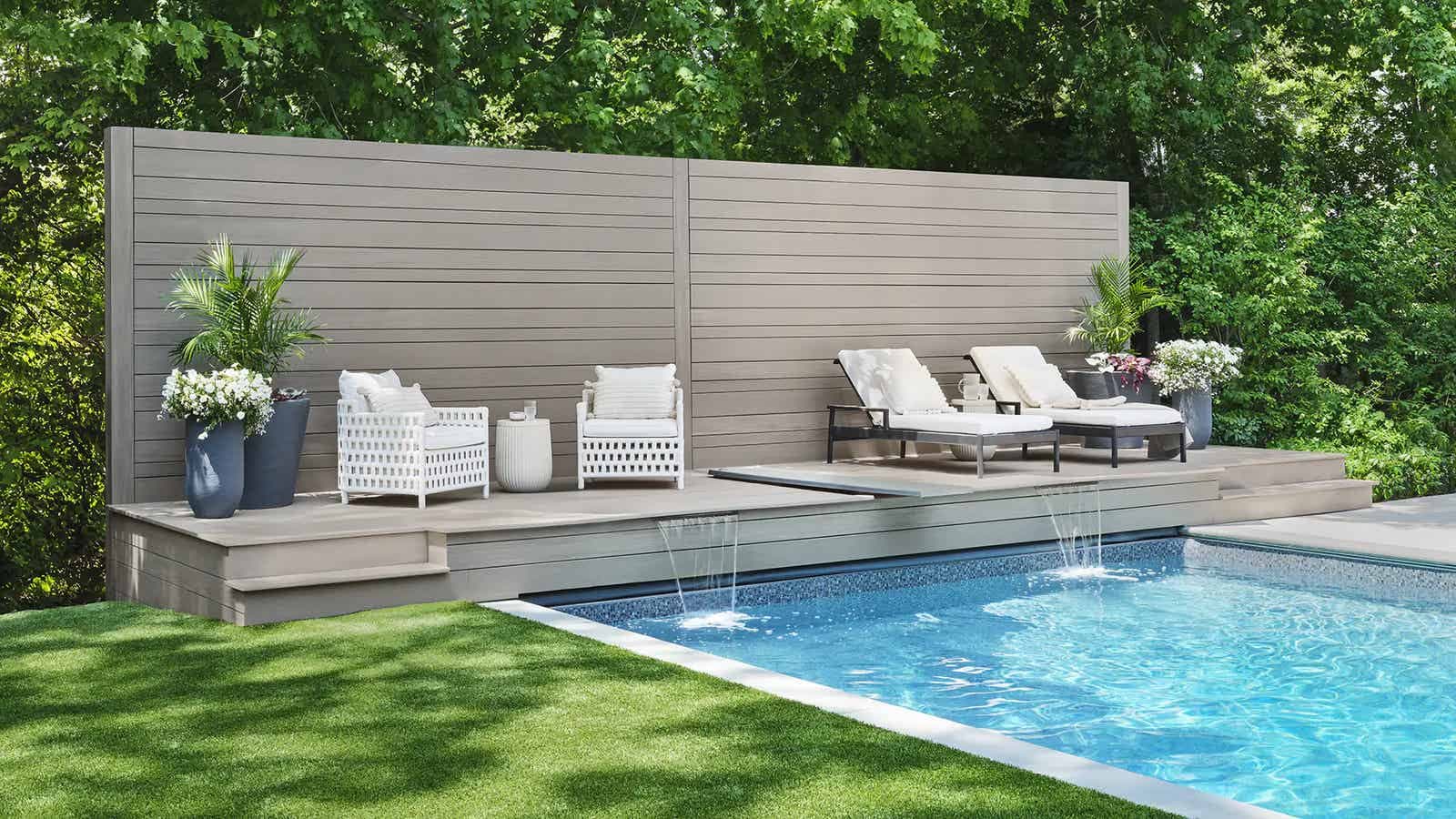
Why AZEK PVC Decking Requires Specific Spacing
AZEK PVC decking boards are engineered from a capped polymer material, meaning they contain no wood. This composition makes them highly resistant to moisture, rot, and insects, but it also means they behave differently from wood or wood-composite decking. The primary factor influencing AZEK board dimensions is temperature.
As temperatures rise, PVC boards expand; as they fall, they contract. The exact amount of expansion and contraction depends on the length of the board, the temperature range it experiences, and the specific AZEK product line. Correct spacing allows for this movement, preventing boards from pushing against each other (leading to buckling) or pulling too far apart (creating excessively wide gaps).
Proper spacing also facilitates drainage of water from the deck surface and promotes air circulation beneath the deck. Good ventilation helps prevent moisture buildup, which, while not damaging to PVC itself, can contribute to mold or mildew growth on debris trapped in gaps, or affect the substructure. (Source: S1)
Understanding Thermal Expansion and Contraction
The degree to which AZEK boards expand or contract is directly related to temperature fluctuations. A board installed on a cool morning will expand as the day warms, and a board installed in the heat of summer will contract significantly when winter arrives.
AZEK's Alloy Armour Technology cap and fully synthetic core contribute to its stability, but thermal movement is still a factor to manage. The manufacturer's installation guides typically provide specific recommendations for gap widths based on the expected ambient temperature at the time of installation. These guidelines are not arbitrary; they are calculated to ensure the deck performs optimally across its expected temperature range.
Ignoring these guidelines can lead to an uneven deck surface, compromised aesthetics, and potential issues with fasteners if boards are forced to expand or contract beyond their designed limits. (Source: S1)
General Spacing Guidelines for AZEK Decking
While specific product documentation should always be the final authority, general guidance for AZEK PVC decking often includes recommendations for both end-to-end and side-to-side spacing.
Side-to-side spacing (between adjacent boards) is typically managed by the hidden fastening system. Many compatible hidden clips, such as the US4 hidden clips recommended for AZEK, are designed to automatically set a consistent gap width between boards. This ensures a uniform appearance and proper functionality across the deck surface. (Source: S1)
End-to-end spacing (between the ends of boards where they meet over a joist) is crucial for accommodating thermal movement along the length of the board. The required end gap will vary based on the board length and the installation temperature. Longer boards and greater temperature swings necessitate larger gaps. The AZEK Vintage, Landmark, and Harvest collections all utilize the same core material, so general principles apply, but always verify the specific product documentation. (Source: S1)
Worked Example: Calculating End-to-End Spacing
Let's consider a hypothetical scenario: You are installing 20-foot AZEK Vintage Collection boards (5-1/2" width, square edge) on a day when the ambient temperature is 70°F. The expected temperature range in your project area is from 0°F in winter to 100°F in summer.
For this example, we'll assume a manufacturer-specified expansion/contraction rate of 0.0003 inches per foot per degree Fahrenheit. (Note: Always use the exact rate provided in your AZEK installation guide.)
**Step 1: Calculate total temperature swing below installation temperature.** Installation temperature: 70°F Minimum expected temperature: 0°F Temperature drop: 70°F - 0°F = 70°F
**Step 2: Calculate total temperature swing above installation temperature.** Maximum expected temperature: 100°F Installation temperature: 70°F Temperature rise: 100°F - 70°F = 30°F
**Step 3: Calculate maximum contraction.** Board length: 20 feet Contraction per foot per degree: 0.0003 inches Maximum contraction = 20 ft * 70°F * 0.0003 in/ft/°F = 0.42 inches
**Step 4: Calculate maximum expansion.** Maximum expansion = 20 ft * 30°F * 0.0003 in/ft/°F = 0.18 inches
In this case, approximately 0.42 inches. This gap allows the board to shrink without pulling away from its fasteners excessively when cold.
This example illustrates the principle; **always refer to the current AZEK installation instructions for the specific product line and local climate conditions to determine exact spacing requirements.**
Tools and Techniques for Accurate Spacing
Achieving consistent and accurate spacing requires careful attention during installation. For side-to-side spacing, using the recommended hidden fasteners, such as US4 clips, simplifies the process as they are designed to create the correct gap automatically. (Source: S1)
For end-to-end gaps, especially at butt joints or where boards meet a structure, spacer tools are invaluable. These can be purpose-built decking spacers or simple shims cut to the required thickness. Measuring and re-verifying gaps as you install, particularly on long runs or during fluctuating temperatures, helps maintain consistency.
Consider the layout of your deck. If you are using shorter boards or have many butt joints, the cumulative effect of small errors in spacing can become apparent. Planning your board layout and understanding where joints will fall can help anticipate and manage spacing requirements more effectively. (Source: S1)
Connecting AZEK Decking to Other Elements
When AZEK decking meets other fixed elements like house walls, posts, or contrasting picture-frame borders, specific expansion gaps are still necessary. These gaps allow the deck boards to expand and contract without putting pressure on the adjacent structures or causing damage to the deck boards themselves.
The required gap at these interfaces will depend on the length of the board running against the obstacle and the expected temperature extremes. For example, a board running parallel to a house wall for its full length will need a calculated expansion gap at its ends. Similarly, where a deck board abuts a fascia board or stair riser, a small gap is often recommended to allow for movement.
Consult the AZEK installation guide for details on these specific transition points. Coordinating your AZEK decking with matching risers, fascia, and rail lines, all available as a full system, can simplify these connections. (Source: S1)
Before you order
- Consult the specific AZEK installation guide for your chosen product line (Vintage, Landmark, or Harvest).
- Identify the recommended side-to-side gap for your chosen fastening system (e.g., hidden clips).
- Determine the expected minimum and maximum ambient temperatures for your project location.
- Note the installation temperature on the day you are working.
- Calculate the required end-to-end gap based on board length, temperature range, and manufacturer's expansion/contraction rate.
- Plan for consistent spacing at butt joints and where boards meet fixed structures.
- Gather appropriate spacer tools to maintain accuracy during installation.
- Consider the impact of temperature changes throughout the installation process on board dimensions.
Confirm installation details, approved uses and warranty terms in the current instructions for the exact product and profile. Your installer should verify the substrate, structure and applicable project requirements.
Questions to help you decide
Can I use the same spacing for AZEK PVC decking as I would for wood decking?
No, AZEK PVC decking has different thermal expansion and contraction properties compared to wood decking. Wood primarily moves due to moisture changes, while PVC reacts significantly to temperature. Always follow the specific AZEK installation guide for correct spacing to avoid issues like buckling or excessive gaps.
What happens if I don't leave enough gap between AZEK deck boards?
If insufficient gaps are left, the AZEK boards will have nowhere to expand when temperatures rise. This can lead to issues such as buckling, warping, or 'oil canning' (a wavy appearance) of the deck surface. It can also put stress on fasteners and the substructure.
How do hidden fasteners affect board spacing for AZEK decking?
Many hidden fastening systems, including the US4 hidden clips recommended for AZEK, are designed to automatically set a consistent side-to-side gap between boards. This helps ensure uniform spacing across the deck surface, simplifying installation for those gaps. However, end-to-end gaps still require careful measurement based on temperature and board length.
Ready to Plan Your AZEK Decking Project?
For a material quote tailored to your project dimensions, exact AZEK profile (Vintage, Landmark, or Harvest), and ZIP code, please contact us. Our team can confirm current availability and service options to help you get started.
Request a material quote →