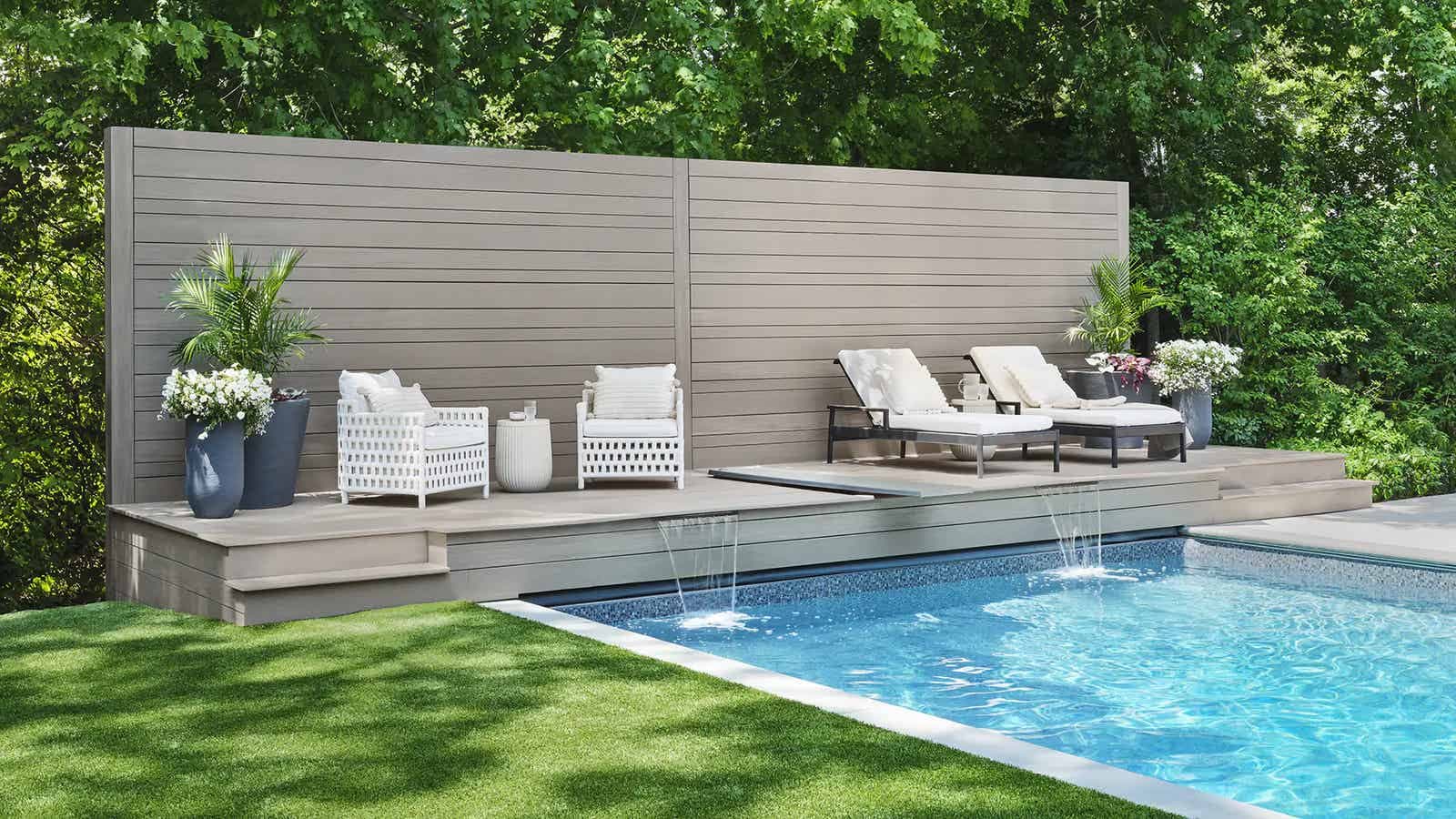
Understanding AZEK PVC Decking Characteristics for Transitions
AZEK PVC decking is a capped polymer board with zero wood content, designed for durability and low maintenance. Its resistance to rot, swelling, and mold makes it suitable for direct contact with soil or moisture, unlike traditional wood decking. This characteristic offers flexibility when designing transitions to garden beds or permeable surfaces.
AZEK offers board profiles of 1" x 5-1/2", with Vintage Collection also available in 1" x 7-1/4". These dimensions are crucial for planning height differences and structural support when integrating with other materials. The material's stability means it won't expand or contract significantly with moisture, simplifying the planning of fixed edges.
The available edge options, grooved for hidden fasteners or square for face-fastening, also influence how you finish the deck perimeter, especially where it meets another surface. Square edge boards can be used for a clean, flush termination, while grooved boards typically require a fascia or trim piece to conceal the joist structure.
Planning Levels and Drainage
One of the most important aspects of any transition is managing water. The finished surface of your AZEK PVC deck should ideally be slightly higher than adjacent paving or landscaping to promote drainage away from the deck structure. A minimum slope of 1/4 inch per foot away from any structure is generally recommended for hard surfaces to prevent pooling.
When transitioning to a lawn or garden bed, consider a small grade change or a gravel buffer strip to prevent soil and mulch from washing onto the deck. For paved areas, ensure the paver base is properly compacted and sloped. The deck frame itself should always allow for adequate ventilation and drainage underneath, regardless of the adjacent material.
Connecting to Paved Patios and Walkways
Creating a seamless connection between AZEK PVC decking and a paved patio or walkway often involves careful alignment of heights. Ideally, the top surface of the deck boards should be flush with or slightly above the paving. This minimizes trip hazards and creates a continuous flow.
To achieve this, the deck joist height and the paver base depth must be coordinated. If the deck is elevated, you might use a matching AZEK fascia board to create a clean vertical edge down to the patio surface. For flush transitions, ensure the deck joists and ledger board are properly flashed and protected where they meet the concrete or paver edge.
Consider an expansion joint material between the deck and paving to accommodate any minor movement in either surface over time. This also helps prevent debris from accumulating in the joint. AZEK PVC decking is designed to run cooler than comparable composite colors, which can be an advantage in sunny areas where adjacent paving might absorb significant heat.
Integrating with Gravel or Stone Pathways
Transitions to gravel or decorative stone pathways can offer a natural, permeable aesthetic. The key here is containment to prevent the gravel from migrating onto the deck surface or into the deck structure. An effective method is to install a robust edging material, such as metal, plastic, or stone, along the deck perimeter.
The edging should extend slightly above the gravel level and be securely anchored. You might also consider a geotextile fabric beneath the gravel to prevent weed growth and maintain separation from the sub-base. The AZEK PVC decking's zero wood content means direct contact with gravel is not a concern for rot, making this a practical option.
Ensure that the gravel pathway slopes away from the deck to manage rainwater effectively. A small gap between the deck board and the edging can also help with drainage and prevent moisture from wicking up into the edge of the decking.
Transitioning to Garden Beds and Lawns
When your AZEK PVC deck meets a garden bed or lawn, the primary concerns are preventing soil and mulch from encroaching on the deck and managing moisture. A common approach is to install a border or curb that separates the deck from the soft landscaping.
This border can be made from various materials like treated lumber, stone, or pre-cast concrete blocks. It should be tall enough to retain the soil and mulch, and ideally, a few inches below the deck surface to allow for air circulation and prevent moisture buildup against the deck boards. The zero wood content of AZEK PVC means direct contact with soil or mulch will not cause the board itself to rot, offering more flexibility in design compared to wood decking.
For lawns, a mow strip of concrete or pavers can create a clean edge and make maintenance easier, preventing grass from growing directly against the deck. Always ensure that irrigation systems for lawns and gardens are directed away from the deck structure to avoid excessive moisture under the deck.
Worked Example: Deck to Patio Transition
Consider a hypothetical project where an existing 10 ft x 12 ft concrete patio needs to be extended and connected to a new AZEK PVC deck. The existing patio is 4 inches thick on a compacted gravel base, and the desired finished deck height is flush with the patio.
To achieve a flush transition, the deck's substructure needs careful planning. This would require the deck frame to be built on concrete piers or posts that are cut to precisely align the joist tops with the desired height relative to the patio.
A 1/2-inch expansion joint material would be installed between the edge of the concrete patio and the first AZEK deck board. The deck boards would be installed perpendicular to the joists, running parallel to the patio edge. AZEK's square edge boards could be used for the perimeter board directly adjacent to the patio for a clean finish. Drainage would be managed by ensuring the patio has a slight slope away from the deck, and the deck frame allows for ventilation underneath.
Before you order
- Determine desired finished heights for all surfaces (deck, patio, lawn, garden).
- Plan for positive drainage away from the deck structure for all adjacent surfaces.
- Select appropriate edging materials (fascia, stone, metal, etc.) for each transition type.
- Consider expansion joints where the deck meets rigid paving materials.
- Evaluate the need for weed barriers or gravel buffers for soft landscaping transitions.
- Ensure adequate ventilation and access under the deck, especially near transitions.
- Review local building codes for specific requirements on grade changes and accessibility.
Confirm installation details, approved uses and warranty terms in the current instructions for the exact product and profile. Your installer should verify the substrate, structure and applicable project requirements.
Questions to help you decide
Can AZEK PVC decking be installed directly on the ground?
AZEK PVC decking boards should not be installed directly on the ground. Like all decking, it requires a properly built substructure with adequate ventilation to ensure performance and longevity. While the zero wood content in AZEK PVC resists rot and moisture, the substructure (typically wood or steel) still needs protection from ground contact and proper air circulation.
What kind of edging is best when connecting AZEK decking to a garden bed?
For connecting AZEK decking to a garden bed, a durable, rot-resistant edging material is recommended. Options include treated lumber, stone blocks, concrete curbs, or metal edging. The goal is to create a physical barrier that retains soil and mulch, prevents them from washing onto the deck, and allows for proper air circulation beneath the deck. A small gap between the deck board and the edging can also aid drainage.
How do I prevent trip hazards at deck transitions?
To prevent trip hazards, aim for flush transitions where possible, or clearly defined and gentle height changes. When connecting to paving, try to align the top surfaces of the deck and the paved area. If a height difference is unavoidable, ensure it is minimal and clearly visible, or consider incorporating a ramp or step if the change is significant. Consistent levels across the walking surface are key.
Plan Your AZEK PVC Deck Transition
Ready to design your outdoor space? Request a material quote for AZEK PVC decking with your project dimensions, desired profile, and ZIP code. Confirm current availability and service options to bring your vision to life.
Request a material quote →