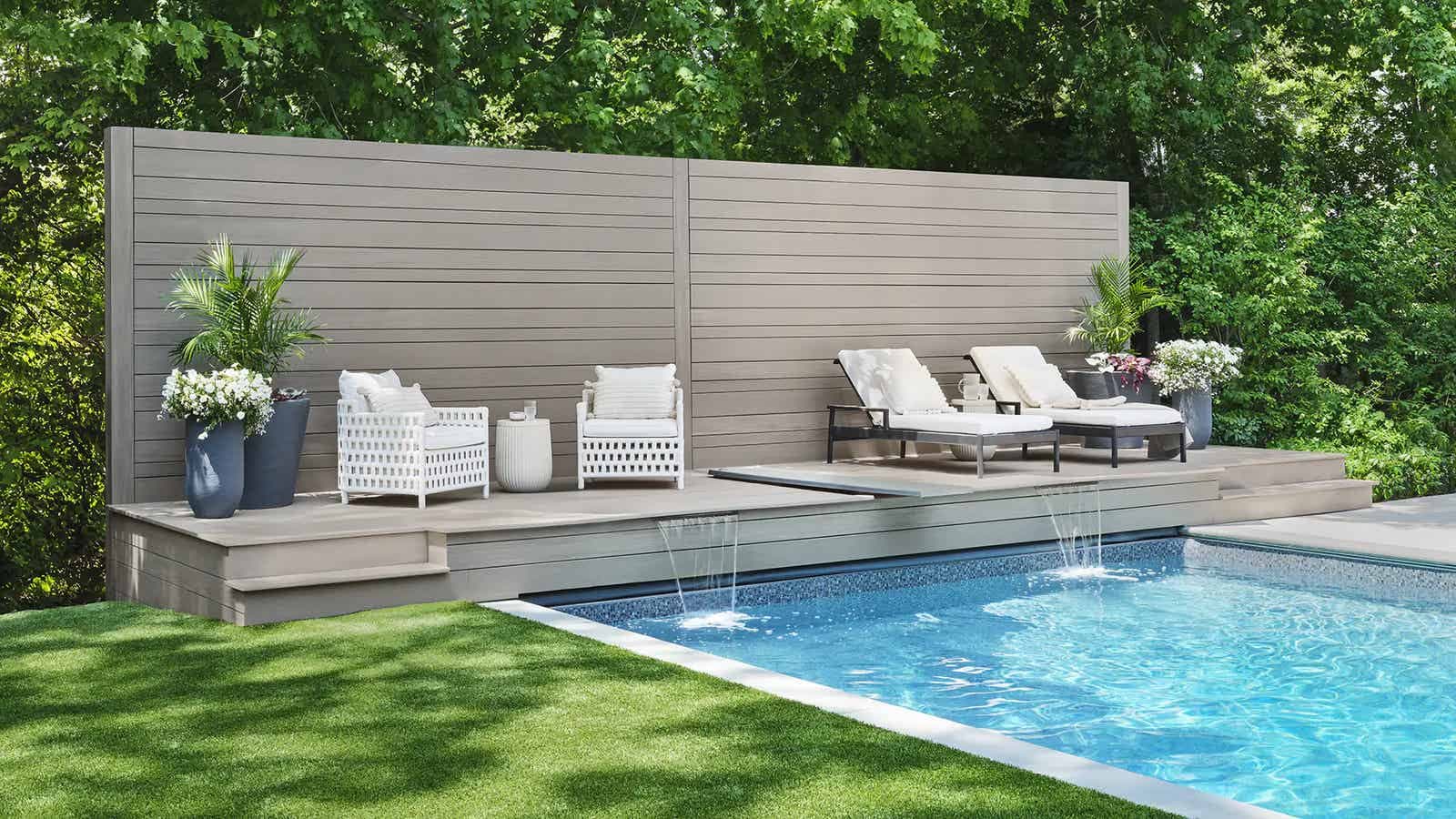
Understanding AZEK PVC Decking for Diagonal Layouts
AZEK PVC decking is a capped polymer board with zero wood content, designed for durability and low maintenance. It features an Alloy Armour Technology cap over a fully synthetic core, making it resistant to rot, swelling, and mold. This material's stability makes it suitable for various layouts, including diagonal patterns. AZEK offers boards in 12, 16, and 20-foot lengths, typically in a 1-inch by 5-1/2-inch profile, with the Vintage Collection also available in 7-1/4-inch width. Boards come in grooved (for hidden fasteners) or square edge options. Understanding these product specifications is crucial for planning any layout, especially a diagonal one where board length and edge type can impact efficiency and appearance.
The zero-wood content means that even cut ends are resistant to moisture, which is a practical benefit when making numerous angle cuts inherent in diagonal designs. AZEK PVC decking is also noted for running cooler than comparable composite colors, which can be a consideration for decks in sunny exposures, regardless of layout. The aesthetic appeal of AZEK's wire-brushed and cathedral-grain textures can be further highlighted by a diagonal pattern, creating a unique visual flow.
Increased Material Waste with Diagonal Installations
One of the most significant considerations for a diagonal deck layout is the increased material waste compared to a straight installation. When boards are cut at an angle, such as 45 degrees, the offcuts from one side of the deck may not be long enough or appropriately angled to be reused on the opposite side, or even further along the same edge. This often leads to a higher percentage of unusable material.
For a typical square or rectangular deck, a diagonal layout can increase material waste by 15-20% or more, depending on the deck's dimensions and the specific angle chosen. It is essential to account for this additional waste when ordering AZEK PVC decking. Ordering an extra 15% to 20% beyond the calculated square footage for a straight layout is a common practice to mitigate shortages and ensure sufficient material for cuts and potential mistakes. This is a general guideline; precise waste calculations may require a detailed cut plan for your specific deck dimensions.
Substructure Adjustments for Diagonal Decking
A diagonal decking pattern changes how the load is distributed across the joists. Decking boards are designed to span a certain distance between supports. When installed diagonally, the effective span between joists increases because the board crosses the joists at an angle, rather than perpendicularly.
To maintain adequate support and prevent deflection, the joist spacing for a diagonal layout typically needs to be reduced. This closer spacing provides the necessary support for the decking boards and ensures the structural integrity of the deck. Always consult the most current AZEK installation instructions for precise joist spacing requirements for diagonal applications.
Hypothetical Example: Calculating Decking for a Diagonal Layout
Consider a rectangular deck measuring 10 feet by 12 feet, resulting in 120 square feet. We plan to use AZEK PVC decking boards that are 5-1/2 inches wide and available in 16-foot lengths, installed at a 45-degree angle.
First, calculate the linear footage of decking required for a straight installation. If boards were laid straight, dividing the total area (120 sq ft) by the board width (5.5 inches or 0.458 feet) gives approximately 262 linear feet. With 16-foot boards, this would be around 17 boards (262 / 16 = 16.375).
Now, factor in the diagonal layout. More importantly, the waste factor is significant. Instead of 262 linear feet, we apply a 20% waste factor: 262 linear feet * 1.20 = 314.4 linear feet. Rounding up, you would need approximately 315 linear feet of decking. With 16-foot boards, this means purchasing 20 boards (315 / 16 = 19.6875).
This example illustrates the need to factor in increased material. This adjustment in joist quantity is critical for structural support and should be calculated precisely based on the actual deck dimensions and local building codes.
Always create a detailed layout diagram to visualize cuts and optimize board usage. While some offcuts might be reusable, particularly for smaller sections or a picture frame border, a conservative waste factor is prudent for diagonal patterns.
Manufacturer Spacing and Fastening Guidelines
Regardless of the layout, adherence to AZEK's specific spacing and fastening guidelines is essential. AZEK PVC decking requires specific gaps between boards to allow for thermal expansion and contraction, as well as adequate drainage. These gaps are typically small, but critical for the long-term performance and appearance of the deck. For diagonal layouts, these spacing requirements remain the same.
When using hidden fasteners, ensure that the clips are compatible with AZEK's grooved edge boards and are installed according to the manufacturer's instructions. Face fastening requires pre-drilling and countersinking for a clean finish. Always refer to the latest AZEK installation guide for detailed fastening patterns, screw types, and specific board spacing recommendations for your chosen product line and application.
Correct fastening is particularly important in diagonal layouts where the forces of expansion and contraction may act differently on the board ends. Proper fastening helps secure the boards and prevents movement that could lead to unsightly gaps or buckling over time.
Integrating a Picture Frame Border
A picture frame border, where decking boards run perpendicularly around the perimeter of the deck, can beautifully complement a diagonal field. This design choice provides a clean, finished edge and helps to visually define the deck space. When planning a diagonal layout with a picture frame border, consider how the diagonal boards will terminate against the border boards.
The angled cuts of the diagonal boards will meet the straight edges of the picture frame. This requires precise cutting and careful planning to ensure tight, consistent seams. The border also provides a convenient way to hide the cut ends of the diagonal boards, creating a polished look. Ensure that the substructure is adequately designed to support both the border and the diagonal field, particularly at the transition points where joists may need to be adjusted or blocking added to provide solid fastening surfaces for all board edges.
Before you order
- Confirm AZEK PVC decking board profile (1x5.5 or 1x7.25 inch) and edge type (grooved or square).
- Measure your deck's exact dimensions (length and width) for accurate square footage.
- Decide on the diagonal angle (e.g., 45 degrees) and visualize the layout.
- Calculate linear footage of decking required, adding at least 15-20% for waste on diagonal cuts.
- Plan for any necessary joist modifications or additional blocking to support diagonal boards.
- Account for a picture frame border if desired, and plan how diagonal boards will terminate against it.
- Review AZEK's latest installation guide for specific board spacing and fastening instructions.
- Consider the aesthetic impact of board length and seam placement within the diagonal pattern.
Confirm installation details, approved uses and warranty terms in the current instructions for the exact product and profile. Your installer should verify the substrate, structure and applicable project requirements.
Questions to help you decide
Does a diagonal layout affect the warranty of AZEK PVC decking?
The warranty for AZEK PVC decking is generally tied to proper installation according to the manufacturer's guidelines. As long as you follow AZEK's specific instructions for diagonal layouts, including any requirements for reduced joist spacing and correct fastening, the warranty should remain valid. Always consult the official AZEK installation guide to ensure compliance.
What tools are recommended for cutting AZEK PVC decking diagonally?
For precise diagonal cuts on AZEK PVC decking, a miter saw or a circular saw with a fine-tooth blade (e.g., a carbide-tipped finish blade) is recommended. Ensure the blade is clean and sharp to prevent melting or chipping the PVC material. A speed square or an accurate protractor can help maintain consistent angles. Always wear appropriate safety gear when operating power tools.
Can I mix diagonal and straight decking patterns on the same deck?
Yes, mixing patterns is a common design choice. A common approach is to use a straight picture-frame border with a diagonal field. This can create a visually appealing contrast and helps define the edges of the deck. When mixing patterns, ensure consistent board spacing and fastening methods where the patterns meet, and plan your substructure carefully to provide adequate support for all board directions.
Request a Quote for Your AZEK PVC Decking Project
Ready to plan your diagonal AZEK PVC deck? Provide your project dimensions, desired AZEK profile, and ZIP code to request a material quote. We can help confirm current availability and service options for your order.
Request a material quote →